Showing posts with label evangelization. Show all posts

Saturday, May 4, 2024

By Any Means Necessary


 The other night I had a couple guys over for beers on the patio--one guy I knew fairly well, the other guy was friends with my friend, and I didn't know as well though we all go to the same parish. As we were shooting the breeze about work and kids, the friend of the friend mentioned casually that he had gotten "the snip." Both my friend and I were somewhat taken aback, but let it slide with half-hearted protests ("that's reversible you know," "aw, that's sad man.") and uncomfortably changed the subject after a minute or so.

But all day at work yesterday I kept thinking about it; it's not every day someone is honest like that, and knowing the company they were in to make such an admission. I was so surprised in the moment, and didn't know the guy real well, that I didn't really push back on it. I didn't know if he a) knew getting sterilized was wrong, and didn't care; b) was ignorant of Church teaching on the matter; c) didn't think it was serious enough to warrant the hellfire. Even though I was kind of stunned in the moment, I regretted being sheepish and not saying something more, even after I had had a couple glasses of Jack Daniels. 

Was this a sin of omission on my part? Or was I being respectful and reserving judgment of a situation I wasn't in a position to comment effectively on? That night taught me a lesson that I'm still attempting to learn and put into practice, a good general policy for any Christian concerned with the salvation of souls:


Just say the thing.


Time is short. My oldest son is twelve. In four years he will be driving. In six he will be going off to college. Then there's a good chance he will be gone, and I won't get the moments with him I take for granted now. Same goes for the other two.

So too with our opportunities to share the Gospel, even when that entails looking foolish or coming across as lacking bedside manners. Thankfully, as I've gotten older I'm more cognizant of the outweighing of "just saying the thing" over looking ignorant or offending someone. You say the offensive thing (even better when you do with a smile) and they listen to you, you save someone from the worm, and that's a win. You say the offensive thing and they don't listen to you, you get some grief or lose a potential acquaintance and....and? Who cares, seriously. Ain't nobody got time for that.

St. Paul knew this. If eating meat would scandalize one of his brothers, he wouldn't eat it (1 Cor 8:12-13). He would debase himself and do whatever was needed, by any means necessary, to win a soul to Christ:


Though I am free and belong to no one, I have made myself a slave to everyone, to win as many as possible. To the Jews I became like a Jew, to win the Jews. To those under the law I became like one under the law (though I myself am not under the law), so as to win those under the law. To those not having the law I became like one not having the law (though I am not free from God’s law but am under Christ’s law), so as to win those not having the law. To the weak I became weak, to win the weak. I have become all things to all people so that by all possible means I might save some. I do all this for the sake of the gospel, that I may share in its blessings. (1 Cor 9:19-23)


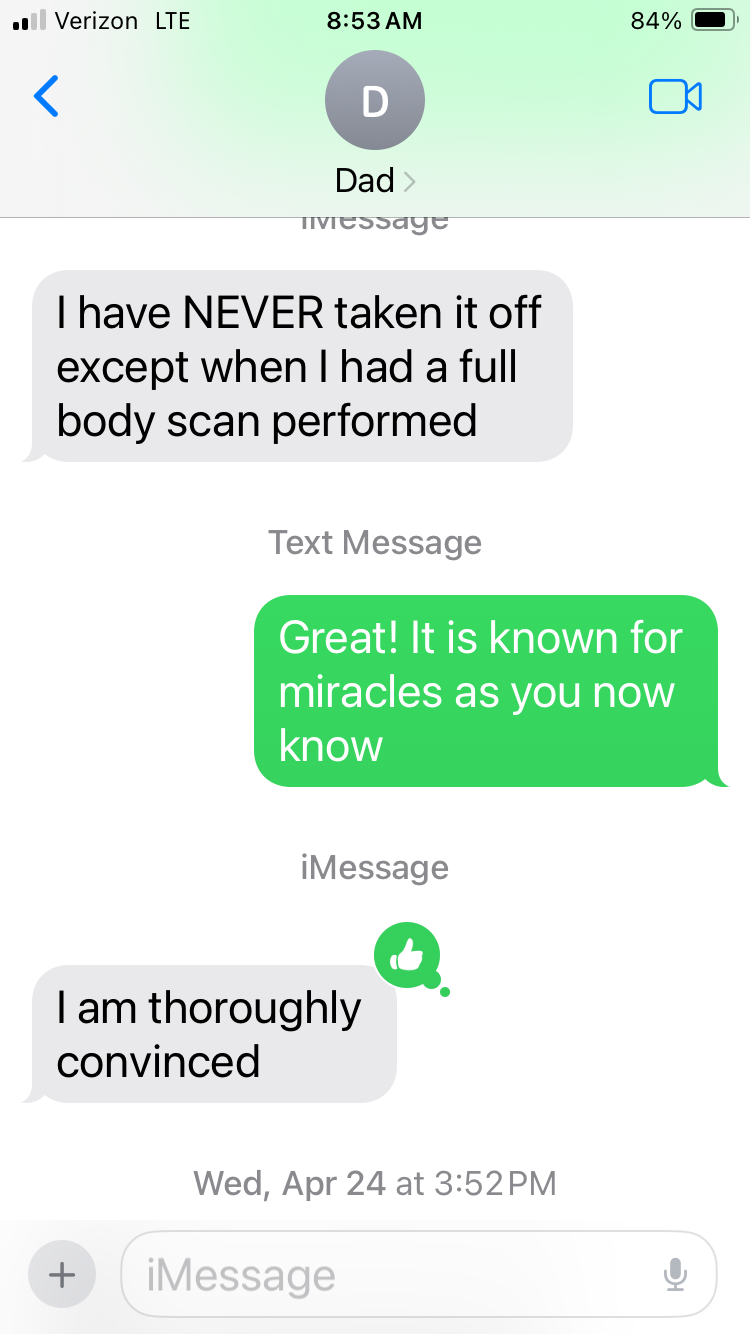
About a month ago, I took off my worn Miraculous Medal from around my neck and gave it to my dad, placing it around his neck. I don't know why, only....why not? He texted me a few days ago with an update about his ability to walk normally again after many falls and loss of balance: 


I told him it was important to thank the Mother of God, were it attributable to her miraculous intercession. And what better way to do that than by establishing a relationship with her? So I just said the thing to my dad, and I thought his response was pretty cool:


At our parish picnic today I was chatting with an elderly woman who was raised as a Southern Baptist in Tennessee. When she moved up to this area, a woman who lived across the street (who was Catholic) was essentially bold enough to tell her about the Church and that she should become Catholic. And so she (and her five daughters) did! If that neighbor had politely kept her mouth shut, the spiritual trajectory of this woman at our parish would have been drastically different. 

I'm not a real "make a statement" guy; I don't wear a lot of branded stuff, or feel the need to identify with "my tribe." Catholicism is not a membership club for me..it's a lifetime debt to pay. Nonetheless, I have curiously found myself lately trying out different methods of evangelizing in the empty airwave space to try to save some, as St. Paul says, by any means necessary. The Gospel is not a pitch, but I do sometimes feel it helpful to think of it those terms--when a screenwriter gets 5 seconds in the elevator with a movie exec to pitch his idea, he'd better be succinct, convincing, and make a lasting impact. I've been trying to do this in little ways--wearing a unmistakable CHOOSE LIFE t-shirt when I go out in secular settings, or the bumper stickers I designed recently for my car that simply state the inevitable (but will hopefully get someone to consider their ultimate end, even if only for a moment at a red light). [Edit: my wife will not let me put them on the car, so they have been relegated to the fridge]

Am I a little embarrassed at the brashness of this messaging I'm employing on my bodily property? Maybe. But the day is now far-spent, and we are a far way from home. If you're going to advertise, at least don't waste it on purposeless branding. We have to start not only letting people know there's a way out of this mess, but giving them the roadmap and directions as well...staying up with them doing so, saying the ignorant thing, risking looking like fools. Going out on limb. Saying the thing.

These are the people who will give glory to God with you in Heaven, and exclaim "Hey! I know YOU! You were THAT GUY who..." The things we risk to lose in this life--our jobs, our reputations, our friends--do seem like big things in this life, but mean ultimately very little in the next. "The years of our life are seventy, or even by reason of strength eighty; yet their span is but toil and trouble; they are soon gone, and we fly away" (Ps 90:10). And likewise, the tongues we hold here on earth will lap bitter dregs from the barrel of unspoken regret in Hell. "The tongue has the power of life and death, and those who love it will eat its fruit" (Prov 18:21).

So, don't hold your tongue. Say the thing...in truth and charity, of course. But yours is a reconnaissance mission. Use everything at your disposal for the sake of the Gospel, and free the slaves by any means necessary.

Wednesday, February 7, 2024

More Thoughts On A 'Third Way' of Christian Discipleship

 I will be joining Eric Sammons tomorrow on his Crisis Point podcast to speak a little about my book but also to discuss my post "The Third Way" and the idea behind it. Since I haven't really articulated in note form what I want to talk about in the interview, I figured I would do so here.

2/9/24 EDIT: The podcast is live and can be streamed here. It took a little bit of a different direction than what I had prepared for here, but turned out to be a good discussion in a different way.


1) So, what is this "third way" of discipleship and how did you start thinking about this?


I wrote an essay five years ago titled "Tradition and Charity: The Face of Renewal" when we first started attending the Traditional Latin Mass as a family, and I've been thinking about the topic ever since. In that essay I wrote:


I think there is a tendency, in the age of identity politics, to delineate into false dichotomies. Those less traditionally minded--as seen in liberal churches, Catholic or Protestant--may compensate by being more active in parish activities, service, and social justice initiatives, while traditionalists are all about the Mass and not as concerned with those other things. I consider myself and my family more as guests in someone's house at this point when it comes to the Latin Mass community, so I don't feel like I have any right to make such judgments about a community that is not yet our own. But I will say one of the most important things, one of the primary motivators besides an integrity in worship and learning to subject my ego to Almighty God, is that we pass on the faith to our children, and I feel that the TLM community is the best place to try to do this in. 


On the point of charity, and why I think traditionalism combined with charity has the potential to be an unstoppable force for renewal...it wasn't until listening to a conference of Fr. Ripperger's that I realized that the 'love' in 1 Cor 13 is really more accurately translated as charity. I considered that kind invitation to attend a Latin Mass by that friend of a friend as an act of charity. I had until then considered the Latin Mass community to be more or less insular and an island of sorts by choice, not open to outsiders. All it took was an invitation to get us there, a kind of gentle and innocuous evangelization in its ordinariness. Coffee and donuts as a way of connecting with other families and homeschoolers once a month was an added bonus.


Coming from a more left-leaning Catholicism in my early years as a Catholic, serving the poor was an important part of my spiritual practice and faith, one that I have no intention of abandoning. I also do not want to fall into the trap of denigrating or comparing Masses or the people that attend them; though we have made the decision to attend the Latin Mass when we are able (which is most Sundays) because we feel this is where God is leading us as a family, I still attend the NO for daily Mass and have no qualms with it (unless there are serious liturgical abuses). I'm a "both/and" rather than an "either/or" guy at heart, I think, and this applies as much liturgically as it does to charity and service to the poor, evangelization, practicing the Works of Mercy, and loving people.


When it comes to loving, we love because He first loved us (1 Jn 4:19). The greatest commandment, the "Big Stone First", is to love the Lord God with everything we have. And yet we also see in 1 John that

Those who say, “I love God,” and hate their brothers or sisters, are liars; for those who do not love a brother or sister whom they have seen, cannot love God whom they have not seen. The commandment we have from him is this: those who love God must love their brothers and sisters also. (1 Jn 4:20-21)


So really a "third way" of Catholic Traditionalism is really Catholic Essentialism: taking the best of the best in worship and charity--since on this the two Commandments rest--in a "both/and" spirit (versus a kind of "either/or" false dichotomy). What I am calling "Third Way" Traditionalism is one kind of "complete protein": of prayer and action, worship and praxis, to make sure we are not just Christian believers or those who worship, but true disciples of Jesus Christ. 


2) What does this "third way" have to do with the Traditional Latin Mass and traditional Catholicism?


As I mentioned, I'm really a guest here, and I consider myself more or less trad-adjacent, rather than a true died-in-the-wool traditionalist. Our family attends the TLM exclusively, my son serves, my wife and daughter veil, yadayada but this is relatively recent for us in the past five years and I'm not about to tell trads what they should and shouldn't be doing. Maybe it is because I am an evangelist at heart, that I see this great potential for renewal in the Church with the rise of the TLM as a locus of authentic and reverent worship, a worthy vessel to bring people into the Church and experience the awe and majesty of God and what Catholicism really is. The TLM already does this effectively in a way in-bound marketing does: it draws you in and piques your curiosity, but doesn't pound you with ads or outbound marketing the way, as Shia LaBeouf mentioned in his interview with Bishop Barron, "it's not trying to sell you anything" [the way the Novus Ordo does]. If Lex Orandi, Lex Credendi is true (and it is), then we have a great foundation in the traditional Mass for building a faith on a solid rock of worship. But it can't end there. There's also that pesky second commandment our Lord slips in there. 


3) What do you see as the issues in traditional and more status-quo/mainstream Catholic communities today, respectively? Where are the blind spots or opportunities for growth for each?


The issues in your standard, down-the-street suburban Novus Ordo parish are pretty ubiquitous: you have these pockets of sometimes great devotion, prayer and piety among individual parishoners, but it's often in spite of, not because of, the parish environment. I don't want to speak for all people in this situation, but for me that was the case: it always felt like swimming up stream, fighting the parish current, to carve out a solid prayer life and something that went beyond the status-quo cultural norms of the N.O. and the particular parishes we belonged to; we felt like outliers, "extreme" religious, like we couldn't relate to people at the parish. So, I think there's this low-bar in many of these parishes that doesn't push people to grow spiritually outside the prescribed parish programs or proscriptions; these parishes can at the same time be very "active" replete with ministries, service to the needy, activities for seniors and retirees to get involved with and stay busy, and doing good things. 

So, when traditionalists see this stuff, there's kind of this pendulum reaction that anything associated with the Novus Ordo is suspect, and so the good things get thrown out with the bad. Like service to the poor and other acts of corporal charity, which of course is not "only" for your standard Novus Ordo parish and is not necessarily the stuff of SJWs.  The thing is, at least at our parish, we don't have a ton of these lay-led "programs" and I think that's a good thing. We have solid liturgy, good music, and an organic sense of community. But we shouldn't think either we are exempt from the work of discipleship, the works of charity and mercy, both corporal and spiritual. We are quick to signal to others that we are "trads" by what we wear, what we hold, how we pray, etc. But we should be more apt to show that we are Christians by how we love. For that's where converts come from.


4) You mention in some of your writings that you prefer to answer "I am a disciple of Jesus Christ" rather than "I am a Catholic" when asked about your religious faith, even though you are a Catholic. Why is that?


It's strange, isn't it, that we have to qualify everything today. Even though I'm more aligned in every aspect with traditional Catholicism, I'm still hesitant to refer to myself as a "trad" or "traditional Catholic." Because although I have been so thoroughly edified by the patrimony of the Church, which I have only been recently been introduced to and which I feel was withheld from me for 20 years as a Catholic since I came into the Church, I still feel there is this identity-thing, this tribe thing that is such a temptation to hold on to. But referring to oneself as "a Catholic" is a very broad term as well: well, what kind of Catholic are you? Are you a 'born-and-raised K-12 Catholic school but don't really believe any of that stuff' Catholic? Are you a Catholic on account of your cultural heritage (Mexican, Filipino, Irish, etc)? 

All that stuff is kind of ancillary as far as I'm concerned. God calls us not just to belief but to work, because Christ is our Master. And there's a lot of work to be done to rebuild and renew the Church, help save the lost, exercise charity, instruct the ignorant. A disciple is under a Master, and I feel that that is where I want my focus more than being a card-carrying member of a country club, or a member of a certain sect or tribe.   


5) What are some of the benefits for evangelization of the Traditional Latin Mass, and what makes it harder in other ways?


This was actually a struggle for me when I was doing street evangelization back in 2018, and it can really be a mixed-bag if you get someone interested in becoming Catholic, but it's like "where do you send them?" There's so many wacky RCIA programs, so many beige and uninspiring churches--not just the architecture, but the parishoners themselves--that makes you feel reticent to send a baby believer there.  Now, I know grace works anywhere God gives it, but for me that was part of the impetus of wanting to raise my family in a more liturgically stable environment, where you didn't have this anxiety about "what is the priest going to do today?" or "what are we walking into here?" When you love something, you want everyone to know about it, and that's how I feel about the TLM. The Mass is perfect, but we are not, and we need to accept that. But I still think it highlights Catholicism in it's truest expression, but needs to go beyond the liturgy and outside the walls of the church--to make saints. 


6) Do you consider yourself a Traditionalist? If so, why; and if no, why not?


I consider these labels a kind of necessary evil, and don't particular like them but it is what it is. Personally, I consider a true traditionalist someone who has a line in the sand, and I know many people like this who will not attend the Novus Ordo under any circumstances. In that sense, I do not consider myself a traditionalist because I will occasionally go to a daily N.O. Mass on campus on my lunch break, although I have not attended a Sunday N.O. in five years. I will drive 2 hours to find a Latin Mass if we are traveling rather than go to the local N.O. parish ten minutes away, but it's not because I think it's invalid or harmful to my faith. I was saved in the N.O., raised up in the N.O., and experienced grace in the N.O. So God can do what He wants, save whom He wants, use what He wants to accomplish that task. I will take grace wherever I can get it, even if I do personally feel more edified and that the Traditional Latin Mass is objectively "better" in every way than the Novus Ordo Missae. 


7) What do you mean when you speak of the traditional faith needing charity in order to be a "complete protein"? 


Matthew 22 and Matthew 25 are really the benchmarks for me in my spiritual life. It is there where Jesus distills the Decalogue into the Two Great Commandments--love God, love neighbor; and where he gives us a warning of how we will be judged by Him: on our charity. And that should fill us with fear. We will not be judged on which Mass we attend, or if we veiled, or that we are devoted to our missals. We will be judged on our love. Those who love God must love their brothers (1 Jn 4:20-21). 

What's so great about Catholicism is that it respects the both/and dimension of things: faith and reason, faith and works, scripture and tradition, fasting and feasting, God's divinity and God's humanity in the hypostatic union. Tradition is the best kept secret in the Church today. But it shouldn't be a secret! But it's not an end in itself. To the extent that it forms us in greater love of God and neighbor, it is doing its job. Otherwise, it's just a resounding gong, as St. Paul says. But when we love God and give him the best first fruits of worship, this sets us on a solid rock to build the house of charity. 

Look at saints like St. Leo the Great and St. Charles Borromeo, just to name a couple. They were high ranking dignitaries and prelates, yet were fully devoted to service to the poor. St. Leo said, "Let us now extend to the poor and those afflicted in different ways a more open-handed generosity, so that God may be thanked through many voices and the relief of the needy supported by our fasting. No act of devotion on the part of the faithful gives God more pleasure than that which is lavished on his poor. Where he finds charity with its loving concern, there he recognizes the reflection of his own fatherly care." And St. Charles during the plague fed tends of thousands of the hungry daily and saw the poor as his teacher.

But charity goes beyond just corporal charity--it is charity of heart, love. Love of God is tatamount, but sometimes trads can be a little....insular. Because it is comfortable to love God and uncomfortable to love people. 

I love the story of St. Aloysius when he came under the spiritual care of St. Robert Bellarmine. When he entered the Jesuits at the age of 17, Aloysius was appointed a spiritual director, St. Robert Bellarmine. Level headed and patient, Bellarmine listened to Aloysius describe his extreme schedule of individual religious practice, then ordered him to cease it. He was assigned instead to work at a local hospital tending to the sick and infirmed. Squeamish, he was repulsed by the work, and he disliked people, which is probably why he was initially inclined to his private devotions and mortifications. When the plague hit Rome in January 1591, the sick and dying were everywhere, overwhelming the hospitals, and Aloysius had to dig deep and draw on that Italian stubbornness and bulldog like willpower to stomach the work.

But in time, a transformation happened by God's grace. Though this was never work he would have chosen for himself, Aloysius began to see Christ in them, similar to St. Francis' encounter with the leper. He experienced compassion for the sick and dying, and often carried them from the streets to the hospital on his back. He contracted the plague as a result, and died June 21st, at the age of 23.


8) Do you get pushback from either more normie-mainstream Catholics or Traditionalists, or both?


I get it from all sides, haha. But I don't care too much. I'm too normie for the trads and too trad for the normies. But that's ok. I just want to love all people, and "be who I am, and be that well" as St. Francis de Sales says. I think it's good we push ourselves, and be honest about our blindspots, so God can make us into saints and we can get to work more effectively.


9) Why even make a "thing" of this? Isn't Traditionalism in its current cultural form enough? 


Well, that's a valid point. I see this "Third Way" between insular Traditionalism and status-quo Catholicism not as a program or an apostolate or even a philosophical school, but just as a consideration on how to worship better, love better, and work better in the Lord's vineyard. I want to live the fullness of the faith, and work out my salvation in fear and trembling, and I can't do that without a solid foundation for worship and without loving my neighbor, which is uncomfortable. To the degree that we take risks for the Lord in love and faith and devotion, I think He will honor that and give us the grace to make up for what we lack. But to the degree that we are content in our little camps, and not doing the work we are called to as disciples, I see that as an issue worth addressing. 


10) What do you see is the role of joy and hope today for both traditionalists and non-traditionalists alike?


People need hope to live, and joy is the icing on the cake. Joy attracts, just like the TLM has this strange in-bound pull effect on people, even non-believers. It's not trying to be what it's not; it's being true to what it is, unapologetically. That's attractive, just as joy is attractive and reflects beauty and God's nature. Hope gives us a reason to work, a reason to live, and faith that things will get better even if that happens after our death. Faith, hope, charity--these three. But the greatest of these is charity. 


11) In your blog post "The Third Way" you linked to two vocational videos: 1 for the Discalced Carmelites and 1 for the CFRs, saying "Both are powerful and moving; both inspire devotion and service to Christ. One order is traditional and contemplative; the other, more charismatic and active. Both are authentically Catholic.". What was the point you were trying to get across with doing that?


Listen, the Catholic Church is a big tent. Not everyone is going to love or be drawn to the TLM. That's just a fact. Our strength is in our diversity of charisms, and that has always been the case in the Church. St. Paul said as much, that an eye is not a hand, etc. The CFRs are solid guys, solid friars. Are they more charismatic? Sure. Does that mean they should be held in suspect by trads? Come on. These guys have a heart for Christ and the poor--would that we be more like them. The Discalced Carmelites in the video, as well, have this ethereal existence so devoted to the liturgy and the hidden lives of being contemplatives. We need both. That's the whole point of what I'm talking about in The Third Way--take the best and leave the filler. Love God. Love your Brothers. Love the poor. Build beautiful churches. Spread the Good News. These things are not at odds. Both/And. Both/And. We can't afford to leave grace on the table, or discount this group or that group because of ideological differences. Come on. Let's get to work. 


Thursday, January 4, 2024

Catechizing My Father

It began with a text on the Solemnity of the Immaculate Conception:

“Dad, don’t forget to go to Mass today. It’s a Holy Day of Obligation. There is a noon Mass at St. Jude’s, FYI. Remember, intentionally missing Mass on a HDO is a mortal sin.”

Four hours later, my father responded, 

“Just got back…it was packed and I arrived with a minute to spare, but one of the ushers found me a seat. I feel good thanks to going. 
Question, though: Is missing a Holy Day of Obligation a mortal sin if you are aware of it and choose to ignore it or a venial sin otherwise (not knowing it and missing it)? Analogous to not knowing a law and breaking one is cause for arrest”

I took a breath and said a quick prayer for pecking out a reply,

“Grave offense, but mortal sin depends on three conditions: 1) grave matter; 2) full knowledge; 3) deliberate consent. If it’s serious, you know, and do it anyway, it’s a mortal sin.”

A few moments later, he responded again:
“A lot of these words are subject to interpretation. I would like to meet you sometime privately and discuss the topic further.” 

Five days later, my mom, wife, and daughter caught an early morning bus to New York City for the day and my dad asked if he could stop by to see my two boys and drop something off for me. “Of course,” I said, “come on by.”

He arrived smiling, recounting almost getting in an accident with an 18-wheeler on the drive over to my home, and gave his grandsons hugs. “Have a seat, dad” I told him in between firing off work emails, “I’ll put some coffee on.”

We went into the kitchen, just the two of us, and he laid his copy of the Baltimore Catechism that I had sent him over the summer on the table, as well as a frayed black prayer book the size of an index card. 


“My dad gave me this prayer book,” he said reflectively, fingering through the yellowed pages.

“Yeah?” I asked, and then inquired about his religious upbringing as a child. Did he go to CCD? Did his father teach him the faith? 

“Well, my father would go to the Divine Liturgy in the city on Sundays,” he began “but he never took me for some reason. There was a boy in our neighborhood who I knew, and I would go to his Episcopalian…what would you call it...Sunday school to, you know, learn the basics. It wasn’t until I turned twelve that we had a Ukrainian Catholic chapel in Roxborough. So after that I started going there with my dad and a priest there would give lessons.”

I knew my grandfather died right before my dad graduated college at age twenty-one, and that always left a hole in his heart that was never really filled. My grandmother--who was Russian Orthodox--struggled with depression and my father was an only child, so I had to assume that he stopped going to church around that time. Like my grandfather and grandmother, my parents’ marriage was one of mixed-faith: my mother was a life-long cultural Episcopalian, my father a baptized-but-uncatechized Eastern-rite Catholic. You can’t give what you don’t have, and so it was no surprise that my brothers and I were left to our own devices when it came to religion: we had no CCD, some sporadic Sunday school and baptism in the Episcopal church as infants…and knew nothing really about the person of Christ of Christian doctrine. Nor were we forced to go to church…and so we usually didn’t. It was only at the age of eighteen, after years of living as a secularist that gave way to a dramatic conversion at the hand of grace, that I came to know Jesus and came into the Catholic Church of my own volition.  

I was piecing together the fragments of my father’s religious childhood formation, and things were starting to make a little more sense in the current context of our text exchange. I decided that rather than shoot the breeze and talk about what was more comfortable (the weather, the stock market, car maintenance, etc), I’d cut to the chase and talk about the only thing that really matters. I asked him if we could say a quick prayer together, to which he obliged, and begged the Holy Spirit to give us the grace to guide our conversation, confident in Christ’s promise that “where two or more are gathered in my Name, there I am in their midst.” 

I could see, at 73 years old, that he was essentially an infant when it came to faith formation. “I was always taught,” he said with a far-off look in his eyes, “that good people go to Heaven, and that bad people go to Hell.” I winced a little. It wasn’t uncommon—I know lots of people of my father’s generation who hold the same erroneous thinking. He went on to say that he was taught (presumably, by the priest as a child), that mortal sin was “heinous, serious”—but never anything more than that. I think what followed is that mortal sin was equated with bank robbers and murderers, and that since my father wasn’t either of those two things, he was in the clear. Things like neglecting to attend Mass, and other sins of commission and omission were never even on the radar.

“You know, dad, it says in the bible that ‘there is no one who is good, not one.’ I don’t know how to say this, but what you were taught is…it’s not right. At least not completely.” For the next two hours, as my father sat quietly listening, I explained the basics of justification: that we are born into sin, washed clean in baptism, and saved by grace through Christ’s redemptive work on the Cross. That it is not in faith alone that we are saved (as sola fide Protestants maintain), that we need works to accompany that faith (for faith without works is dead, as St. James writes), and how mortal sin severs friendship with God and the life of grace within us and is easier to commit than one may think. 

At one point he got a concerned look on his face. “I mean, how can one get to Heaven when there are so many sins one could commit? No one is perfect.” I gently told him about the great mercy extended to us in the Sacrament of Penance, that mortal sin severs that friendship with God and must be restored through Confession and that as long as we have breath in us we can always turn to God in repentance. He fingered an Examination of Conscience pamphlet I had given him a few months ago. “See,” I pointed, “if you are unsure what may be grave matter, this will help you examine your conscience and serve as a guide.” We went through the Baltimore Catechism together, or at least one section of it (on sin).

“Ok, then what is purgatory?” he asked. Purgatory, I told him, is purification after death, and it hurts like hell but is not forever; that it is also a great mercy of God extended to us sinners so that “none are lost.” “All this is a lot to take in,” he said somberly, his voice a little unsteady. “I’m seventy-three years old, and it’s not easy to change, especially when you’ve been thinking and believing a certain way all your life.”

“Dad,” I said to him softly, “I want you to be saved. I want you to be with us in Heaven. God can supply the grace to change. He gives to all who ask. Look at the Good Thief on the cross. He was able to join Jesus in Paradise, given the grace of final penitence. As long as you’re still alive, there is still time. But once you’re dead…that’s it. Game over. No re-dos. There is a Heaven and there is a Hell, and we get to choose, through our free will, what path we want to walk. It’s impossible for us, but all things are possible with God. And Hell isn’t just for the Hitlers and Salins.”

I pulled the Miraculous Medal I wear around my neck out of my shirt. “This is called a sacramental. The Church gives us these various sacramentals as a conduit of grace to help us do the impossible by faith.” I recounted to him how my wife and I were converted away from the mortal sin of using contraception by way of the Miraculous Medal, and how the Mother of God poured out graces from her Son to help us change course. “I have some extras in the dining room…I’ll give you one before you leave. It may be just the help you need.” 

I knew it was a lot to take in all at once—that the Church in the 1960’s through now had kind of dropped the catechetical ball and left men like my father in a sea of subjective theological heterodoxy and catechetical ambiguity; I reassured my dad that he was not alone or unique, but that many people of his generation simply weren’t taught the faith well, that bad teaching and fluffy filler got mixed into the mortar to weaken the foundation. “But it’s never too late to learn, dad.” He nodded thoughtfully.

When my five year old came in to tug on grandpa’s sleeve so that he would watch him ride his bike, that was our signal that I had to get back to work and my dad had to get back to, well, whatever retired people do with their days. “One more thing, dad.”  He turned. “Just like you can’t have a healthy marriage with mom without talking and listening and spending time with her, you can’t have a relationship with God without prayer. Can you commit to taking an hour out of your busy schedule some time in the next couple weeks to spend before the Lord in Adoration? You don’t have to do anything or say anything…just give God the hour. Can you do that?” 

“I can do that.” 

Great, I said. The church down the street from you has it on Wednesdays from 8:30am-8pm.

“What’s today?” he asked. He never knew what day it was.

“Today is Tuesday,” I noted. “How about I join you tomorrow, say eleven o’clock? The church is right down the street from my office. I can go there on my lunch break.” 

“Okay,” he responded. “Eleven o’clock.” 

“Great. It’s a date.” 

As I walked my dad to the door, he told me a story of praying to St. Jude when he was twenty-one years old and completely despondent after graduating college at unable to find a teaching job, despite sending out applications everywhere. He took out a taped and folded prayer card of the saint to show me. “I had prayed that prayer in the car when I was out, and when I returned home my mother told me someone had called wanting to bring me in for an interview. I was so…happy. I couldn’t believe it.”

“That’s awesome,” I said smiling, adding, “Dad, if God can answer prayers like that for your material well-being, think how much more He can do for your spiritual well-being, which matters even more? Ask and you shall receive; knock and the door will be opened for you. It’s the only thing that really matters in the end.”  

“Okay, then” he nodded as we got to his car in the driveway. “I guess I’ll see you tomorrow then. Eleven o’clock. See you there.” I hugged him, and he hugged me back tightly.

I’ll see you there, dad.

Saturday, December 16, 2023

The Third Way


Call me crazy, but I have a vision of the church --a mental portrait of the renewal that will have to take place to recapture the essence of what it means to be a Christian in the 21st century. It will require boots on the ground and in the field, lots of hard work, a willingness to take risks, look foolish, and get one's hands dirty, creativity and out of the box thinking, deep lives of prayer and service, a docility to the Spirit, associating with sinners, a thirst for souls, and a willingness to suffer. This is not a program, nor an apostolate or religious order--it is simply people embracing the "both/and" ethos of Catholicism and refusing to settle for anything less than full-throated "lives fully lived" for Christ. I don't want to be a cafeteria Catholic; I want the whole buffet.

But because this is a tall order, I'm taking as a mission statement the adage, "be the change you wish to see in the world." We can only change ourselves and live authentically as God calls us. Since we are called as disciples to put our hands to the plow and not look backwards, there's no way of knowing who is following us when our eyes are forward-looking, focused on Christ. And that's a good thing--movements come and go; but Christ remains. 

Why is this important? St. Paul sought the unification of the Church when dealing with factions, those who say "I am of Paul, or I am of Apollos" (1 Cor 1:12; cf. 1 Cor 3:4). The early Christians were also identified in the public square by their love (Jn 13:35)--not because they wore a chapel veil or had ashes on their forehead on Ash Wednesday. They were also willing to go to their martyrdoms singing joyfully, knowing their reward was in Heaven. They were not SJWs, but shared what they had cheerfully with the poor and those in need. Many worked miracles by faith, and tended to the sick and dying. In short, they believed and lived out that belief in the pagan streets of Rome and beyond.  

When I see factions in the Church today, I see weakness; a missing the forest for the trees, and a forgetting of one's first love. The potential for a formidable bloc of believers which transforms our fallen world is vetoed in favor of a comfortable country club of card-carrying dues-payers, or a degenerate squabble-fest, fiefdom against fiefdom. We pour into these little projects and kingdoms rather than deferring our wages to the Divine Architect to fund his master piece. 

Tradition is the best kept secret in the Church today. What I see is people being fed and fortified by it in their liturgical lives, having found a vessel worthy to hold their offerings of worship. It may be branded as "Traditional Catholicism" but really it is simply authentic Catholicism believed and lived out. I also see people wary and suspicious of this "brand" and instead of embracing it, hold it at arm's length and not giving it a chance. Or finding their first experience or two were negative ones and so refusing to return. I see caricatures, avatars of "trads" invoked as the rationale for keeping distance from this authentic Catholicism--sometimes valid, other times not.  

But Tradition is not the end goal, our raison-d'etre. It is a formidable means to an end to fortify us, but not the end itself. For in the New Covenant there are not one, but two Great Commandments: “'You shall love the Lord your God with all your heart, and with all your soul, and with all your mind, and with all your strength. ' The second is this, 'You shall love your neighbor as yourself. ' There is no other commandment greater than these” (Mark 12:30-31). While the ornate chasubles rustle and the sun reflects off golden candlesticks on the altar, the more muted orders of charity sit outside the sanctuary door waiting to be filled: to feed the hungry, clothe the naked, shelter the homeless, visit the sick and prisoners, bury the dead. The doubtful await counseling, sinners need admonishing, our enemies demand forgiveness, the ignorant live in darkness. While traditional Catholics are busy griping about liturgical abuses and turning down their nose at the Novus Ordo ad nauseum, their counterparts in their local suburban parishes are carrying out these works of mercy day in and day out in anticipation of their judgment: "I was hungry and you gave me food; I was thirsty and you gave me to drink (Mt. 25: 35-40). 

Take as way of example these two vocation trailers: the first for the Discalced Carmelites, the second for the CFRs. Both are powerful and moving; both inspire devotion and service to Christ. One order is traditional and contemplative; the other, more charismatic and active. Both are authentically Catholic.


And so, like a naive babe or a misguided fool, I see these two seemingly disparate blocs of Catholics and think to myself, "Why not both/and?" If lex orandi lex credendi is a proven law (and it is), and if we will be judged on our charity, why are we shutting down one lung in the body of Christ to breathe with the other? Is a joyful, evangelical traditionalism that is committed to being the hands and feet of Christ in the world a contradiction in terms--or is it a third way forward that leaves nothing on the table and no room to doubt that we are, in fact, Catholic Christians through and through, known by our love?

Yes, I see a Third Way of living out my life as a Christian...but not as much around me. This is the change I want to see in the church and in the world. I am not interested in movements or factions or joining a tribe; I am a laborer, and I want the whole package. If I'm alone, I'm content to be alone. But if there are others, I would welcome the company. Call me crazy...but call me hopeful as well. 

Saturday, December 9, 2023

Why I Lost Faith in the "New Evangelization"

 I've been made aware from homilies at Mass in which our priests were instructed to weave Eucharistic themes into their sermons, that we are in the midst of a $28 million National Eucharistic Revival, which is sponsored by the U.S. Catholic bishops and is to culminate in a National Eucharistic Conference in 2024. The stated mission of the Eucharistic Revival is to “renew the Church by enkindling a living relationship with the Lord Jesus Christ in the holy Eucharist.”

Now, I really try hard in speech and word not to crap on things that have an obviously good motivation and core; I try hard not to be too critical, give the benefit of the doubt, and do my best to support such initiatives which do not conflict with conscience; and (obviously as readers of this blog know), I don't always do a great job of that. That being said, when I heard about this Eucharistic initiative by the U.S. Catholic bishops, I let out a little sigh because it felt a bit like deja vu, like I had been here before. 

In 2017, I got involved with an apostolate called St. Paul Street Evangelization. I was drawn to their grassroots mission of "taking to the streets" to spread the Gospel of Christ and give bold witness in the public square. The mission of SPSE draws from Sherry Waddell's Forming Intentional Disciples, as well as the Second Vatican Council's reiteration that all Catholics by their baptism in Christ are called to evangelize and "make disciples of all nations" (Mt 28:19), given credence in Pope Benedict XVI's establishment of the Pontifical Council for the Promotion of the New Evangelization. In his 2010 homily on the Solemnity of SS. Peter and Paul, he called for “renewed evangelization where the first proclamation of the faith has already resonated and where Churches with an ancient foundation exist but are experiencing the progressive secularization of society and a sort of "eclipse of the sense of God", which pose a challenge to finding appropriate to propose anew the perennial truth of Christ's Gospel.”

I started a local SPSE chapter at the parish we were attending at the time, ordering placards, apologetic tracts, rosaries and Miraculous Medals in bulk. Once a month we would set up in a busy section of town and try to engage passersby. If they were non-Christians, we would speak to them about God and eternity; if they were non-Catholics, we would engage with them on our commonalities, and ask them if they ever considered Catholicism; if they were Catholics, we would ask them what their parish was and encourage them to come back to Confession and Mass if they were fallen away. In addition to monthly evangelization sessions and training team members wanting to get involved, I worked for SPSE as a 1099 contractor, typing up reports and testimonies from other teams across the country for the apostolate.

In his epistle to the Ephesians, St. Paul writes of the various gifts of ministry, that "[Christ] gave some, apostles; and some, prophets; and some, evangelists; and some, pastors and teachers" (Eph 4:11). I did feel like I was called to give witness to the Gospel as an evangelist(as opposed to teaching, priesthood, or prophetic ministry), and this seemed like the practical application of that calling. The field seemed ripe for harvest--how many fallen away Catholics, how many baptized, had failed to have the seed of the Gospel take root in their hearts? These neo-pagans were surely ripe for the picking in the harvest of the New Evangelization--the 21st century New Springtime of Renewal.   

I don't know at what point I lost the fire for this apostolate and ministry; of course I had realistic expectations that we weren't going to see mass success or conversions, and I also knew that it becomes "work" at some point after the initial excitement and honeymoon wears off. While I never lost the zeal to bring souls to Christ, I did start to doubt that the model of this particular apostolate as an extension of these post-conciliar initiatives put forth by the Holy See under John Paul II and Benedict XVI. This doubt started to creep in around the time we were transitioning over to a Traditional Latin Mass parish and waking up to the problems inherent in the post-conciliar reforms, and I was faced with the question, "If someone I am evangelizing said, 'All you say sounds good. Take me to Mass! How do I become Catholic?' what the heck do I do?" Take them to the parish secretary or priest at the local (Novus Ordo) parish? Get them signed up for RCIA? It was almost a crisis of conscience, and one I felt guilty about even experiencing. Isn't it a good thing someone would (hypothetically) want to become Catholic? Attend Mass? Binge watch Bishop Barron videos? Sign up for the Bible in a Year with Fr. Mike Schmitz? Read the Matthew Kelly books the local parish gives out and become a Dynamic Catholic™? 

I said I didn't want to crap on good things, so I'm going to try really hard not to. But circling back to the National Eucharistic Conference that I mentioned at the beginning of this post, I am reliving that inner conflict I had with the evangelization apostolate and recalling the words of our Lord regarding the foolish builder who built his house on sand, "The rain came down, the streams rose, and the winds blew and beat against that house, and it fell with a great crash" (Mt 7:27).

The new revised (1995) Catechism states that the Eucharist is "the source and summit of the Christian life" (CCC 1324). It is fundamental doctrine that the Eucharist is truly and substantially the Body, Blood, Soul and Divinity of our Lord Jesus Christ made truly present under guise of bread and wine. I believe this as a Catholic, as all Catholics should (though as many research groups have highlighted, a majority of Catholics do not have even this basic understanding of transubstantiation). 

And yet, there is this idea of "do as I say, not as I do." For if we truly believed that our Lord was truly present before us at Mass, why in God's holy Name do we persist in 95% of Catholic parishes with:


-employing legions of lay Eucharistic Ministers distributing Holy Communion;

-giving Communion in the hand;

-giving scandal by not ex-communicating Catholic politicians who support abortion and have the audacity of presenting themselves to Holy Communion;

-neglecting to remind Catholics who are in a state of mortal sin not to receive Communion;

-failing to preach from the pulpit about the sin of contraception and the permanence of marriage.


On that last point, I wrote in Consummation, 


Marriage is more than a contract, more than an agreement which can be broken. It's validity, it's lifeblood, the ratifying of the contract depends upon consummation--a fusion of flesh, and this is the nature of Eucharistic communion. In it we partake in the mystery of Christ's death and resurrection. It is not for everyone, because it is not profane or common, but exclusive to those disposed towards its worthy reception. In it we become one bread, one body, one spirit. One cannot get any closer to the presence of the Lord than during this moment when we become One Flesh with the Bridegroom Himself. It is a moment of profound privilege and intimacy reserved for those who are called to His chamber. We do not "think and speculate" in this moment about the Lord. We TASTE AND SEE the goodness of the Lord (Ps 34:8).

Satan has his work cut out for him in the perversion and debasement of the sexual act during his reign here on earth. But he does it, why? Because in deforming the meaning and act of sex as properly understood, he can obscure our understanding of true spiritual consummation--what it means to eat the flesh of the Son of Man! If we don't understand what sex is and what it is for, our telos is reduced to a temporal, sterile, material act of self-fulfillment rather than an eternal, fruitful, profoundly spiritual act of self-abandonment. And if we don't know what committed, chaste, fruitful, selfless sexual intimacy is, is it any wonder we have adopted such a casual, profane, and presumptuous posture in the Communion line?


The inconsistency in how we live as Catholics (and how our shepherds choose or fail to teach and admonish) amounts to an example of "do as I say, not as I do." I would never discourage someone, even a non-Catholic, from visiting an Adoration chapel and making a holy hour and encountering the Eucharistic Lord in prayer, and I see the value in Eucharistic processions as a means of public witness. But when the post-conciliar allowances present in the GIRM (EMs, communion in the hand, etc) which have now become common practice combined with the fact Catholics who eschew contraception and divorce-and-remarriage are considered "radical" or "rigid," and Catholic pro-aborts are given a free pass, we are sending mixed messages. 

Whether it is the New Springtime of Vatican II, the National Eucharistic Revival or the "New Evangelization," I'm sad to say I have do not have faith in these institutional initiatives as a means of renewal in the Church.

But I have not lost faith--in fact, it is quite the contrary. I still have a heart for evangelization, to bring the Good News of the Gospel to the poor, the lost, the lukewarm. I carry Miraculous Medals with me in my car and bag to give out wherever I go. I do the uncomfortable work of trying to admonish and catechize my poorly-formed Catholic father about the basics of Catholic doctrine (sin, the need for Confession, Holy Days of Obligation, judgement, Heaven and Hell, etc). I write into the internet void, hoping a seed of truth lands in someone's heart and strengthens their faith or leads them to metanoia. As a family we try to live basic, fervent authentic Catholic lives on the ground even when we eschew Catholic™ programming. 

But this is all because I believe, as I heard one Orthodox bishop insightfully state recently, that “Christ did not come to change a bad person into a good person, He came to give life to a dead person.” When you prepare a feast for a King, you set the table. Nothing should be neglected--not the polishing of the silver or the placing of the centerpieces or the instruction of the servers. Should the table or chair be wobbly or off center, wouldn't you want to correct that before he sits down to eat? Otherwise all your other initiatives are overshadowed by this shaky setting. 

Jesus Christ is not a "better way"...he is the only way to the Father (Jn 14:6). The Christian life is not a matter of self-improvement or ecological or economic harmony...it is the difference between life and death. The lukewarm the Lord will vomit from His mouth (Rev 3:16). That those who preach the basic fundamentals of Christian doctrine in the Church today are canceled, silenced or marginalized should cue the orthodox believer to read the signs of the times. There is an old saying: Red sky in morning, shepherd take warning. Red sky at night, shepherd's delight--which also appears in holy Scripture:

“When in evening, ye say, it will be fair weather: For the sky is red. And in the morning, it will be foul weather today; for the sky is red and lowering" (Mt 16:2-3)

As the new sun rises blood red in the sky over this godless generation, we would be wise to trim our lamps and prepare for the Bridegroom's return rather than waiting for the warnings to come from the top down. The smoke of Satan has already entered the Church; someone fell asleep in the armchair as the cigarette hits the carpet. Or maybe it was shoddy wiring covered up by decades of plaster. Who knows. Meanwhile our shepherds are making their beds and brewing coffee and ordering new curtains for the living room rather than pulling the fire alarm. Meanwhile, the rest of us with burning nostrils and choked lungs are doing everything we can to pull out our brothers and sisters--tying bedsheets together, throwing mattresses out of second story windows, breaking our legs in the fall and running back in through the front door to try to pull out more bodies. 

We might never know what caused the fire in the first place. But to stand on the lawn and see the smoldering house, where not even the foundation remains, we realize that we are indeed now homeless tenants, sojourners, pilgrims and laborers. The rebuilding will take place over time, but slowly--brick by brick, joist by joist--from the hands of the survivors. 


Friday, December 1, 2023

"Worse Than A Thousand Karens": Why Your Office Administrator Is Crucial To Your Parish's Success


I'm taking a lunch break after a morning conducting interviews for an open position in our office. This is probably the sixth or seventh search committee I've served on and while it can be a lot of work, I've always appreciated the opportunity to be on the "other side" of the interviewing table. I was never great in interviews, and it's a wonder how I even got a job at all. But being on the hiring side, you get a valuable perspective of what managers are looking for in candidates, what annoys them, and what makes one stand out.

It can also be trying to find a needle in a haystack for some positions that require that people wear a lot of "different hats" in the role. Sure, you want someone who is technologically adept and can interpret data and reports...but you also need them to be a people person, willing to travel, be a good team player but also able to work independently, has the right background and experience, etc etc...and willing to work for less than they can make elsewhere. 

The parish office administrator (or to use the old-school nomenclature, the "church secretary") is one of those positions. They wear a lot of different hats--they do administrative work, sure, but it's not all bulletins and church envelope mailing. It's fielding calls from a dizzyingly wide array of issues from "What time is Christmas Eve Mass?" to "I need a priest, my father is dying!" to "I'm considering becoming Catholic and don't know where to start." It's being a dependable confidant to the pastor. It's organizing church and social functions, it's accounting, it's bookkeeping...the list goes on and on. And all this for typically a low to modest salary. 

The most important aspect of their position, however, is that they are the first point of contact for many people to the parish particularly, and the Church as a whole. As someone who recruits for a living, I'm always cognizant that I am the "face" of the institution I work for. If I come off as condescending, ignorant, uninterested, or fail to return correspondence in a timely manner, I'm not only not doing my job effectively--I'm communicating to that prospective applicant that this is what people at XYZ Organization are like. They have other options, and if I make a bad impression, there is no shortage of other competitors who will give them the royal treatment and welcome them to learn more. First impressions go a long way, for good and for bad. 

I told our pastor recently after our parish Trunk or Treat: "Make sure you take care of M___ (our parish administrator); she's a diamond in the rough." And she is. She's warm, welcoming, responsive, empathetic, organized, hard-working, faithful, social, and loyal. She's everything we could ask for, and our pastor knows it. We have been growing as a parish, and I know she plays a part in that. 

On the flip side, I remember having a conversation with a woman I supervise one day and we were talking about kids, family, etc. She mentioned that when her kids were younger, she took them to the parish office to have them enrolled in Catholic school. When she encountered the church secretary and inquired, she was curtly told "we don't do enrollments this day. You'll have to come back tomorrow on the day we do them," or something that effect. Understandable. And it was also understandable that my Catholic co-worker immediately exited with her kids, enrolled her kids at the local public school, and never darkened the door of that particular church again. 

Like it or not, the parish office administrator/secretary is the GATEKEEPER to your church. She can be a door of welcome, or a complete barrier to keeping the lights on. Getting the person in that position right is probably more crucial than the youth minister, the DRE, the sacristan, the finance council, the parish council, and probably any other employee of that parish. 

So, though I am not a pastor and I do not work for the Church, I would offer the following advice for those who are or do to ensure that you don't put up needless barriers to current or potential parishioners when hiring for this position:


Pay them as much as you can

It is a worthwhile investment. We communicate value, for better or worse, through compensation. This doesn't always have to be in W-2 fashion, but even modestly increasing a secretarial salary by an extra $2,000-$3,000/yr can go a long way in retention and attracting the right candidate. If that is not possible for whatever reason, taking her out to lunch, giving a kind of monetary or non-monetary bonus, giving her extra days off--whatever it takes to keep or hire a good administrator will pay dividends for you. Pay her compliments and reward incentive and initiative, provided it is in line with the parish and pastor's mission.


Train them in customer service

We don't usually equate customer service with anything related to the Church; it's corporate lingo. But believe me, it goes a long way, and it doesn't take much. Encouraging little things like greeting people, being friendly, smiling, being flexible and accommodating, returning calls and emails promptly, and going above and beyond is not at odds with the function of an office administrator. If anything, it's the most important thing; again, because they are the "face" of the Church. It sets the tone for who you are as a parish and what you want to become. There is also the second-hand effects of evangelizing those with whom they come into (first) contact with. The church secretary may be the only person from the Church a non-believer encounters in a phone call, and that can set a trajectory for life. It's no small thing!


Encourage them in their prayer life

I think it was St. Catherine who said, "I'd rather have a trained spiritual director than a holy one." The parish secretary should be a practicing Catholic, obviously, but I would venture to say the non-religious aspects of their personality and temperaments related to the job should outweigh their piety. But you also don't want to hire someone who doesn't exude the love of Christ and live in alignment with Church teaching. Again, this can feel like a needle in a haystack, but the more you set the example of holiness and virtue as a pastor (and lead your flock in that way), the more you inspire those who work for you to do the same. Prayer has a way of changing us, increasing virtue and patience, kindness, love, understanding, etc...all the kinds of qualities you want in the front-facing staff member answering the phone and meeting people at the door. 


Treat them as part of a team and give them a voice

When we have buy-in in an organization, we tend to believe in the mission and even put in extra work because we feel a part of something, valued, appreciated...that we belong there. This means having a clear vision and mission for your parish, and communicating that to potential applicants so that their own values align with that of the church or organization. That, in turn, will ensure they want to come to work, want to do their best, want to go above and beyond in their position. Treat the custodian, the office administrator, the sacristan not as less-than-important in relation to other members, but as vital to the overall goal of leading people to Christ, giving glory to God in worship, bringing in more revenue...whatever. How you treat those "beneath" you is not only a reflection of good servant-leadership, but how you live your life of faith. As St. Benedict said in his Rule, "Welcome all guests as Christ." 


Be willing to let someone go

A parish like any organization should be true to its mission, and the chain is only as strong as its weakest link. If you have a toxic or apathetic office administrator, this may call for taking a hard look at whether it is helping or hurting your parish. It is not uncommon for organizations to "clean house" when a new administration comes in; of course this takes prudence and discernment. But you need to think hard about keeping someone on just because they have been there a long time, or their family member is a donor, or they are a long time member of such-and-such parish. This smacks of corporate coldness, but sometimes you need to think with a different hat and make hard choices. The Church has suffered enough with kick-the-can syndrome, cover ups, ecclesial cronyism, and a business-as-usual mentality. 


We are all familiar with the pejorative term "Karen," someone who gets themselves in a tizzy or acts entitled or angry. I don't know of a similar term for an off-putting church secretary, but I've encountered my share of them in real life, and I can say I don't blame people like my co-worker for saying, "Well, thanks anyway." It's one thing to have a Karen-esqe individual in your pews...it's another to have them being the literal gatekeeper of your parish. 

If you have a good parish office administrator on your staff, count your blessings and tell them you appreciate them. A little goes a long way. Hold on to them as long as you can, and realize it's a small but dividend-paying investment in your parish. They will probably be there long after you've been reassigned, but your parishioners and your predecessor will thank you. If you are looking to fill this position, do it mindfully and don't underestimate how important this "gatekeeper" role is for the sake of the Good News of Christ, not to mention your financial bottom line. The more attractive you can make the position, and the more clear you can be about the expectations, the more trouble will spare yourself later.  


Monday, November 13, 2023

The Great Divides


It's no secret that I write a lot on this blog about the Latin Mass, Traditionalism (the good, the bad, and the ugly), and ancillary topics as they relate to the aforementioned. I'm no expert on these things, just a guy writing from the pew, and that pew where we sit now as a family has changed over the years. As I've written about here, I'm an Eastern Catholic (Byzantine) by rite, but came under the wing of Charismatic monastics early in my year as a Catholic. We spent periods in beige suburban parishes where we felt like fish out of water, but in the last five years have found a home and laid roots in a diocesan Latin Mass community, attending the Latin Mass every Sunday exclusively. 

I'm no stranger to the rich spiritual and liturgical heritage of the East, and am probably more cognizant than your average Catholic that the Church herself is big and diverse, encompassing 5 other rites (besides the Latin rite) and 25 particular churches unified under the Pope in Rome. Neophytes to the TLM can sometimes suffer from "Latin (tunnel) vision" and don't realize something so fundamental about the Church and the liturgy that I think it's worth mentioning.

When we were first discovering the Latin Mass, I wrote a post titled Tradition and Charity: The Face Of Renewal to try to reconcile (for myself) this newfound love of the traditional liturgy with the nagging feeling that the life of a Christian disciple must nonetheless go beyond the walls of the church where we find such safety (in the rubrics of the TLM) and comfort (being among like-minded believers); that we are meant to be a light to the world, and take serious the command (not suggestion) to "make disciples of all nations" (Mt 18:19-20). I spent time early in my conversion devoted to serving the poor, the drug addicted, and refugees in the inner city trying to "pray the black, do the red." I wanted to follow the Holy Spirit, the "wild goose" and go wherever he led me, even when it took me to crazy places. I hit the streets doing public evangelization and made a fool of myself in many ways--a fool for Christ. In all of this, God has been faithful, wasting nothing in the process.

But that nagging feeling has persisted--yes we have found a solid community of like-minded believers; yes, the Latin Mass is more edifying than the Novus Ordo and objectively speaking, is more fitting for Catholic worship. Yes, we have lost many of the powerful prayers and rites that have been excised in the post-conciliar church, and the reclaiming of our patrimony is a good thing. The temptation for all good things, however, is to pitch a tent and set up camp, as Peter proposed on Mt. Tabor at the Transfiguration and say "Lord, it is good that we are here" (Mt 17:4). 

So, when my friend Kevin texted this afternoon because he was taking a course through Encounter Ministries and was getting impatient to "do something" (going "out there" to make disciples and heal the sick, spread the Good News, and proclaim Christ to the world), it was a bit of a crisis of conscience for me. Hadn't Dr. Mary Healey (who is the Encounter School Curriculum Advisor) written critically of the Latin Mass and the renewed interest in the TLM in Church Life Journal? And hadn't Dr. Peter Kwasniewski (whom has been a supporter of many of my pieces, and for whom I had written a review of one of his many books) skewered her and her colleagues in response in the edited work Illusions of Reform? And hasn't Fr. Ripperger mentioned in a number of his conferences about his wariness of Charismatics in general? This is all insider-baseball in the Catholic liturgical and traditionalism world where I write from the peripheries, stuff my friend Kevin most likely isn't aware of or if he is, could care less about. All he knows is a fire has been lit inside of him, and he is seeing with eyes that see that the Catholic faith and the power of the Holy Spirit are the best kept secret that simply can't be hidden any longer. It has to get out there. 

I remember watching the Fearless documentary when it came out a few years ago, probably not long after I got back from attending a St. Paul Street Evangelization conference after listening to Fr. Mathias Thelen, Ralph Martin, Janet Smith, and Mary Healey speak, and experiencing the sessions of healing that took place there, thinking to myself "Yes, yes." And then also having a similar (though more subdued) reaction after watching the Mass of the Ages documentary (though that was after having attended to the Latin Mass exclusively for three or four years already)--"yes, yes." It didn't take me long to realize, though, that these kinds of Catholic enclaves--the Charismatics and the Traditionalists--were as far apart from one another as the Irish and black ghettos were in New York City in the early 20th century. As the saying goes, you can't have your cake and eat it too. 

One thing I admire about Elon Musk is his unwillingness to play by the way things are supposed to be done. People said you can't disrupt the automotive industry--it's too hard, too entrenched--and he took it as a challenge and Tesla was born. People said you can't have a private company that does space exploration, and he responded in the same way. Whereas NASA's model was "Failure is not an option" and had stalled for decades as a result of their unwillingness to take risks and think outside the box, Musk assured his SpaceX team "It's ok to fail." Because nothing great ever happens without risk.

I sometimes wonder if Peter and Andrew had hesitated when Christ called them to leave their home, their family, and their jobs and come follow him. But scripture makes clear they dropped their nets "at once" (Mt 4:20) at those three words. When we get comfortable in our tribes and risk-averse, we tend to keep our radios tuned into the same stations. I know faithful Catholics who won't even attend a Latin Mass--either out of principal or based on second-hand information--just as I know many traditionalists who hold Charismatics and things like healing ministries in suspicion. 

Because my friend Kevin is looking to me to help him "go out there and do something" for Christ I don't want to let him down. He wants to go straight into the warzone of Kensington (one of the largest open air drug markets in the country, just a half hour from my house) and pray over the tranq-addicts, arming ourselves with Narcan just in case we accidentally brush up against some fentanyl in the process. And I would, but I told him this evening "let's start local and work up to that" with a smile. 

The thing is, I must have a little bit of that Elon Musk thinking in me because I'm thinking to myself "Well, why can't we? Why can't we have our cake and eat it too?" Just because I assist at the Latin Mass doesn't mean I can't pray over people in need of healing and the Holy Spirit on the street? Or just because I'm open to such things and believe in faith that God can move mountains, heal instantly, move mountains...that means I'm resigned to worship in a way that is less fitting, less reverent, less traditional just "because trads are 'mean, rigid, etc'"?

While people on the traditionalist side are angsting over the Strickland hammer drop and writing articles and worrying about everything coming out of Rome, and people on the Charismatic side of the spectrum would never consider giving the TLM a chance, I'm here in the middle thinking to myself "I want it all. I want the traditional liturgy. I want the power of the Holy Spirit. I don't want to choose" in this binary manner. And I look at the enthusiasm with which my friend Kevin has, his amusing impatience, and his pure intentions and I think to myself "Well, why not? What do we have to lose? We have the Truth. We have the assurance of faith. We have everything we need by grace. Why can't we do big things for Christ?"

Like Tex-Mex and Asian Fusion, maybe there's a place for traditionally minded Catholics like myself to stretch and push ourselves uncomfortably out from the safe space of the parish walls and follow the Holy Spirit where he leads--whether that's on the streets, witnessing at a gay pride parade, starting a conversation with a complete stranger, or simply being willing to look like a fool for Christ. And maybe there's a place for charismatic Catholics to be open to worship that isn't extemporaneous or untethered, but disciplined and structured and efficacious. If you say "no, you can't do that," I would simply ask "Well...why not?"  

You can't pick grain on the Sabbath (Mt 12:1-2)
You can't heal today (Mk 3:1-6)
You can't talk to that woman (Jn 4:9)
You can't cut through that region (Jn 4:4)
You can't feed all these people (Mt 14:1-2; Mk 6:14-16; Lk 9.7-9)

It's interesting that the only place where Jesus "couldn't do any miracles" (Mk 6:5) was because of the lack of faith of those in his hometown, and this lack of faith "amazed him" (Mk 6:6). But to those who possess faith, what does he say?

“Truly I tell you, if you have faith and do not doubt, not only can you do what was done to the fig tree, but also you can say to this mountain, ‘Go, throw yourself into the sea,’ and it will be done."

These signs will accompany those who believe: in my name they will drive out demons, they will speak new languages. They will pick up serpents, and if they drink any deadly thing, it will not harm them. They will lay hands on the sick, and they will recover." 

Do not be unbelieving, but believing" (Mt 21:21; Mk 16:17-18; Jn 20:27)

As the Church descends into more and more factions and camps, those who side with this or that prelate, who worship in this or that manner....maybe there is a place for others who aren't content to accept the boundaries we establish, the walls we erect to keep ourselves in and others at arms length, or the stunting of faith with regards to what is possible for true renewal in the Church and in the world. "I tell you the truth, unless you change and become like little children, you will never enter the kingdom of heaven" (Mt 18:3) For the kingdom of God belongs to the child-like... and little children have not learned these artificial divides--the actual from the imaginary, the possible from the impossible, the real from the ideal. They dream big and they believe the words of those they trust and love, even when they don't have the head knowledge or life experience or bitter disappointments to tell them otherwise. Maybe it's time we humble ourselves and follow the example of these little ones, so that we too can begin to get to work and not be put off by the divides we see that are, for all intents and purposes, largely illusory.  

Saturday, October 28, 2023

Lessons From the Titanic for the Synodal Church

In Why Did The Titanic Sink?, writer Sarah Pruitt puts forth seven possible reasons why this tragedy took place in April of 1912. I'd like to briefly outline these seven reasons and offer a corresponding analogous warning for each one as it pertains to the "synodal Church" preparing to set sail from the port of Rome currently. 


It was traveling too fast. The Titanic was traveling at 22 knots through iceberg-heavy waters; some speculate the skipper was trying to best a speed record.


The wireless radio operator dismissed a key iceberg warning. When a nearby ship (the Californian) radioed the Titanic to warn the crew about the ice, they dismissed the warning because they considered it "non-urgent" and did not necessitate a direct acknowledgment because it lacked the prefix MSG (Master's Service Gram).


It may have taken a fatal wrong turn. One of the crew members became confused--perhaps owing to the fact that ships at the time operated on two different steering order systems--when told to turn the ship starboard and instead of turning away from the iceberg, went directly into it


The Titanic’s builders tried to cut costs. The more than 3 million rivets holding the hull's steel plates together contained a high concentration of low-grade "slag," causing the hull to break apart on impact.


Mirages and hazy horizons were created by weather conditions. One British historian claims that an atmospheric condition known as "super refraction" took place on the night of the Titanic sinking, creating mirages or optical illusions that prevented the lookouts from seeing the iceberg clearly.


The lookouts had no binoculars with which to see icebergs; a simple but overlooked precaution.


There weren’t enough lifeboats. The civil servant who inspected the Titanic felt that the ship needed at least 50% more lifeboats than it had, but gave the ship the go ahead anyway for fear of losing his job should he have delayed the go-ahead.


Regarding the speed at which the Titanic was traveling as it relates to the synodal Church, it is a common cry from so-called "reformers" that change cannot happen fast enough. Whether that is women's ordination, a blessing of same-sex unions, or even defining what the mission of the Church is, what we see during this ram-shod Synod on Synodality convening is an eschewing of Tradition, and racing towards a new horizon. Whether this is motivated by the Holy Father's own desire to exact this change in his lifetime, or those of his inner-circle I cannot speculate on.

Regarding the dismissal of warnings, we can look to the dubia questions presented to the Holy Father by Cardinals Brandmüller, Burke, Zen Ze-Kiun, Sandoval Íñiguez, and Sarah as the concerns for the direction the Church is heading under the guise of "synodality." While the Holy Father did respond to the dubia (somewhat nebulously) put forth by these prelates, their "conservative" reputation and outlier status seems to be grounds for not taking their concerns to heart, much like the lack of the "MSG" prefix that accompanied the warning from the Californian to the Titanic.

Regarding the confusion of the crewmembers with which direction to steer the ship, one may point to the perception of "two parallel liturgical rites" within the Roman Church--the "ordinary" and the "extraordinary" form of the Mass, as Pope Benedict XVI referred to them. Many bishops--acting as crew members--are being ordered to celebrate one and suppress the other, causing confusion for their priests. When all signs point to a renewal in the Church by way of a return to tradition to dodge the icebergs of modernity, many are being ordered (or are simply confused) to turn the other direction--away from the "rigidity" of traditional practices and towards the novel and nouveu in the wake of Traditionis Custodes.

Regarding the cutting of costs and the use of low-grade "slag," the de-emphasis of the vertical axis of worship in favor of the horizontal/anthropological has broken apart the hull of faith for countless Catholics. Is the Church the Barque of true faith? Or is it merely a charitable religious NGO? Faith is not always dismantled in one fatal crash; but the cheaping-out on millions of rivits (with the watering down of divine truth) will over time weaken the vessel and make it susceptible to destruction. 

Regarding the mirages caused by super-refraction, we can see this all around us: the mirage of a global utopia and "bending" of truth by Satan himself roaming to and fro on the earth to convince Catholics that an adherence to the law of God is optional, or that those who believe what the Church teaches or do adhere to this divine law are somehow "rigid" and "backwards looking." 

Regarding the lack of binoculars, traditional Catholics know the power of sacramentals--the brown scapular, the Miraculous Medal and St. Benedict medal, blessed and exorcised salt and holy water, relics, etc. These are accessible to anyone who wants more tools in their spiritual toolbox to navigate the minefield of demonic icebergs in the sea, but as sacramentals they only have spiritual effect when activated by faith. There is no emphasis or elevation of such things in a synodal Church--in fact, the de-emphasis of such "superstitions" is more the norm. Instead, we have traded our spiritual binoculars for "dialogue" and "inclusivity."

Regarding the lack of lifeboats, the Church, like the Titanic, is thought to be "unsinkable." Of course we know the promise of our Lord that the gates of Hell will not prevail against Her--but that doesn't mean She can't run aground. And that seems to be precisely what the Church (and those steering the vessel) under this guise of "synodality" is seeking to do. Catholics who care about their faith and seek to preserve it and save their children from this wicked generation are building their own lifeboats when the Church fails to stock them--intentional communities, vibrant traditional parishes (or alternative enclaves of refuge, when those communities have been stripped away by their bishops), faithful priests delivering meaty exhortations from the pulpit, and solid sources of catechesis are just a few examples. They are not finding these life-saving measures stocked in the storerooms of the nouveu-Church. So they are banding together to chip in to buy (or build) their own.


When the Titanic struck a massive iceberg on that fateful April night, these seven factors may have caused it's demise. Many perished that night, but it would have been much more were it not for the valiant and determined deployment of the RMS Carpathia to rescue those who had not succumbed yet to hypothermia or drowning. It was not an opulent ship (there were no first-class accommodations), but when the distress call came in from the Titanic on April 15th, Captain Arthur Henry Rostron (a pious man of faith and devout Christian believer) pushed the vessel at 17 knots through ice-berg choked waters and rescued 705 passengers from the Titanic. Asked later how he performed such a feat, he simply replied, "I can only conclude another hand than mine was on the helm."   

The unfolding story of the Church in our epoch cannot be told apart from the story of the Carpathia. For every prelate cloaked in a blanket of corruption and every lukewarm priest and unbelieving bishop, there is a faithful lay Catholic man and woman eschewing the hubris of titanic overconfidence and quietly preparing his lifeboat. For the icebergs of destruction on the horizon are emerging into full view, and they know they must suffer in cold and hunger, and cling to their faith in the black sea of faithlessness. They are laborers, evangelists, hold-outs pulling each other aboard as rescuers. They are diligently getting up at dawn, day after day, to pull in the harvest before it rots on the vine while the landowner dialogues with his friends miles away. They draw their strength to do so not from perishable provisions, but from deep wells of faith and the fine manna of trust. For their faith is in Christ, the Rock of salvation; anyone who falls on this stone will be broken to pieces and anyone on whom it falls will be crushed.

While the call goes out for more "involvement" of the laity, they don't happen to hear it because they are immersed in work--seeds to sow, children to rear, lessons to teach, faith to transmit, churches to build, bodies to carry. The harvest is great, and the workers are few. And so they pray to the Lord of the harvest to send out more workers to join them in the rescue, pulling bodies from the sea one by one; not willing for any to perish, but for all to come to repentance.