Wednesday, July 6, 2022

Purgatory And Christian Charity


A friend recommended a film to me, Purgaotry (2021) by a Polish Catholic director, which my wife and I plan to watch this evening. I will let you know how it is in the next few days. 

For Catholics, we believe the state of Purgaotry is a savage grace our Lord extends to us for our purification after death. The souls who go to Purgatory are saved, but experience the temporary (but very real) pains of Hell, for as Scripture says, "Nothing impure will ever enter it, nor will anyone who does what is shameful or deceitful, but only those whose names are written in the Lamb's book of life" (Rev 21:27). God's justice is just that--just. He gives us every opportunity and grace to repent in this life, and through our hardness of heart and apathy, we often choose the alternative--sin. 

But even for those who die in a state of imperfection with the stains of venial sin, they will be purified in the most painful way--by the flames of Hell. The only difference is that it is not forever, and how long we remain in purgatory after death depends on how much work or burning away needs to be done on our souls to bring us to perfection. Make no mistake--Purgatory is a grace. The Lord could send us straight to Hell, which is what we deserve. 

Of course, Protestants don't believe in Purgatory, this "third state," because they don't believe in differentiation between mortal and venial sin, and erroneously deny tradition as "man-made." The saints who go straight to Heaven are those who die in a state of grace and have done the requisite penance in this life to atone for their sins (again, something Protestants take issue with based on Martin Luther's erroneous theology). But Catholics do. We recognize the Church Militant (those fighting the good fight here on earth), the Church Triumphant (the saints in Heaven), and the Church Suffering (those in Purgatory). 

Here on earth, we can do the spiritual works of mercy by praying for the souls in Purgatory. One of the best ways for this is to obtain a plenary indulgence for the dead at every opportunity.


The following is an excellent explanation of what one must do to gain indulgences. It is taken from The Gift of an Indulgence by the Apostolic Penitentiary and based on the Enchiridion Indulgentiarum, Fourth Edition, July 1999 (for more information cf. Manual of Indulgences, 2006, USCCB).

1. This is how an indulgence is defined in the Code of Canon Law (can. 992) and in the Catechism of the Catholic Church (n. 1471): "An indulgence is a remission before God of the temporal punishment due to sins whose guilt has already been forgiven, which the faithful Christian who is duly disposed gains under certain prescribed conditions through the action of the Church which, as the minister of redemption, dispenses and applies with authority the treasury of the satisfactions of Christ and the saints".

2. In general, the gaining of indulgences requires certain prescribed conditions (below, nn. 3, 4), and the performance of certain prescribed works.

3. To gain indulgences, whether plenary or partial, it is necessary that the faithful be in the state of grace at least at the time the indulgenced work is completed.

4. A plenary indulgence can be gained only once a day. In order to obtain it, the faithful must, in addition to being in the state of grace:

— have the interior disposition of complete detachment from sin, even venial sin;

— have sacramentally confessed their sins;

— receive the Holy Eucharist (it is certainly better to receive Jesus while participating in Holy Mass, but for the indulgence only Holy Communion is required);

— pray for the intentions of the Supreme Pontiff.

5. It is appropriate, but not necessary, that the sacramental Confession and especially Holy Communion and the prayer for the Pope's intentions take place on the same day that the indulgenced work is performed; but it is sufficient that these sacred rites and prayers be carried out within several days (about

20) before or after the indulgenced act. Prayer for the Pope's intentions is left to the choice of the faithful, but an "Our Father" and a "Hail Mary" are suggested. One sacramental Confession suffices for several plenary indulgences, but a separate Holy Communion and a separate prayer for the Holy Father's intentions are required for each plenary indulgence.

6. For the sake of those legitimately impeded, confessors can commute both the work prescribed and the conditions required (except, obviously, detachment from even venial sin).

7. Indulgences can always be applied either to oneself or to the souls of the deceased, but they cannot be applied to other persons living on earth. [The Gift of the Indulgence, Apostolic Penitentiary, 29 January, 2000, www.vatican.va].

The complete detachment from sin necessary to gain a plenary indulgence and mentioned in n. 4 is expressed in different words by the act of contrition below which says, “I detest all my sins…” This should be taken to mean all venial as well as mortal sin. This detachment from sin is not a feeling but simply an act of the will. 


There are various ordinary ways to obtain plenary indulgences for the dead. I try to engage in these spiritual works every opportunity I have, if not every day, because of my own debt to the Lord, but also as a work of spiritual charity. They are not hard (believe me, when compared to the pain of Purgatory), and are within reach of every Catholic:

Other works that may gain a plenary indulgence every day are a half hour of reading or listening to the Scripture, a half hour of adoration of Jesus in the Holy Eucharist whether in the tabernacle or exposed, or making the Stations of the Cross in an approved manner. Each of these works must include all the other conditions mentioned in n. 4 in the quotation above. One may fulfill the half hour of Scripture outside of a church and alone. 


Sometimes I will listen to Scritpure being read for a half hour while driving. Sometimes it will be a half hour visit to the Lord in Adoration, or a communal rosary before Mass in church. I only know a handful of people close to me who have died, so instead of "earmarking" these indulgences, I just offer them to Mary to dispense to a soul as she sees fit. 

I have committed so many sins in this life, that I am still working out my salvation with fear and trembling while I still have breath. But I also try to not let any opportunity to exercise charity go wasted, whether corporal or spiritual. You can too. Can you imagine the indebtedness of a forgotten soul, with no one to pray for them, being released from Purgatory because of your prayers here on earth on their behalf as an advocate? I have to believe there is merit there. 

Yes, yes, we do not "buy" our way into Heaven through good works. We are saved by grace and grace alone. But the authority given to Peter to loose and bind (again, another scriptural mandate spurned by Protestants) allows the Church and Her Holy Pontiff the authority to do just that--loose and bind. As the Master says, "Don't I have the right to do as I wish with my own money? Or are you jealous because I am generous?'" (Mt 20:15). Demons recognize rightful authority when they see it, and they know when one does not possess such authority given by Christ to his priests (especially in exorcisms). And they will do anything they can to keep us from praying, including praying for the dead to loose them from the torment they are experiencing by Satan's hand. 

You can't fool God. He knows everything you ever did, every slander and idle word, every foul thing done in the dark. Yes, you deserve Hell. It is only God's grace--and your co-operation with that grace by the will--that keeps you from going there. Charity and good works (remember--faith without works is dead! Ja 2:26) goes beyond feeding the hungry and giving drink to the thirsty, which we must do. It includes the spiritual works of mercy, including praying for the living and the dead.  We will be judged on our charity in this life. Don't let the opportunity to live it out pass you by.

“Settle matters quickly with your adversary who is taking you to court. Do it while you are still together on the way, or your adversary may hand you over to the judge, and the judge may hand you over to the officer, and you may be thrown into prison. Truly I tell you, you will not get out until you have paid the last penny." (Mt 25:25-26)

Sunday, July 3, 2022

Courage Is A Gift Of The Holy Spirit

In our dining room hangs a printed photograph, Aid From The Padre by Héctor Rondón Lovera. You can see it for yourself, here:


Navy chaplain Father Luis Manuel Padilla was giving last rites to soldiers in Venezuala during a military uprising in 1962. I love the photograph on a lot of levels, but in large part because it captures the kind of terror of war on the priest's face as bullets fly all around him. At the same time, though, he is there in the middle of it all, defying his very human fear, holding up the soldier. 

We often think we are brave when we are not, and end up having courage when we feel the least like it. It reminds me of the parable of the two sons in Matthew 21:

“What do you think? There was a man who had two sons. He went to the first and said, ‘Son, go and work today in the vineyard.’

“‘I will not,’ he answered, but later he changed his mind and went.

“Then the father went to the other son and said the same thing. He answered, ‘I will, sir,’ but he did not go.

“Which of the two did what his father wanted?”

“The first,” they answered." (Mt 21:28-31)


Fortitude, or courage, is a gift of the Holy Spirit. It allows us to face those humanely impossible situations that faith sometimes demands, when we really have nothing but fear and dread in our hearts. Gifts are freely given, not merited, but we can ask for them, as our Lord says, "ask and it shall be given to you" (Mt 7:7). Fortitude buoys our spirits to do the work of faith when our body and human will fail us. When we are scared out of our mind and frozen in our tracks, but move forward anyway by this gift of God's grace, this gift of the Holy Spirit. The Holy Spirit will give you the words to say at the moment when you need them (Lk 12:12). The Lord tells us not to pre-rehearse them. 

Even the most humanely courageous of us will lose heart in the spiritual war without this gift. Our Confirmation strengthens us to fight, to take courage, to give witness. Like the Padre giving aid to the dying soldier in times of war, we may find ourselves humanely terrified, saying "I will not go!" Yet there we are in the midst of it all, doing the work of God, proverbial bullets chewing up the concrete all around us. Give glory and thanks to God for the gifts of the Spirit. We would be completely ineffectual without them!

(And Happy Independence Day, to all my fellow American readers.) 

Friday, July 1, 2022

How Do You Talk Someone Off The Ledge?


Though I have thought about staffing a suicide hotline as a volunteer, I don't think I could do it. I wouldn't know how to answer that question were it posed to me on the other end of the telephone line, "Why shouldn't I kill myself, right here, right now?" I'd probably end up saying something like, "I don't know...from what you've told me you have every good reason to. It doesn't really make sense to go on living. I mean, you shouldn't, but I can't tell you why you shouldn't." And that wouldn't be good.

Suicide is the "out" when you feel like there's no way out. When everywhere you turn, you hit a wall. It's an out we shouldn't allow ourselves, sure. You shouldn't get the abortion. Have the baby. You shouldn't throw in the towel with your marriage. Stay married. You shouldn't end your life. Just...I don't know. Just don't. I'd be so unconvincing.  

But for the person in it, what is real? Are they seeing through all the bs of unfettered optimism: "People care about you!" Yeah, prove it. "Your life is worth living!" Why? Are they seeing life as it really is with the blinders off? Or is it skewed, darkened, subject to temptation?

Maybe in a pinch, I would just let someone speak. Listen to them. Sometimes people just need someone to really hear them. We're always getting sold to, manipulated, exploited by advertisers, tugged by manufacturers for our attention, talked down to, talked at...but never really heard. Maybe someone on the ledge just...wants someone to listen. Again, I don't know. I'm afraid if someone wanted to kill themselves I'd probably say something to the effect of--"it's true. People really aren't there for you the way you may need them to be. It gets worse before it gets better. I don't know how you're ever gonna pay off that debt. Life really does just suck sometimes." People who are suicidal often have an acute bs meter, when you are blowing smoke up their ass. Then again, I've never been trained in this kind of counseling. I'm just speculating. 

The thing that sucks for people who know the system, who find themselves feeling hopeless, is you are even more trapped when that hopelessness veers towards suicidal ideation. Because you can't say that, of course! Because then it's a whole mess. No one wants to take responsibility for that. Better safe than sorry ( *dials 911). Then the cops show up, social services. What a mess. So, just better not to say anything. But that's hard too! What a heavy burden, what a condundrum--damned if you do, damned if you don't! 

People are so lonely. I mean, I do see faith as an innoculant of sorts. If anything just to put a fence up, give a hard "no" when you have no other reason not to pull a trigger or tie a slipknot. Sorry, not an option. You gotta suffer. I'm glad I had that. So many people don't. But faith doesn't cure loneliness. It doesn't put a rose tint on life all the time. It helps you make sense of things just enough to give hope which keeps us alive. In it's truest form, it helps us grow, love, thrive, work miracles, raise the dead. But yeah, it can be a real grind, and you have to go on faith that it's worth going on when things get bad, I mean real bad, like no way out bad. 

But yeah, I wouldn't know what to say to someone on the bridge. They're there for a reason, and it may be a valid one...though they shouldn't be there, and there may be a more valid reason for climbing down. Maybe just listen, and don't feed them trite bs. I don't know. Maybe the devil is whispering in their ear to take the step. But maybe they've been stripped of the blinders, too, and are seeing their reality and the reality around them for what it really is--hopelessless burdensome, and very, very lonely.

Do Men Need Other Men?


Every now and then I will hear a story of an old lady who lives alone who passes away. Sometimes it is days or weeks before the super gets wind of it or anyone notices, and when they open the apartment, it's a dreadful smell of weeks-old death. I hate hearing stories like this, and yet I think it's more common than we think. 

I'll confess to feeling a bit of resentment sometimes when my mind gets to speculating. I feel like I'm always checking in with people, but people rarely check in with me. Aside from my family, if I passed away in my room, how long before anyone would notice?

 One of my personal Achilles' Heel is being a relational person. Whereas most Catholic men are content to just be with their families and go to work, I feel I benefit from outside relationships. This often makes me feel like a defective archetype, a "less-than" man, and a shameful weakness. It's not normal to be like this. It's kind of womanly.

There was a helpful article I came across in Catholic Exchange on this topic. I'll quote a bit of it, as the author and I seem to be on the same frustrated page:


“Do men, Catholic men, need the support of other Catholic men?”

A few years ago, I asked this question of my friend, and fellow parishioner, Jack. “Of course they do,” he replied. “I couldn’t get my job done at work without the support of the men in my department. And I’d go crazy from all the stress I’m under if I didn’t go out every Sunday with my buddies from St. Mary’s and play golf. You know, ‘All work and no play makes Jack a dull guy.’”

“I see your point, Jack,” I responded. “But that’s not what I mean. Do Catholic men need to share their lives with other men on a personal level? Do men need to be part of a group in which they can build close relationships by sharing their personal and common struggles, pray for one another, support one another, and hold one another accountable to live an authentic Catholic Christian life of integrity?”

“Well, now you’re talking about a whole new ball game,” Jack replied. “What you’re describing goes against the whole grain of who we are as men. By nature, men are created to be individualistic, strong, independent, self-reliant, self-sufficient, and guarded. We keep our distance from other men. We have to. Remember, men have always been the protectors of their family. Why, the highest compliment a man can receive is to be called a ‘self-made man.’”

“I agree with you, Jack, that men have certain God-given characteristics so they can fulfill their roles as protectors and providers of their family. But let me ask you a couple of questions: Have there been times in your life when you felt helpless or lacked the power or wisdom to change things? I’m talking about destructive behavior in one of your kids, grave disagreements with your wife, or a splintered relationship with a family member. Have you ever felt powerless to fight certain temptations or sinful habits?”

At this point Jack got very quiet. Then he said, “How about the playoffs so far. I don’t think the Yankees or Red Sox are going to make it. Wouldn’t that be something?”

Jack is not alone in believing that when it comes to our personal lives, men are not called to share them with other men. Yet, if we are honest with ourselves, we all know how difficult it is for men and their families to thrive in today’s culture. The ever-increasing demands on men’s time and energies and the collapse of traditional values and support structures underscore this challenge. Yet, I do not believe that God intended for Catholic men to live out their faith on their own.

Times have indeed changed. We’re working harder, our schedules are tight, and what little time we have is often used for television, sports, or activities that help us unwind. This has led to men having even more superficial relationships with other men. In spite of this, I do not think most Catholic men even consider that they need to be part of a group that prays together, or to have committed brothers in Christ who could offer prayer and sound advice to help them through difficult circumstances."


I will confess to feeling frustration with my local men's group, but it's not their fault--I find we connect well over "things"--events, shooting guns, worship events, bible study, social things, etc. But rarely do any of us get "real" enough to share our struggles with one another. We struggle alone. Part of me understands this, and part of my frustration bubbles up in saying, "well, what's the point of this, then?" 

Years ago there was a guy from our old parish, a few years younger then me with a large family who had some struggles with the common sins for men, as well as scruples. He was a blue collar guy, but sensitive enough to reach out and share a degree of vulnerability. I was doing my best to give him support and some guidance, sharing resources, etc, but eventually like a rubber band the relationship snapped back into the "I only need my family and not other men" mode. And I never heard from him again. 

I think all this goes back to that issue of expecting more of people than they may be willing to give. Just because I find I need support and relationships with other people, doesn't mean other men do. Part of me gets in this "well, screw this" mode and retreats, trying to be more like them--self-contained, not reaching out when struggling, keeping to oneself, etc--but it's just not how I'm wired. So I end up getting resentful--both that I'm not more like the other guys, and part that they're not more like me (and that I'm able to relate to someone on the same level). 

Augustine writes beautifully on the need for friendship, and that Christian friendship is the highest ideal. The love between two men is a beautiful thing, but many men are uncomfortable with it because it feels gay and too vulnerable. But Augustine had this with Alypius (as he recounts in Confesssions), and that love was not superficial or surface-y. But today, this is a rare thing indeed, and I have not found it.

So, the question remains--do men really need other men? Their wives might say, "yes, totally." And maybe a man might even think deep down inside he could benefit from it. But I rarely find a man willing to say, "I need a brother in Christ to help me be accountable, help carry my cross, push me, etc". We have these group things like Exodus 90, etc. where there's this warrior/knight/soldier archetype which is kind of generic and works for a lot of guys, but I find I just don't operate that way. I have a lot of guys I know--but not "one good friend" who I feel I can confide in, or if I can, that he would feel the same way. Like the U2 song goes, "I still haven't found what I'm looking for."

Thursday, June 30, 2022

Get Off My Island

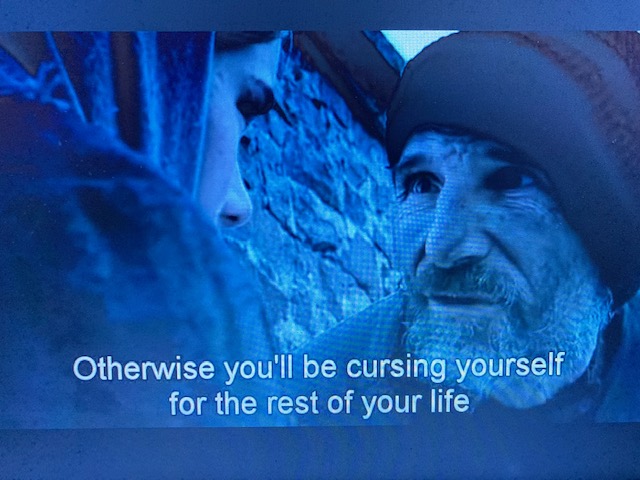
 "The Island" is a 2006 Russian biographical film about a 20th century Eastern Orthodox monk. Pyotr Mamonov, who plays the lead character, formerly a rock musician in the USSR, converted to Eastern Orthodoxy in the 1990s and lives now in an isolated village. Film director Pavel Lungin said about him that "to a large extent, he played himself." Mamonov was first very hesitant to play in the film, but then was urged by his confessor to play the character. After the filming, one of the movie crew staff decided to stay on the island and live there as a hermit.

Here's a great scene (in stills) of the starets (the holy fool) giving some straight talk to a pregnant teen who seeks him out:


Tuesday, June 28, 2022

Some Thoughts On The Trades


I have worked in the field of higher education for the past twelve years. Like most people in the admissions and enrollment management field, I fell into it, transitioning out of social services and starting part time as a transcript processor and transfer credit evaluator at a community college, moving onto being a road warrior for undergraduate admissions, and for the past eight years have worked at the graduate level at a public institution. When I give admissions presentations, I talk about the "graduate wage premium"--that is, the ROI on investment when aggregated over the course of one's career earning potential. The institution where I work is reputable and competitive in terms of tuition rates. I don't feel like a used car salesman because the "product" I "sell" has value, which is nice. 

That being said, I fully believe not everyone should go to college. And that's perfectly okay. The skilled trades are a field I don't have much experience with personally, though my trajectory was set when I was 17 and I lost the battle with my father (I wanted to become a carpenter, he said I was going to the local state university). My parents are both college educated.

My neighbor across the street is a union carpenter in his mid-fifties. He hasn't been working much lately because of injuries, though he has been doing some side gigs after multiple surgeries and physical therapy. I also have a buddy who is a (non-union) electrician, who I was chatting with tonight. When I asked him, "what would you tell a kid who asked whether he should go to college or learn a trade?"

He said they should get some college, but that you can also make a good living in the trades. "It will be just that, though...a living." Meaning, you're going to work. "There's also a salary cap, unless you work for yourself." His father was a union electrician his whole life. "The pay is better, better wages, better retirement and benefits, but...you don't always work. A lot of times it's six (months) on, six off. You may be making much better wages, but there's always that possibility you're only working half the year. I do better than most electricians." But he's also had his shares of injury and joint replacements. He's 41, with 22 years in the field. "It takes its toll"

My kids can go to university for free if they choose to, so we have to take that into account when it comes to what they want to do and where their aptitudes lie. Community college in our area (if we didn't have that benefit) is also very affordable. It is an investment, of time and money. I've always told friends and people who ask that if you can, do the two years at cc and get your core and electives done, transfer to a four year and max out at 18 credits (you pay the same at the undergraduate level whether you are taking 12 or 18 credits). I graduated in three and a half years, taking a few summer classes at cc (my mom taught at a community college, so I could take them for free), and also maxing out my load during the academic year. The "college experience" today is overrated. If you can, commute and live at home. You have to be careful about student loans, but even if you do have to take them out, work your ass off to pay them off quickly. 

The joke of majoring in "Underwater Basket Weaving" or "Gender Studies" is a predictable joke, and not without merit. There are a lot of majors which are more indoctrination than education. But fields like accounting, engineering, statistics, computer science--these ain't that. But majors like English and Philosophy are not "useless." If you can learn to write, to reason, to think critically....these are transferrable skills. But again, this isn't everyone's cup of tea. If it is, and you can afford it or make it work, higher education may likely pay off for you in the long run.

Anyway, I digress. I found some interesting comments from various reddit threads that I thought were worth sharing. I don't share them to dissuade anyone from going into the trades. God knows we need them. But there are things you need to consider as well, that don't always get talked about: when your body gives out in your mid-forties, what are you going to do until you reach retirement age? Can you have a back up plan? What if you get injured, which is always a possibility?  What is the whole-picture of your total compensation? What if your industry gets outsourced? Can you retrain easily? Among other things. 

Here are the comments I found interesting, often coming from those in the trades themselves. I have nothing but respect for those in the skilled trades, but it's worth getting the whole picture. I share them without judgement, for consideration:


"Trades are notably evangelized by online "experts" who notably went to college and would never go into the trades themselves. The high wages promised are only obtained by the small subset who are able to start or acquire highly successful businesses (as opposed to the majority, who are employees or journeymen), continued employability is constantly threatened by minor changes in prevalent materials or equipment making skills obsolete, and retirement has to come early due to the strain trade work puts on one's body.

In short, people decide against going into the trades for the same reason they don't go into sports or entertainment, a knowledge that not everyone gets to be Clayton Kershaw or Beyonce and that even those two are on borrowed time.


————-


Maybe this is a good idea, but as someone who's dad was a plumber (who probably gave himself heart failure from having to work so damn hard to keep our house from being foreclosed on)* and who has himself worked with his hands until they bled, the blue collar LARPing so many Catholic intellectuals engage in really irritates me. They have no idea how privileged they are to be able to engage in manual labor (and pontificate about it) as a sort of hobby and they give no indication that they have any idea how hard life as a tradesman can be.**


*I think the best example of this was when he had a pacemaker put in on a Thursday and then was crawling around under people's houses on Monday, even though the doctors had told him he couldn't lift his arms above his chest because he might pull the leads out of his dying heart. He had to though, otherwise we wouldn't have eaten.


**Yes, I know being a tradesman is an important vocation and that college isn't for everyone. My complaint is only about the way certain Catholic intellectuals talk about manual labor.


—————


It's because reddit skews young.


It's very, very common for people between the age of 20 and 30 to question their career choices, to ask whether adulthood is what they expected (it usually isn't) and then whether adulthood could be different somehow. They're used to coming off of their adolescent and teen years where everything changed every few years, on a track, and when they first go into the open world without a track they question whether the track was the right on in the first place. It's a common quarter life crisis, and everyone deals with it in their own way.

Trades work allows for people to make money earlier with less up front commitment. Comparing a 25 year old with 5 years of work experience and no debt, versus a 25 year old with 2 years of work experience and six figures of debt, it's very easy to say "man college made that guy worse off."


But if you look at a longer time frame, people with college degrees tend to do better over time, because the income trajectory of college educated workers plateaus later and higher. Their credentials are also generally more marketable for switching industries mid-career, which gives them resilience against recessions and localized crashes, and allows them to jump onto the hot new industry. So somewhere around 30, most white-collar college degree holders pass up their blue-collar trades counterparts.


And then when health issues start kicking in, not necessarily from the job, but just growing old, blue collar workers find that they're not able to do the job as well. A car accident, a sports injury, or an ordinary slip and fall can take a blue collar worker out of work and put on disability coverage for a few weeks or months, whereas a white collar worker might just need an accommodation in the office. Throw in actual on-the-job injuries, or repetitive stress injuries, and you'll see that a lot of the older workers have to leave long before retirement age. And most of the time, disability insurance for blue collar workers comes through union CBAs, so non-union blue collar jobs actually bear a lot more risk of interrupted income. Through in the fact that a lot of the industries served by the trades are cyclical, and you might see that the typical tradesman spends more time unemployed between the ages of 20 and 40 than the typical office worker.


And so you might have former tradesmen who are making less at the age of 50 than they did at 30. That's less common among college educated office workers. And for those who line up cushy jobs and choose not to retire at 65, but instead keep extending it to 70 or 75 or even 80, those are usually very high paying jobs that can still be done by 60-somethings. The trades don't produce those types of jobs.

Blue collar work is great. There are actually a ton of blue collar jobs that require college degrees (stuff out in the field), and combine the idea of working with your hands with working with your brain. And union representation can get strong contractual protections and income and retirement for workers. But the actual trades versus college debate is a little bit different from that, and asking a 25-year-old which is better will often get a very different answer from a 35-year-old, a 45-year-old, or a 55-year-old."


 What do you think? Feel free to comment. This is a "safe space" lol.

Monday, June 27, 2022

The Two Lungs of the ProLife Movement


Pope St. John Paul II described the unity of the Church, saying, “The Church must breathe with her two lungs!” Here, he speaks of the mutual interdependence and healthy tension that should exist between the East and West so that the Church, as a whole, fully can benefit and her mission become more effective. In Fides et Ratio (1998), he spoke of faith and reason, which "are like two wings on which the human spirit rises to the contemplation of truth; and God has placed in the human heart a desire to know the truth—in a word, to know himself—so that, by knowing and loving God, men and women may also come to the fullness of truth about themselves" (cf. Ex 33:18; Ps 27:8-9; 63:2-3; Jn 14:8; 1 Jn 3:2).

The pro-life movement is in the spotlight now that RvW has been overturned; the truth is, the pro-life movement itself has these two lungs, two wings, in which the truth--the flowery truth that all life is sacred and begins at conception, and the unsavory truth that abortion is the taking of a human life--is communicated, often in trying and unfavorable circumstances.

I have friends who are fervently pro-life, but approach the "issue" of pro-life (issues are theoretical though, and not the best term to use when real lives are at stake) from different angles. I have friends who, on the one side, devote their time, energy, and resources to sidewalk counseling--attempting to change the minds and hearts of women seeking abortions ("Love them both") in a few precious moments before they walk into the mill. They offer literature, resources, love, encouragement, hope...anything to make them reconsider the tragic mistake they are about to make that will alter their lives irreparably forever. This is the model 40 Days for Life has adopted, and there have been many "saves" from their efforts (in rain, snow, and unbridled animosity hurled at them)--a baby that gets to live, and a mother who had the courage to give their child a chance to live it.

I also have friends who may from the outside be seen as a more "militant" wing. Their signs are gruesome and graphic, because abortion is gruesome and graphic, and they hope to counter the lies of the abortion industry that seeks to gloss over the reality of abortion. "Clumps of cells" do not have eyes, fingers, toes, and organs. Some "cross the [literal] line" and put themselves between the abortionist and the women, offering them roses (Red Rose Rescue), and doing anything within the power while risking arrest to save a life. Their work is admirable, if not without controversy in the press (which doesn't understand what is truly at stake from the vantage point of these pro-life warriors). They are branded as terrorists, agitators--whatever can be used to distract and deflect from what is actually taking place: a global holocaust of innocent life. 

These are battles in the war being waged, and each battle has its own tactics and merits. I am involved only peripherally with both camps, but part of my struggle is seeing as if one is "the right way" and one is not. In reality, though, I think they are two approaches that have merit and are needed. I may be inclined more towards one than the other based on temperament and personal discernment, but the only "wrong way" is to not do anything. Even if prayer is your weapon, use it. Even if you can't be on the sidewalk every day rain or shine, but can go once a month, go once a month. If you have other gifts (financial, talents, etc), use them rather than burying them. If you speak or write truth, you may mobilize a mind and heart that works for greater things years down the road.

One unfortunate thing (as an outside observer) is in-fighting. I can't speak to this, but I'm sure it happens. It happens with liturgy, it happens with politics, and I'm sure it happens in the pro-life movement. There is no "one way" to win this war. And Yahweh Sabaoth is the one who leads. We are simply the foot soldiers, taking orders and doing the brunt work. Some are generals, some are officers, some are ground troops. 

When I was in college, the "Williard Preacher" would stand outside the Williard building on campus and preach repentance. Rain or shine, cold weather or hot, day in and day out, for years. He was old school, but he was dedicated, which I'll give him credit for. I don't know how many hearts he changed, but if a person was "cut to the heart" hearing their need for repentance and turning away from sin and need for Jesus Christ, I would think that would be a win in Heaven. Maybe this is what the "graphic" sign holders who bring light to the holocaust are doing. How effective it was, I can't say. That's for God to judge. 

Also in college, there was a couple (the husband became a deacon, eventually) who befriended me, invited me to their home for dinner (I had only been Catholic for a year), encouraged me, etc. That also was a way to preach the Gospel and build up a person, one at a time. It wasn't any kind of official "ministry"--just kindness and encouragement. Maybe this is what sidewalk counseling is like. How effective it was, I can't say. That's for God to judge. 

If anything, RvW's overturn has knocked down the fence posts--there's no fence sitting anymore. Where someone stands on the fundamental issue of life will tell you a lot about a person. But that doesn't mean their hearts can't change. That's a grace in its own right, and it belongs to the Holy Spirit. 

But the agents, the soldiers on the ground doing the work of fighting for the right to life--rather than the right to end it--will at least have the scars of vitirol, arrest, and weariness covering their bodies from the battles waged here on earth when they come before the Lord. 

It's the lack of scars that should concern one getting ready to face their judgement. Something I need to pray about myself.

Why Do I Write?

There was a song in Good Will Hunting by Luscious Jackson titled "Why Do I Lie?" It's catchy, I like it, and I liked the movie when I saw it twenty years ago. It also reminds me of one of my favorite and meaty passages of scripture, Romans 7, where Paul asks "Why Do I Do That Which I Hate?" So apropros. 

It's good to take stock of why we do the things we do from time to time. A smoker might ask themselves "why do I smoke?" Or an over-eater why they overeat. Because I'm anti-social? Because I lack confidence? Because I need a bit of pleasure here and there through vice? Because I'm anxious? It helps us get to the root of our motivations, why we do the things we do. Most people go through life with little self-reflection, and so find themselves trapped in cycles of self-perpetuating habits.

Writing is no different. I was thinking about it this morning and came up with a few reasons as I reflected on them.


Charity

I try to write as an act of charity, first and foremost. My hope has always been to do the work of an an evangelist, but my writing has shifted over the years to also trying to fortify the people of God in their own walks. Not by prescribing anything, but as an act of solidarity from one sinner to another. To give witness to the love of God, and grace. As St. Paul says, "in preaching the gospel I may offer it free of charge, and so not make use of my rights in preaching it" (1 Cor 9:18). This is because I have been forgiven a debt, and the debt I must work to repay.


Penance

Writing is less a penance than something I just do--neither pleasurable nor painful. But as above, God has entrusted some kind of talent in me, that I'm apt to bury, but just can't. So, the goal is to multiply it for His glory. That means if any of it is about me, it is only as a subject, not a focus. Defer, deflect--all glory to God and the Gospel. I could think of worse penances. 


Compulsion

There could also be worse activities of compulsion: gambling, drug use, etc. Compulsion is a strong force; even when we want to stop, we can't sometimes except by a monumental act of the will. As Jeremiah lamented, "I will not mention his word or speak anymore in his name,” his word is in my heart like a fire, a fire shut up in my bones" (Jer 20:9). This is what writing is for me. A shame and a glory. A fire and a scarring. A hot potato that needs to be passed to someone else, lest it burn your hands.  Paul said he was "compelled" to preach the Gospel (1 Cor 9:16). He fears if he does not. Maybe that is what I mean by compulsion.


Encouragement

I am not a good friend. But Sometimes I can be a cheerleader for the faithful of Jesus Christ, even though I get burdened myself. That's when it gets tough, and doubt creeps in. "What you have heard from me through many witnesses entrust to faithful people who will be able to teach oth­ers as well” (2 Tim 2:2). I don't sleep a whole lot, and think, chew cud, process, discern, and spit out. What's there is, I figure, maybe of use to others who may not have the time to digest the weighter matters of faith. 


Vanity

This is becoming less of an issue the older I get, but I did want my name out there for a while. This has faded, as Ecclesiastes notes, "all is vanity." So much vanity out there, a vice we're not often aware of. It goes back to that self-reflection: why do we do the things we do? Jesus says to not let our left hand know what our right is doing. This is good, because as I've said on more than one occasion: you're not that important. People can live without your insights. It keeps me in my place. Deo Gratias. But affirmation is my love language, so it's an ongoing struggle. 


Connection and Community

I also like to connect people together by way of degree. Maybe my writing can serve that purpose, string disparagent people in different isolated circles together. Seven degrees of Kevin Bacon and all that. Again, all for the sake of the Gospel. There is solace in knowing you are not alone--especially if you've felt the acute pain of loneliness, as I have, even in the midst of others. Feel free to use the blog as a well of sorts to meet and discuss. Comments are always open.


Education

I'm not an especially educated person, but I used to read (a lot!) and think about things, and there is so much to learn in the Church you will never plumb the depths. That is a great gift to have such a bottomless well of grace and tradition and history. I'm just scratching the surface and offering the flakes for others.


 Legacy and Remembering

I write to remember. For better or worse. I want to leave a legacy for my children. My wife has aleady threatened to print and compile all 600 of my blog posts from the past few years for them. I do it for me. For the Lord. But also for them. Lord, just let it be after I pass, though. It's too embarrassing otherwise. Let it be a kind of knit-blanket from their father they can keep to remember me.


Working Out My Demons

I write to process. I talk things out with my wife and friends, too, but writing is where I do it alone. It goes back to that question of "why do I do that which I do?" I have time to think and digest, and throw it up on a page for later. To go back to, maybe, to learn and more forward. Breadcrumbs for my family, and my own consciousness. I struggle sometimes, a lot. It's for me, not anyone else. But I'd rather it be used than sit rotting in a diary somewhere. I've benefitted greatly from the honest humanity of others. Maybe I can pay it back someday in the same way.


Glory to God

All glory belongs to God. I didn't ask for this. I don't know why I do it. But He does and he knows what He is about. Just use me Lord, as embarrassing as it is. Just don't let it be about me. Take it all and make it new.


On The Lack of Solace And Comfort


"It is not hard to spurn human consolation when we have the divine. It is, however, a very great thing indeed to be able to live without either divine or human comforting and for the honor of God willingly to endure this exile of heart, not to seek oneself in anything, and to think nothing of one’s own merit.


Does it matter much, if at the coming of grace, you are cheerful and devout? This is an hour desired by all, for he whom the grace of God sustains travels easily enough. What wonder if he feel no burden when borne up by the Almighty and led on by the Supreme Guide! For we are always glad to have something to comfort us, and only with difficulty does a man divest himself of self.


The holy martyr, Lawrence, with his priest, conquered the world because he despised everything in it that seemed pleasing to him, and for love of Christ patiently suffered the great high priest of God, Sixtus, whom he loved dearly, to be taken from him. Thus, by his love for the Creator he overcame the love of man, and chose instead of human consolation the good pleasure of God. So you, too, must learn to part with an intimate and much-needed friend for the love of God. Do not take it to heart when you are deserted by a friend, knowing that in the end we must all be parted from one another.


A man must fight long and bravely against himself before he learns to master himself fully and to direct all his affections toward God. When he trusts in himself, he easily takes to human consolation. The true lover of Christ, however, who sincerely pursues virtue, does not fall back upon consolations nor seek such pleasures of sense, but prefers severe trials and hard labors for the sake of Christ.


When, therefore, spiritual consolation is given by God, receive it gratefully, but understand that it is His gift and not your meriting. Do not exult, do not be overjoyed, do not be presumptuous, but be the humbler for the gift, more careful and wary in all your actions, for this hour will pass and temptation will come in its wake.


When consolation is taken away, do not at once despair but wait humbly and patiently for the heavenly visit, since God can restore to you more abundant solace.


This is neither new nor strange to one who knows God’s ways, for such change of fortune often visited the great saints and prophets of old. Thus there was one who, when grace was with him, declared: “In my prosperity I said: “˜ I shall never be moved.’” But when grace was taken away, he adds what he experienced in himself: “Thou didst hide Thy face, and I was troubled.” Meanwhile he does not despair; rather he prays more earnestly to the Lord, saying: “To Thee, O Lord, will I cry; and I will make supplication to my God.” At length, he receives the fruit of his prayer, and testifying that he was heard, says “The Lord hath heard, and hath had mercy on me: the Lord became my helper.” And how was he helped? “Thou hast turned,” he says, “my mourning into joy, and hast surrounded me with gladness.”15


If this is the case with great saints, we who are weak and poor ought not to despair because we are fervent at times and at other times cold, for the spirit comes and goes according to His will. Of this the blessed Job declared: “Thou visitest him early in the morning, and Thou provest him suddenly.”16


In what can I hope, then, or in whom ought I trust, save only in the great mercy of God and the hope of heavenly grace? For though I have with me good men, devout brethren, faithful friends, holy books, beautiful treatises, sweet songs and hymns, all these help and please but little when I am abandoned by grace and left to my poverty. At such times there is no better remedy than patience and resignation of self to the will of God.


I have never met a man so religious and devout that he has not experienced at some time a withdrawal of grace and felt a lessening of fervor. No saint was so sublimely rapt and enlightened as not to be tempted before and after. He, indeed, is not worthy of the sublime contemplation of God who has not been tried by some tribulation for the sake of God. For temptation is usually the sign preceding the consolation that is to follow, and heavenly consolation is promised to all those proved by temptation. “To him that overcometh,” says Christ, “I will give to eat of the Tree of Life.”17 Divine consolation, then, is given in order to make a man braver in enduring adversity, and temptation follows in order that he may not pride himself on the good he has done.


The devil does not sleep, nor is the flesh yet dead; therefore, you must never cease your preparation for battle, because on the right and on the left are enemies who never rest.


(Imitation of Christ, Book 2, Chapter 9)

Sunday, June 26, 2022

Why Are You Here?


For some reason today I really felt the weariness of Elijah the man of God, in reading 1 Kings 17-19. 

In chapter 17, Elijah proclaims a drought on Yahweh's authority. This is set up in the shadow of King Ahab's coming to power, who "did what was evil in the Lord's sight more than any of his predecessors," marrying the wicked Jezebel and serving Baal (1 Kings 16:30-34). After proclaiming the drought, the Lord sustains him in the Wadi Cherith, where he drinks and ravens bring him bread and meat. When the wadi runs dry, he goes to Sidon at the Lord's command, and demands a widow with her last morsel of food make him a cake. This widow was fully planning to eat and drink her last pathetic meal, and then succumb to death. The Lord, however, worked through the Elijah to ensure her flour and oil did not go empty. When her son falls sick and dies, Elijah brings him back to life (17.22). 

In chapter 18, the mighty prophet Elijah proves his mettle in going toe to toe with the prophets of Baal. King Ahab claims Elijah is a "disturber of Israel" (a nation that has gotten comfortable with worshipping both Ball and the Lord of Hosts), and Elijah fires back unapolgetically that it is the King who disturbs Israel by following the Baals (18:18). He demands the 450 prophets of Baal be summoned to show these his people--these "fence sitters"--who is Lord and God. He works a fantastic miracle by God's power, deferring to the priests of Baal to arrange their bull themselves for holocaust, and drenching his own alatr in water. He embarasses the prophets of Baal by their impotence, and the fire of the Lord consumes Elijah's saturated offering, proving beyond doubt that the Lord is God, and there is no room for the abobination of idolatry in his midst. Then he rounds up and slaughters the priests of Baal. 

In chapter 19, Elijah is spent. The last remaining prophet of the Lord in a land of abomination (18.22), and having worked mighty miracles and standing up to King Ahab and the 450 pagan priests, you would think he would have been fortified. Instead, he fears at the words of Jezebel who sought his life. He prays for death. "Enough, Lord! Take my life, for I am no better than my ancestors" (19.4). He rests a while, and eats and drinks the angelic rations provided to him; it is enough to strengthen him to make the 40 day trek to Mt. Horeb. When he arrives, he recountes all he has done for the righteousness of the Lord. And yet, the Lord asks him twice, 

Why are you here, Elijah?


Why are you here? I often pray the prayer of Samuel, "Here I am!" (1 Sam 3). It's short, to the point, and affirms a readiness to listen and serve. It affirms the zeal of Elijah, the last prophet standing, to do what is commanded.

But I'd be lying if I didn't have my moments where I also prayed the prayer of Elijah, the man of God: Lord, let me die. It is enough. You get weary. You get spent, discouraged, disgusted. There is the natural expiration of the widow--"let me eat my last meal and die" when her food runs out. But the longing for death by the prophet goes deeper: he is not let off the hook. Not permitted to expire while there is still work to do. He sees it as a respite, a temptation even. But then he shows up to the mountain, and the Lord asks him, Why are you here? Elijah, why. are. you. here?

This needs to be separated from the so called "dignity" of assisted suicide, in which a person desires to leave the earth by their own hand, to be the commander of their destiny, or to avoid the indignity of suffering and loss of bodily functions. Whatever the reason, a Catholic cannot follow this line of reasoning. The Lord is the author of life, and He determines when it ends. We cannot intentionally end our lives by suicide because it is not for us to decide. 

That being said, my wife and I have discussed if we were given a terminal diagnosis (cancer, say), is it permissible as a Catholic to refuse chemotherapy or other things that simply prolongue the inevitable? What is the right thing to do? This is why we have the Catechism but also bioethics to help explore and seek to answer these sometimes grey and complicated questions. I have caught myself on more than one occasion "Please Lord, if you want to take me, just take me. I love my wife and kids. But there's not much keeping me here except the work you need me to do. If you need to keep me around to do it, I will. But Lord, give me death, as long as I can be with you forever."

Why are you here? Speaking to myself: If it is to do the work of the Lord, then get back to it and quit your memento mori daydreaming. If you need a rest and a snack, so be it. But you're not going to get off easy. This is the weariness of the disciple, when he forgets the joy of following the precepts of the Lord and only tastes dryness and never ending expansiveness of the road. 

Why are you here? Lord please let me die. This world holds nothing for me, and it would just be so much to leave it behind. I'm tired. Take me how you choose, send what you will. Just let me not defect from your word. Lord I long for death, the respite from this life, but not my will but yours be done.

Why are you here? You worked miracles through Elijah, showed your mighty Hand, slaughtered the priests of Baal. I have done nothing, accomplished nothing, but I keep going out to the fields, your fields to do the work. Elijah calls down fire which consumes soaked wood. I pick grapes, one by one, fill my basket because you tell me to. I try not to complain, but then I find myself hot, thirsty, sunbruned...and the complaining finds me. When will the work end, Lord? How long, my life? Can't I be with you now? I don't know how. I seek you in this life and am covered with noise, blasphemies, and idolatry at every turn. I am here because I want to see your holy Face, do your will. How long do I have to stay here? How long, O Lord?