Showing posts with label home life. Show all posts

Tuesday, November 28, 2023

Saying No To Good Things


As a married father living “in the world,” I’m aware that the period between Thanksgiving and New Year’s seems to operate at warp-speed. People on the roads seem impatient, there’s always something to do and somewhere to be, and folks are feeling stretched thin. It may be culturally driven as consumerism naturally ramps up during this time frame, but as Catholics we are also entering into a new liturgical cycle as well. If we’re not careful, we can get robbed as the simple and beautiful anticipation of Christmas—Christ born in a manger—becomes one more thing to “get through.” 


Because we homeschool our three children, we are blessed with more time than we would otherwise have if our kids were in school. But if I’m being honest, there is no shortage of activities and opportunities in our circle: from sports to theater to poetry recitation, nature study, field trips, youth-group—our kids are probably overly-socialized! While my wife is a true introvert, and we are more or less homebodies (when we have the choice), I consider myself an “extroverted-introvert.” I genuinely like connecting with people one on one, but don’t tend to gravitate towards large gatherings as much. 


We do, however, guard our family time and try to make sure we have amble unstructured “down time.” This concept of “white space”—space that has value in and of itself, not simply time that isn’t filled up with something, was something I wrote about in “The Space Between”:


“Musicians know that the space and tempo between notes is just as important as the notes themselves. Artists need to make use of negative space to contrast and accentuate the form and color that is on the canvas. Writers need to make the words on the page count, and not use too much filler. The comedian and rhetorician knows that timed pauses and strategic silences are just as important as the punchlines themselves. And every saint has found that 'time away' in private prayer, akin to Jesus' retreat to 'lonely places' to commune with his Father, is indispensable to counter-balance active ministry. White space--the space between--has value in and of itself. It's lack of defined substance is, by its very nature, where its value lies.”


Part of this “guarding” is in the interest of self-preservation; but I have also felt as Catholic Christians, we need to be good stewards of our time so that we are not spending it all on ourselves or our children; we should be making ourselves available to others, and in service to those in need. I came across a quote somewhere that was very convicting, since as Christians are fundamental vocation is to love: "Love and hurry are fundamentally incompatible. Love always takes time, and time is the one thing hurried people don't have."    


In trying to maintain our balance, but also while seeing everyone around me so jam-packed with things to do, I have been thinking about this “epidemic of busyness” lately. To see if I was the only one, I reached out to a friend of ours who is a homeschooling mom of seven to get another perspective and who graciously gave me permission to use some of her insight for the purposes of this reflection.


“Even in the faithful Catholic world full of people stumbling along learning to express their cultural Catholic identity, there is this tendency to imagine every feast day is important to celebrate every time. Everything must become a tradition or activity or event. But no one was making a big deal out of St Patrick AND St Lucy AND John the Baptist AND St Anthony AND St Nicholas AND….


Don’t get me wrong. I love reading Sigrid Undset and being immersed in that medieval world where Christianity permeates the culture so much that the liturgical year was how time was marked and measured by everyone. It is beautiful.


But I think there is a temptation to take this modern tendency toward busyness and try to sanctify it.


Also, I think that formal activity has taken the place of casual/organic activity. As cultures shifts to one with fewer children overall, fewer stay at home mothers, and less shared culture and community, we don’t chat with other mothers out hanging their wash or play pick-up games in the neighbor’s yard.


I remember a priest who grew up in the city describing how drastically air conditioning changed the neighborhood he grew up in. Neighbors used to spend summer evenings cooling off on their front porches, which inevitably involved socializing with neighbors. But once everyone started getting air conditioners, they spent their summer evenings inside.


So, in some sense, I think our culture of busyness is an attempt to compensate for lack of community, poor neighborhood planning in the fifties, no sidewalks or front porches, and lack of a shared culture. The organic framework that used to exist for exactly what you describe (just come in for tea, let’s help elderly Mrs M with her home maintenance, etc) has left us making stuff up from scratch. 


But also, there is a lot of FOMO going on and parental guilt. It can be like keeping up with the Joneses and imagining that our children are being deprived of something if we say no.


“I listened to some wise women back in the early days of the internet on Catholic homeschool forums and such. There was an emphasis on guarding the margins of your time and the reminder that it will mean saying no to *good* things. That is something I was able to take to heart. Our current world offers so much excess, and perhaps that includes excess of opportunity.”


I thought that was really insightful. For many of us, our intentions are good; we’re doing the right things while fighting an uphill cultural battle. Many of us are trying to restore a traditional faith life we were never given a blue print for, and through trial-and-error doing the best we can. But the isolation, the social fracking, is real. Exhausted moms try to curate some community in their spare moments through digital means (Facebook, chat groups, etc) because of geography. Busy dads in careers find that they are too spent at the end of the week to do much of anything, let alone get together with other men. We are a lonely generation, but for many of us we are trying to restore the health of the social soil which has been stripped by the bulldozer of modernity. And so we can sometimes over-compensate, as my friend mentioned, with “all the Catholic things” because we don’t have the benefit of those simple organic bonds that were taken for granted in previous eras. We’re trying to figure it out as we go. 


As you get older, you realize time is currency; we’re all on borrowed time, and what we spend it on becomes more important and worthy of daily discernment. We pour into our children, sometimes neglecting our spouse. We focus on our family, sometimes failing to pour into our community and those in need. We focus on the material, the tangible, the schedule-able at the expense of the “useless” unstructured time and space needed for creativity, availability, and yes, even boredom. We often don’t even think that a phone call or a visit to someone who could use it is even possible, given our schedules. These aren’t big things, we just miss them.


As we enter into this reflective time of Advent, where we anticipate the coming of the Christ-child, it may be worth taking an inventory of our greatest asset—time—to see how we are spending and investing it so that we do not end up like one of the foolish virgins who miss the Bridegroom when he comes. And to make that necessary space and time, that may mean saying no to even “good” things.


Tuesday, September 19, 2023

What Cast Iron Cookware Can Teach Us About Faith And Life


A couple years ago I wrote a post on why we use cast iron to cook with. This was kind of a strange post for this blog, given the home-maker nature of the topic (I also wrote one about linen towels). But I'm going to double down and extol the virtues of this time-tested cookware once again, but scratch a little deeper beneath the surface of the kitchen into the foundation of the house. 

First things first--I'm the primary cook in our home. I hate cleaning (which my wife doesn't mind, thank goodness because I make a mess of things), but I don't mind making meals, so it's just where the chips fell in our marriage. Being that this is my primary domain for the majority of meals, I get to choose what I want to use. And I've used everything in terms of cookware--stainless steel, aluminum, Teflon. I don't know how I got turned on to trying out cast iron (it may have been when I purchased a stand-alone induction burner), but I'm glad I did because I've grown to love it.

The thing about tradition and traditional things is they are time-tested. They're not always flashy or sexy or nuevo, but they get the job done. Sometimes there are better ways of doing things which technology can benefit--I like having fuel injectors in my car rather than carburetors; I appreciate laptops versus desktops or typewriters. But let's be honest here--the time of craftsmanship has gone away. If you've ever watched new construction homes being built, they are slapped up with pine 2x4's and OSB, clad in cheap vinyl, with no thought to anything but maximizing profit and minimizing cost. Homes over one hundred years old were built much more solid. Churches, no contest. And, yes, planned obsolescence is a real thing. So, I'm not a curmudgeon, but I think there's something to be said for the lost-arts when people built things to last and took pride in their craft.

I think cast-iron falls into this category, which is why I considered it "Trad-approved." But there are some parallels to traditional cookware and a traditional faith and life. I'm not interested in virtue signaling or needing to trad-flex for Instagram. I'm tend to be pretty pragmatic when it comes to these things. Does a more traditional faith or Mass help to ensure the transmission of our religion to our children? Then count me in. Does it foster reverence, piety, a fear of God? That works for me. 

But enough with the philosophizing. Let's get down to the nitty-gritty with the random topic at hand: what cast iron cookware can teach us about faith and life.


Built on rock, not sand

In scripture, our Lord says the one who hears Christ's words and heeds them is like a man who built his house on rock, rather than sand (Mt 7:24-27; cf Lk 6:48)). He names Cephas Peter, "Rock." David refers to the Lord as his "rock, his deliver" (Ps 18:31). Rocks are solid, unbreakable, built to last. 

You can beat the hell out of cast iron and it can take the abuse. Heck, you can beat hell out of someone with cast iron, and do some real cranial damage. It doesn't scratch. It doesn't bend or break. If you drop it on your tile floor, you'll probably need to replace some tiles. 


It's doesn't waste heat, but is resourceful like the woman of worth

In Proverbs 31, we see a woman, a wife, of noble character and great worth. She works hard and is resourceful. "Charm is deceptive, and beauty fleeting," says the King, "but a woman who fears the Lord is to be praised" (Prov 31:30). In other words, she brings benefit to her husband and family--she gives and creates and multiplies, rather than taking and squandering. 

What's neat about cast iron is it holds heat incredibly well. And that heat that is held is used for its purpose--to cook food. When I cook rice, I turn the stove on (yes, I have an electric stove, and no, I don't worry about the government turning it off remotely on me) for about five or ten minutes, and then turn it off. The rice continues to cook for a good half hour unsupervised. It doesn't scald. It radiates nice and evenly--almost like a crock post or a radiator. Which brings me to my next point.


Patience

Cooking with cast iron takes an adjustment of our expectations. Cooks in 5-star restaurants need to run over meals quickly, but in the home we have more time (usually) and can enjoy the process. Because it is so heavy, cast iron heats up slowly and holds heat. This can mean sometimes longer cook times, if you want to fry a quick egg or boil water (unless you are using induction). Is that such a bad thing? Cooking can be a chore, but it can also be a way to be together, enjoy doing simple and fundamental things, and take our time. 

It's like Mass. We can "git r done," or we can enter into the experience as part of life, not something we "have to do," but something we get to do. If a solemn high mass with a schola takes an extra half hour of our time, is this time we are robbed of? Of course not. 


You have to care for it

Cast iron is not without some drawbacks. If you soak it for a while or leave it outside, it will develop rust. It's non-stick properties can rival Teflon, but you have to heat it in the oven or stove-top, and season it periodically with vegetable oil. 

Like our faith, which we need to nurture and work at. Daily mental prayer, adoration, exercise of charity, rooting out hidden faults, reception of the sacraments, examination of conscience are all part of living our faith. It takes extra work, just as you prune and fertilize a tree to maximize fruit production. 


It's overlooked and cleans up well

Cast iron pots can be found at thrift stores for ten dollars and last a lifetime. Sometimes they are rusty, but the "bones" are good, and the rust is easily cleaned off with vinegar or lemon juice. 

In scripture, we see the man who finds a pearl of great price and runs home to sell everything he has in order to buy it. He knows it's worth. He also sees its potential. God, too, does not see our rust and neglect and trauma, but our heart. He pulls us out of the miry pit and sets us on a firm foundation (Ps 40:2). He washes us of our sin with his own blood, makes our garments white as snow (Is 1:18). And once it's cleaned up and set aright, it has the potential to prepare hundred of thousands of meals for the rest of it's life. It will never wear out, never run dry (Jn 4:1-26). 


It eschews the disposable mindset

Like I said, you will rarely see cast iron on an As Seen On Tv ad. It's not meant to be thrown out, but passed down through generations. When we are young, poor and unsettled it's tempting to buy the cheapest non-stick cookware at Walmart, the way you buy Ikea furniture. But in the end, the things that last come out cheaper in the long run. Even just having one or two nice pots or knives is better (in my opinion) than having an arsenal of low-grade equipment.  

Additionally, the Faith is not meant to peter out after it becomes passe or unfashionable, but to endure from generation to generation (Ecc 1:4). That means it needs to be true to its nature, focused on it's eternal worth, and not prone to whims or trends. Even if it does find itself neglected or abused, a wipe down with an acid and a sheen of oil will restore it to its former glory--just like the worst sinner is only one confession away from a restored friendship with his creator.


I hope you enjoyed this random post. The next time you go to Goodwill, check the shelves for a rusty old cast iron pot or skillet and see for yourself what I mean. As the Lord says, "Test me in this." (Mal 3:10). 

Thursday, August 10, 2023

All Hail King ALDI


When I was growing up, my dad always did the grocery shopping for our family. This was not very conventional, but then again my dad was not a very conventional man.

I continued this tradition in my own family, for whatever reason. Unlike my father (who I think cooked a Taylor pork roll for himself back in the 1970's but was never known to prepare dinner for us; that was my mom's domain), I do about 80% of the cooking in our household, which I don't mind. I think it's because as a teenager I was up at 4am delivering newspapers, then school, then track or wrestling practice and by the time I got home I was starving. But we always ate late because my mom worked. So I probably subconsciously vowed when I grew up that I would take dinner-matters into my own hands.

I don't mind grocery shopping. At least now I don't, thanks in large part to a German grocery chain called Aldi. It wasn't always this way. I used to shop at the old-school, 1980's era supermarkets like Acme and Giant because they were close by and it was the bane of my existence. Prices were not competitive, lines were long and annoying, selection was sub-par, and the whole experience just sucked. Wegman's was a nice shopping experience (and Catholic owned), but it started to hurt the wallet; which is unfortunate because it was on my home from work). I don't mind picking up a loaf of bread or gallon of milk from Walmart, but I don't want to do all my grocery shopping there.

When I discovered Aldi, everything changed. It has literally been a godsend for our family, and I'm going to tell you why. But first a little history about the chain. 

The first Aldi store was opened in Germany in 1913, and came to the U.S. in the mid-seventies. “In the aftermath of the war, "scarcity and necessary frugality demanded the avoidance of waste," Dieter and Nils Brandes wrote in their book "Bare Essentials: The Aldi Success Story." "The principle was: less is better than too much. This applied to capital, personnel, size of stores." It sounds like the founding brothers were rather ruthless in their efficiency mind-set. 

The secret of the current Aldi model is in the details and mission, which squares with my own. I grocery shop with the same mindset I buy and use a car: to get from point A to point B cheaply, reliably, and efficiently.  I know a lot of big families swear by Costco, but after having shopped there a couple times with a borrowed membership card, I'm not sold (you buy in bulk, and the quality of food and meats is good, but the unit prices are not as competitive as you might think. I also hate the "mega-mart" warehouse feel) 

For those who may have shopped at Aldi, you may notice:

1) There are no "cart boys," since it's self-service. You pop a quarter into a cart to unlock it, and get it back when you return it. No biggy. 

2) The aisles are wide and relatively spacious. This is related to the next point, which is

3) Choice and brand selection is limited. I'd say 95% of items are Aldi brand. I have yet to buy something that was sub-par or lacking in quality, and that includes produce and meats. And I actually love the limited choice options for brands and things, since it's less I have to think about or mull over. Studies have proven that 'decision-fatigue' is a real thing. 

4) There are maybe two to three employees working in the entire store at any one given time, and that includes the check out people. They are expected to do many different jobs in the store, but from what I hear the pay is competitive and the working conditions are not too bad.

5) The check out people sit when they check you out, rather than stand. They are pleasant but don't make chit-chat, they just scan your dang groceries like lightening. 

6) There are hardly any lines, and if there are, they move very quickly. It's efficient, which I love. I have never waited in line for more than a couple minutes.

7) Everything gets placed in a cart, and you move over to an area where you bag your own groceries (I usually bring my own bags as well). 

8) I consistently spend almost 40-50% less on groceries than I would anywhere else. And no freaking coupons needed.


Grocery shopping is no longer an onerous, dreaded thing for me. It's in-and-out, with minimal wasted time, no choice-fatigue, no coupon-clipping or sales to think about. And I'm often coming in at less than $100 per trip for a trunk load of groceries (I usually go once a week or so). 

I'm glad Aldi gets people like me. We can afford to eat healthy and well. When you're on a budget, it's the little wins you're grateful for!

Tuesday, June 6, 2023

"That's The Good Stuff"

I saw this image the other night and it hit me right in the feels. It said very succinctly, in a kind of koan-type fashion, exactly what I have thought on many occasions, and how easy it is not be be present to the blessings right in front of you. 


Middle age is a tough time for dad. You're so focused on your career and managing things that time is at a premium. I try to balance having time for myself (time that my wife usually doesn't have as a luxury, admittedly), time with other men, time with my parents, time with my wife, time with my kids, time writing, and time in prayer.  

My wife was chastising me a bit last night for not being present with my kids when I have the opportunity. She's not wrong. She is a 'be-er' and I'm a 'do-er.' Every time I do have the opportunity to just 'be' I end up 'doing' something instead. Everyone knows that you can't substitute time together with other things and expect to have a healthy marriage. And the more time you spend with someone, the more you get to know them, and want to spend time with them. I feel like my kids pick up on that I am not as present with them as their mom is, and so they turn to other 'things' to fill the vacuum that I could be filling if I was more present.

There's an image I have, when I go out on the patio for some time to myself, of looking from the outside in while the rest of my family is inside. I've chosen to take time for myself, but I would be horrified if I tried to come back in the house and it was locked for some reason. Then you realize the place you really want to be more than anywhere, with your family, you're barred from, because of what you've chosen instead. I know it's just a moment but I don't want it to project as a future reality. Moments add up to days, and days to years, and before you know it if you're not careful, you can become a stranger in your own house.


My wife was telling me something she heard from Leila Lawler, some erudite wisdom on homemaking and childrearing, along the lines of "You don't 'make memories' for your children. They make their own memories." I don't know the exact context of what she was saying, but from what I surmised "the trip to Disney World," or "the birthday party" or whatever is often not the true memory. The memories are those snippets, those scraps of tapestry, that the children make for themselves. It could be the smell of the salt air, a song heard on the radio, laying on the couch with mom, or the salted caramel ice cream cone your dad treated you to.

We played a round of miniature golf yesterday, and walked over to the Wendy's afterwards to treat the kids to some frosties and things. It was "a great day" for them, and it wasn't because of the mini golf or the burgers or any one thing, but because we were together as a family. I don't make much money and I don't have any real professional status or standing. But I realized many people would kill to have what I have. My 'new core memory' as a dad that day was seeing them at the table as I ordered food, and realizing I am not a poor man, but instead very, very rich.


Robbin Williams has a great monologue in Good Will Hunting (part of which I heard was unscripted) when he's talking to the young Will about his deceased wife. 

"My wife used to fart when she was nervous. She had all sorts of wonderful idiosyncrasies. She used to fart in her sleep. One night it was so loud it woke the dog up. She woke up and went like "oh was that you?" I'd say yeah...I didn't have the heart to tell her...Oh God...[laughing]

Will: She woke herself up?

Sean: Yesssss....aahhh. But, Will, she's been dead two years and that's the shit I remember. Wonderful stuff, you know, little things like that. Ah, but, those are the things I miss the most. The little idiosyncrasies that only I knew about. That's what made her my wife. Oh, and she had the goods on me, too, she knew all my little peccadillos. People call these things imperfections, but they're not, aw, that's the good stuff." 


We are coming up on our thirteenth year of marriage, and I have plenty of those memories of my wife--the things that make her my wife. The time she dozed off looking at her phone and dropped it on her head; the particular sigh she makes which distinguishes whether she is angry or just tired, which would be lost on anyone but me; when she laughs and then accidentally snorts at the same time. I try not to take them for granted, either, to recognize and give thanks for that privileged place. 

There's a saying I'm fond of, when it comes to your life in Christ as a Catholic:


You have all that you need.


You have the grace of your baptism; the heavenly manna of Christ's flesh in the Eucharist; the opportunity to confess your sins to a priest; a community of fellow pilgrims and those who have gone before you, the saints; the solace of prayer and silence; the assurance of the promise of salvation; the opportunity to become a saint. We are rich in faith, every single one of us. And if we're not careful, there will come a time when you would give all you have to have that again and not find it. You will remember the heavy smell of incense, the flicker of an offering candle bouncing light of the stained glass windows, the solidness of the oak pews where so many hands have been placed, the unlocked door that allowed you to sneak in for a few moments of quiet. 

Same goes for our families, or marriages. These are great graces which we can build up, invest in, and recognize them for what they are: moments stitched together in time, moments not promised that can be taken away from us at any moment as the Lord wills. Each moment can be sacred, can be sanctified, especially while the kids are young--if we are paying attention and not letting it pass us by. This is what makes a man rich, establishes a legacy. You have all that you need.

Sunday, May 21, 2023

What Should A Catholic Family Look Like?


Occasionally I get slightly self-conscious because although we are Catholic through and through, and our faith is the most important thing in our life, we don't always comes across as the most "Catholic" of families. We have been known to have family dance parties in the kitchen to top-40 pop songs from the radio. We don't pray the rosary consistently every night as a family (though my wife and I do make every effort to pray it daily on our own). My youngest wears urban hand-me-downs I got from a black family in Philly, and my daughter refuses to wear long dresses. My humor is sometimes off-color.

On the flipside, we home school, my oldest son serves the Latin Mass, we say grace before meals, and we have Catholic books, art and crucifixes throughout the house. We love the Lord, we love our faith, and we try to live it out where it matters. 

We are heading to our monthly poetry recitation after Mass this morning with our co-op, and I was joking around with my wife that I should recite Gregory Corso's beat poem Marriage (published in 1960), which begins: Should I get married? Should I be good? Even though I didn't live through that time period, the Beats were a huge influence in my life growing up--for better or worse. I wanted to write like Jack Kerouac, who threw syntax and conventional form out the window and banged out his epic novel On The Road in 1957 on a single scroll of typewriter paper. The Beats were critical of post-war American conformity, typified by jobs, marriages, and suburban domesticity, and I shared Kerouac's affinity that "the only people for me are the mad ones, the ones who are mad to live, mad to talk, mad to be saved, desirous of everything at the same time, the ones who never yawn or say a commonplace thing, but burn, burn, burn like fabulous yellow roman candles exploding like spiders across the stars and in the middle you see the blue centerlight pop and everybody goes "Awww!""

But Kerouac died un-enlightened, suffering a massive abdominal hemorrhage at the age of 47. The New York Times obit interviewed his wife the day after, who told reporters, "He had been drinking heavily for the past few days. He was a very lonely man."

"I'm not a beatnik. I'm a Catholic," Kerouac used to make a point of telling reporters. And he was. The late 1950's and 1960's were marked by an upheaval of conventional social mores, and Kerouac was no exception to being swept up in this wave of throwing off shackles--of syntax, of dogma, of sexual morality, of what was expected of a good American citizen.

And yet the irony is that as huge an influence as Kerouac and the Beats were on my teenage and young adult years, I saw the writing on the wall: no one was happier, no one was enlightened, and their sexual forays didn't bear fruit worthy of eating. When I met my wife and ultimately got married, I wasn't asking the question "Should I get married? Should I be good?" or feeling like I was succumbing to social convention based on the expectations of others. Rather, I said to myself, "I want to get married, because this is good."  And it truly has been.

I do from time to time get a case of the shoulds, mostly related to how we look "on the outside" as Catholics while other homeschool parents are living out the liturgical year with little crafts for their kids, and families are going to Catholic Family Land, etc. But as the saying goes, "comparison is the thief of joy." I certainly don't want to give scandal by doing anything contrary to the faith or in morals, and I think we're good there--because if we weren't, none of the externals matter. 

But is there a 'typology' or what a Catholic family should look like? I don't think so, and I'm not going to make some bullet point list of things you can do to look more Catholic as a family, either. To be honest, I think the bigger problem is that for many American families who are Catholic and may even go to Mass every Sunday, they are largely indistinguishable from the culture at large. 

So, what should a Catholic family look like to those on the outside? I think first and foremost, as we see in today's Epistle from 1 Peter, "Before all things have a constant mutual charity among yourselves; for charity covereth a multitude of sins. Using hospitality one toward another, without murmuring...that in all things God may be honored through Jesus Christ, our Lord." (1 Pt 4:7-11) Catholic families should have charity as their mark, and joy as the plate it is served on. 

I do remember that when I was in high school and before I was Catholic going to a friend's house and noticing a picture of the Sacred Heart on the wall. I thought to myself, "What's that?" but it always stuck with me…and I came into the Church a few years later.  So, Catholic art is a good thing, and can be an external mark as well that has the potential to lead others to curiosity, and perhaps ultimately, salvation through grace. Saying grace before meals in public, or praying the rosary on the train, can be good things if it does the same .

I do think some people get it in their heads that they have to "dress the part" or use churchy language all the time, or any other number of things in order to stake out their Catholic identity especially if one is trying to figure out "how to be Catholic" and what that looks like externally. That's all fine and good, but to the degree it comes from a spirit of comparison or even a kind of spiritual covetousness, it would be better to eschew those externals and focus on inner conversion, prayer, and charity and let the rest eventually take care of itself. We don't wash the outside of the cup first, but the inside (Mt 23:25). 

Writers try to find their voice by borrowing from other writers and trying on their style, as I did with Kerouac. But over time, my confidence in both my identity as a Catholic, a husband, and a writer grew, and I found I didn't need to try to sound like x, or write like y, or dress like z. I could just be myself, and be that well, as St. Francis de Sales was so fond of exhorting. 

 A true Catholic identity is more like a blush that subtly highlights rather than a bright red lipstick meant to draw attention to itself. So, to the extent you are loving the Lord, honoring him in worship, being charitable to your neighbor and the poor, and raising up your children to do the same, you're most likely on a good track.

Sunday, May 7, 2023

Happy Are You Bored

 One thing I admire about Millenials is that many of them are hustlers. What I mean is that for those who are motivated, they "optimize to monetize." Maybe it was the '08 crash that made a lasting impression on them as kids, and they vowed to do things differently to ensure they didn't face the same financial distress as those they saw going through it. Many young professionals, it seems, will work their 9-5 (or 8-6, 7-7, whatever) corporate job, and then use their waking or late-night after hours to start a YouTube channel, moonlight an online business, do IT consulting, invest in real estate to create multiple passive income streams. They have no company loyalty (which is not a bad thing) and have no issues switching jobs every few years for five-figure salary bumps. Maybe it's the modern-day equivalent of post-Depression era grandparents having a stockpile of canned goods in the basement or refusing to throw anything out "just in case 'it' happens again."

There are signs this hustle culture may be rethinking their priorities, though. It's a hard pace to keep indefinitely, and burnout and the phenomenon of "quiet quitting" seems to be taking hold in many of those in #beastmode.

I remember in my twenties not having the skills to make good money, but committed to using my spare time for projects to generate extra cash (since I made so little): I built custom platform beds to sell, built bikes up in the basement of my apartment to sell, sewed custom outdoor equipment and messenger bags to sell. Even my gardening hobby was geared towards maximizing food production to cut my grocery bill. 

In my thirties, with a couple of little tykes at home, I still did a lot of that. I did some freelance writing for an apostolate that paid a little bit to cover groceries, repaired and flipped furniture I found for free on Craigslist, taught a few university courses as an adjunct, hosted international students in our home to help pay the mortgage, and worked some extra W-2 jobs. None of these paid particularly well, but every little bit helped, and I was happy to stay "busy."

Now in my forties, I feel like I've slowed down a lot. There's still grass to be mowed and things to be built and repaired, but I've lost some of that energy I had in my twenties and thirties. My back can't take hauling dressers down flights of stairs by myself anymore, and I've probably lost a percentage of testosterone as well as I've reached middle age. We are in a relatively comfortable financial situation (though sometimes it feels like "death by a thousand cuts" when I look at our credit card bill at convenience spending, Amazon, etc). My job is pretty regular hours with a "don't let the door hit you on the way out" hard stop, and I'm not as willing anymore to sacrifice the time with my family since we're doing okay. The law of work is that you trade time for money. And I'd rather have more of the former. 

My dad recognized this early on in his life and committed to banking everything he could early, investing, and leveraging the power of compounding to retire from his job at age 51 after thirty years of teaching high school. He has enjoyed every moment of retirement, it seems. I still remember a painting that hung above my parents' dresser growing up, a mountain scene in Colorado with the words "Nothing is ours, but time." I tried to recreate it, here.


But it's a funny thing--I also remember growing up being really bored a lot of the time. And it wasn't for lack of things to do...it was just that there were more opportunities to be bored. We didn't have smartphones. I didn't really play video games. We built bmx jumps in the woods down the street, went to a water hole where there was a rope swing in the summer, drove around. In high school, I always had a Penquin paperback in the back pocket of my corduroys and my idea of "optimization" then was to read on the bus, waiting for a pick-up, or in between classes. But there were other times where we were just plain bored. It was built into the fabric of our childhoods, and gave a lot of time for daydreaming and creativity to ferment.  

The advent of the smartphone has completely killed the phenomenon of boredom, not to mention the ability to concentrate or, gasp, read. If you're bored, you fish your phone out of your pocket and scroll or browse. Go to any sporting event or whatever with your kids and all the parents are doing it. You're weird if you put your phone down and attempt to have a conversation with one of them. But I'm just as guilty as the rest of them. We've traded our time for money for convenience so that we are never bored. Our attention has been hog-tied and sacrificed like a goat on the altar of technology. It is an extremely strong current to fight against.

It's a slow time for me at work, and when I'm in the office sometimes I find myself just staring at the wall, or looking out the window when I don't have any work to do. It's an unfamiliar thing, given how rare moments of boredom are for modern man with a digital universe in his pocket. And it's slightly uncomfortable, too. I feel like I should be doing something (if I had something to do, of course, I would be doing it in those moments). But I'm trying to force myself into those uncomfortable moments of downtime when they come, rather than optimizing them with something else, or trivializing them with my attention scrolling this or that.

But something else has been sacrificed here, and that's really what I want to write about in this post. And that is the white space that can and should be built into our lives which is not devoted to any thing. Americans pride themselves on being "busy." Our kids are in sports, every waking moment is scheduled with this or that (even good Catholic things), we shuttle and drive our kids to this or that function or event. Even as homeschooling parents (my wife doing 99% of the homeschooling), I see that even though our kids get their schooling done in 3-4 hours, the time gets "filled up" with no shortage of good, wholesome, engaging things for them to take part in. Co-ops, sports groups, socials, theater. We as a family are not over-scheduled, but we are 'scheduled.' That's just the reality of every parent's life. Even more so for large families with four or more kids. 

But I recently came across a quote that made me think. It said, "Love and hurry are fundamentally incompatible. Love always takes time, and time is the one thing hurried people don't have." The reality is that we make time for what is important to us. And some families are busier than others given their circumstances. But just like Fr. Thomas DuBay's Happy Are You Poor is an uncomfortable book to read because it pushes you beyond where you really are comfortable going (with regards to material wealth, even as a husband or wife with a family), I think this idea of always being busy (or, to a lesser degree, always being 'scheduled out') should be pushed on a little bit.

I recently had three instances which I really appreciated--two conversations, and one general interaction--given the situation three particular friends find themselves. I was the needy one, but these three friends took time to love/listen to me, without feeling like I was a burden or inconvenience. 

In the first instance, a friend in the midst of a move to Germany with her husband who had just sold their house the week before took a good forty five minutes to listen to me complain about and work through something that was bothering me. I think it was beneficial for her as well, but given that I was just lying on the couch and she was in the middle of packing up boxes, fielding calls with realtors, and trying to find a temporary rental, it meant a lot to me. Because she spent the currency of time and attention on me for that forty-five minutes without trying to get off the phone with me. 

In the second instance, a couple weeks ago, my friend Boniface did the same for me when I was struggling with my writing and motivation, and just discouragement in general. He is a guy who by necessity schedules to the half-hour every part of his day, but again, never made me feel like I was an inconvenience or bothersome. He gave me his time, attention, and fraternal love over the course of an hour. And again, it meant a lot because I knew it wasn't cheap time for him.

In the third instance, a friend who is a doctor with four kids would make time for me in efficient ways (like meeting him at his son's soccer games, or giving him a ride to the auto mechanic to pick up his car) so that even though it was double-duty use of time, he didn't dismiss my need for charity because of a lack of time. He simply found time for me in little pockets. 

I know this is just the reality of many of our lives, especially those with big families. But I do worry sometimes that we miss opportunities to just 'be' with someone in their times of need (whether that is a friend or stranger, a lonely millionaire or a struggling single mom) because we send the signal that we "don't have time"...because we've scheduled ourselves out not accounting for these 'need moments.' 

How can we practice charity with our most valuable currency--our time--when we have so little of it? Is it (and this is the gentle push), simply because we don't prioritize those moments that might leave us bored when a need doesn't arise? Or maybe because we are too spent to care to listen to someone else's problems, or do corporal acts of mercy, or simply visit or sit with someone?

At First Saturday Mass yesterday, I chose as my fifteen minute meditation the mystery of the Visitation. Mary's charity was so pure, so selfless, that even while pregnant with the SON OF GOD, she made haste to visit her cousin who was in her sixth month of pregnancy (with John the Baptist). Now, it could be true that she felt as compelled to go to share this mystery with Elizabeth for her own benefit (killing two birds with one stone), but that is not something born out of selfishness. And she didn't duck out after a week or so, but presumably stayed, it says in scripture, until John was born (Lk 1:26-47), which was about three months time. It's a meditation worth meditating on.

St. Ignatius was laid up after the Battle of Pamplona with a broken leg, and it was during that time of convalescence and white space/boredom that he was converted. An achiever-type, he reached for a romance book of fiction to pass the time and fantasize about getting back on the battlefield for glory and honor, but all he found instead was The Life of Christ and a book on the saints, which the Lord serendipitously used to win his heart when he was incapacitated. 

Does someone need to tell you, "You're too busy?" I don't know your life situation, but it's worth asking yourself that question as a kind of audit about what you are spending your time on. Is it simply to fill the day? Avoid boredom? Stay active? What percentage of your day is "nothing space?" What percentage would you say you devote to charity or prayer? Are there things you could cut out, the 'empty calories' of time, which could be devoted more purposefully? What are you 'spending' your time on?

How many moments is the Lord waiting for us, to make time for Him and Him alone? Or how much do we really give to serve Him in the poor and those in need (or even a friend), or make available time specifically for that purpose. If time, attention, and charity are the most valuable currencies we possess, the virtue then is not in the 'doing,' but the being. Of course there are limits, and we need to be mindful of our responsibilities, our households, and our state in life. But it can be trans-formative, too, because people aren't used to having time and attention "wasted" on them. 

Saturday, August 20, 2022

Trad Approved: Why We Use Linen Towels


 Last year I wrote a post, Trad Approved: Why We Use Cast Iron Cookware, to extol the benefits of cast iron. It's funny how with many of these things, what's old is new

Another one of those items that we have recently discovered is linen towels. Linen is spun from the flax plant (see a cool video on how it's made, here). It is a completely natural fiber that has been used for thousands of years, and requires much less water to grow than cotton. It is so durable that people in ancient times used to deed their linen undergarmets to family members in their wills! It is more expensive because it is a more labor intensive process to produce, but it will outlive cotton ten times over. 

Linen bath towels are a different experience. Linen is as absorbant as cotton, but it is a little "rougher" than terry cloth, so it's a different toweling experience--a little brisker, a little more physical. One nice thing is linen has natural anti-microbial properties and because of the weave, dries very quickly (which is why they are probably more popular in Europe, where they don't use driers, and where more flax is grown). Like merino wool (another natural fiber), it doesn't stink at all no matter how much you use it, unlike cotton towels. And it actually gets softer and more broken in with each wash. They fold down very small, taking up less space in the linen closet. They are also great for travel because of this too, and because of how quickly they dry.

I actually found a good deal from a supplier in New York, where it can be had for five dollars a yard, which is a very good price. It's easy to sew, which is how we made all our bath towels, hand towels, and tea towels for the kitchen. I sew a little loop of fabric in the middle which they hang by on a hook. I expect these towels to last thirty plus years, so like cast iron, they are a good investment in that sense. 

Like bidets (which we use as well), however, I know no one else who uses linen towels. Maybe it's one of those things where it's unheard of outside of Europe, but the benefits are numerous and maybe people just don't know about it? My wife and I are sold, though. It takes a little adjustment in lifestyle, but worth it, in my opinion.

Saturday, July 30, 2022

The Habits Of The Home


Until recently I was the only guy in my neighborhood with a push gas mower, since everyone here has riding mowers. Now, I'm the only guy mowing his half acre with a manual, old-school reel mower. And I'm really digging it.

For those who aren't familiar, these are the old school non-gas, non-electric mowers with blades that rotate by muscle power. They are usually intended for city/small lots, but I found one that was wider at 20" which almost matched my previous gas push mower. It cost me $40 on Craigslist. The cut is fine, you have to overlap the rows a bit more than you would with a normal mower, and it's definitely more effort than a gas or self-propelled electric. But since I sit on my ass all day at a computer during the week, and don't belong to a gym, I consider this a forced workout--and it's a good one.

One nice thing too is I enlisted my 10 year old to do half the lawn for me for $20, while I do the other half. I know he'll hate me as he gets older, but I have more comfort that there's no gas to mess with, or electric cord to run over. He was struggling a bit at first, but I'm proud of him in pushing through and completing the whole back last week. Besides an occasional backlapping/sharpening once a year, there's really nothing to do with it--no oil to change, no battery to charge, nothing to plug it into. It's more effort for sure, but it comes with very little maintenance upkeep and cost. 

Then there is the dishwasher. This is our second dishwasher in seven years, and this one is only four years old. The heating element seems to have gone, which means that it washes but doesn't dry the dishes that well. When our washer died last year, I made sure to get an older model used on Craiglist that were built better and to last, without any bells and whistles; I got a 20 year old toploader for $50 and it is holding up fine--I plan to repair it if it needs it. 

But since dishwashers are in the kitchen, there's some ascetic considerations; I dont necessarily want one from the 1980's. I found a similar stainless steel model from a guy on Craigslist who upgraded all his appliances and is getting rid of his working GE (again, for $50) that I will take a look at next week. But I may not even do that if we end up washing dishes by hand.

Like the mowers ("won't start, not sure what's wrong with it, for scrap") put out to the curb on Craigslist, dishwashers and other appliances are becoming more commonly rendered inoperable after four or five years. A new circuit board might cost upwards of $200, so people just scrap them and buy another one. Frankly, I'm getting a little tired of this cycle personally--I would gladly pay more to have something last twice as long. But now I'm questioning the unquestionable--why do I need this at all? 

I spent the morning getting some additional things to make this new "system" work. I have it all set up, and have been testing the "system" since last night--it is working much better and easier than I thought it would! It needs buy in from the family (check) and a different approach to out usually slovenly habit of leaving dishes everywhere, and just grabbing new ones--kind of a new "clean as you go" approach.


I have one dish basin filled with two gallons of soapy water in the sink on one side where dishes and silverware can soak for a bit. When that gets close to full, one can use a stiff bristled brush sitting in a cup of dish soap and water to wash the dish/bowl/silverware and then simply drop it in the other dish pan on the counter (filled with 2 gallons of water and 2 tbsps of bleach or a few drops of tea tree oil) for a quick rinse, take out, and put in the dish rack right next to it. It's shockingly simple, and not much more effort than some of the additional steps needed with the dishwasher (plus no bending, which is a plus). Plus if a piece of cultlery or a plate or bowl is needed, it can just be grabbed from the dish rack, futher simplifying the constant need to be loading/unloading/putting away from the dishwasher. 

I did crack during the heat wave and turned on our twenty year old central air for the week. Now that nightime temps are dropping back down to the low seventies in the late evening, I may go back to opening up windows and running the box fans at night to bring in the cooler air (though it does raise the humidity in the house a little). We still have our mobile air conditioner in our bedroom as well, if the central AC ever does conk out one of these days. 

And of course, we haven't used the dyer in years, except very rarely. Drying the clothes on giant racks in the bedroom under the skylights have worked really well, and now we don't even think of it as an inconvenience. It's just the way we dry clothes, by hanging them. There's nothing to break, nothing to repair. And it really doesn't take much more time either; pluse the clothes when they are dry are right by our dressers, so we just take them off, fold them, and put them away right there. Easy.

Not all things that are old-fashioned are better (I'm reminded of the clever funny ad about 'hand-crafted artisinal toilet paper') --but not all things that are new are either, and they come with a cost for convenience that we don't always think about. Everything is a trade off in one way or another, and engineer-types would be best to remember that sometimes the simplest solutions are better than the most optimized or efficient. 

This is in the trial stage right now--the reel mower, the handwashing dishes, the fans--but I'm hopeful it may be one more thing we do somewhat intentionally, and one less thing we have to worry about breaking down. I think a change in mindset will be important too--mowing the lawn isn't a chore, but a chance to exercise. Washing the dishes isn't a bother (well, we'll see) but a chance to relax and do some Christian meditation over the suds and rinsing. The fans--well, maybe that's an opportunity just for mortification.


Regardless, I'll let you know how it goes. For softies like me, what's old is new again. 

Tuesday, June 14, 2022

How To Discern A Move


 State Farm had a great commercial a few years ago that almost every dad could relate to. It starts with a young man poolside with his friends at a party who says, "I'm never getting married." The next scene is of him picking out a ring at a jeweler. Subsequent scenes include "We're never having kids" while on an airplane, followed by...the wife in labor; "We're never moving to the suburbs" while in their city apartment with their child, followed by his family outside their new suburban home; "We're never getting one of those," followed by him washing his new minivan. And so on.

I've followed this sequence pretty predictably and to the letter; at first I felt like a sell-out, a betrayal of some kind of pact I made with my past-self. But then you come to just accept it, that things change, and that it's more or less a natural progression. 

One thing I've noticed is some of my Catholic friends talking about moving to a "good diocese" or a "red state." Part of this is understandable, given that we tend to want to be surrounded by people who share our values. One friend I have with ten kids took advantage of the hot Phoenix real estate market and sold their home to buy 15 acres in the Midwest with the hopes of starting a Catholic community of families affiliated with a monastery. Another friend (also with a large family) did the same thing with their home in California to relocate to Ohio and start a hobby farm. One local friend wants to move downtown so they can walk to the local parish. One acquaintance wanted to flee our home state here to escape the imagined tyranny of our liberal Govenor and move to a "red state" like North Dakota. Another moved somewhat hastily from Australia to Mexico to flee the vaccine mandates. Some have spoken about being drawn to intentional Catholic enclaves like Ave Maria in Florida, or St. Mary's in Kansas. 

All this sounds great in theory. One night I even found myself browsing Zillow for houses in Steubenville (Ohio), where Franciscan University is located. "Wouldn't it be cool to live in a Catholic town, and be able to buy a house for $50,000? Hmm." I wasn't seriously considering it, but the thought went through my head, even though we have a great local Catholic community and parish here, our family is in the area, and we feel blessed to have found a home that we can see ourselves growing old in. All things not to be taken lightly or on a whim.

On the flipside, I had been conversing with a friend who had real doubts about the decisions he had made for his family to go to Haiti as missionaries (which ultimately didn't end up working out due to lack of funds), and joining the Air Force (which necessitated another move). He felt that he hadn't really discerned these decisions carefully, but was trying to find solutions to problems that needed addressing (dealing with student loans, as one example).  

Apologist Devin Rose wrote a book a few years ago titled, Farm Flop: A City Dweller's Guide To Failing On A Farm In Two Years Or Less. In it he honestly details the dreams and realities of moving from the city to live out the ideals of Distributism and the Catholic Land Movement. I didn't read the book, but he offers some illustrations of how things didn't go as planned and how they had romaticized such a move (and vastly underestimated the amount of work required to run a farm) here. They eventually landed on their feet, and learned from the experience, but it was still an ordeal. 

Moving is sometimes necessary, and sometimes self-initiated. I initially didn't want to move from our row house in the city because of the hassle and stress, but it ended up being the best thing for us. And it's true that Americans used to move with much greater frequency in the early part of the 20th century, and that uprooting has become less prevalent in subsequent decades. But like all big decisions that can have an effect on our families, it should be discerned carefully and prudently. When a friend texted me an idea of buying an abandoned monastery and was trying to get other Catholic families to buy in and split it up into family units, I felt like I rained on his parade by bringing up the counter-points (that he hadn't considered): Where will the men work? Will they be able to find jobs to support their families? What is the local economy like? Will they need to retrain in a new industry? What about the neighboring community? The local parish? What if the families got along in our local area but didn't in this new community? How would ownership and zoning laws factor in? 

But these are valid points and even if they dampen the dreams with the realities that will have to be dealt with, they deserve to be considered, especially if a family is considering uprooting to go in on the idea. 

There is also this idea for fervent Catholics that a move from a "bad diocese" to a "good diocese" may outweigh other considerations, since faith comes first. But as one can see with what's happening in Phoenix currently, I'd hate to have moved there under Bishop Olmstead's charge only to be greeted by the new appointment of "LGBT-positive" Bishop Dolan. Church hopping because you "like the pastor" is another example on a smaller scale; and yet, pastors are reassigned quite frequently (maybe for good reason, but not without effects on the local parish community), making decisions based on this short-sighted. 

I think social media can have its drawbacks in this regard--when housewives see others in their circle on Instagram or Facebook lamenting or extolling this or that, there is a kind of infectious desire to be part of it, or find dissatisfaction with their current situation; in some cases, they may apply gentle pressure on their husbands to consider a move, which puts him in the difficult and pragmatic situation of having to find a new job, or even a new industry if jobs are not available where one has dreams of moving to. 

With any major decision, whether moving or anything else, one should as always take it to prayer. This cannot be overstated. A novena to St. Joseph (who was no stranger to moving his family) is a good start. The nine-day gestation period gives time for grace to percolate, and also to reflect on the real reasons and motivations one has for the decision. 

In addition to prayer, it can help to sit down and rationally make a pro/con list detailing the costs and benefits of a move (or a new job, or a new parish, etc). It's not contrary to faith to employ one's reason. This should be in consultation with one's spouse, and should ideally involve to a degree the children as well. All considerations should be taken into account, and weighed and discerned with regards to the family's particular circumstances and values (not because everyone on Facebook is doing it!). 

It may help to scout things out if possible, do research, and talk with people who actually live in the area you are considering moving to. Maybe rent a hotel and spend a week there to get a feel for it (again, if possible) and visit the local parish for Mass. You may find your idealized version may not square with how things actually are. 

I think it should be noted, too, that sometimes our dissatisfaction with our current situations come from something inside of us, rather than in the externals. We often blame our spouse when there is something inside of us that needs changing; we point to all the flaws in a parish when we aren't investing in it ourselves; we are unhappy in our jobs when maybe all we need is a shift in perspective or attitude. In those cases, it might make sense to stay put and not make any decisions in moments of dischord and unrest. There is something to be said in the "bloom where you are planted" mentality, and you may discern that your restlessness for "somewhere else" may have legitimacy, or it may just be an effect of not being at peace with yourself. 

Friday, December 10, 2021

Trad Approved: Why We Use Cast Iron Cookware


Like many guys my age that I know, I'd say I do eighty percent of the cooking in our household. As a result, I get to be picky about the tools I use. For instance, I only have two main (quality) knives (which I wrote about here). 

For cookware over the years, I have used cheap aluminum, stainless steel, Teflon lined, you name it. For whatever reason, I never considered cast iron--it seemed totally impractical, like something from the 19th century that had no use in a modern kitchen. 

Around the time we started attending full time the Traditional Latin Mass, I also "re-discovered" cast iron cookware as a potential option. It's the kind of stuff you'd find at an antique shop, or your grandmother's basement. But as I wrote in the post "What's Old Is New",

"Everything that goes around comes around--what's out today is en vogue next year. My prediction? Mid-century is going to make a comeback. IKEA will still have it's place among college students and transients. But somewhere, at some point, people are going to wake up in their white room white couch white bed clean dustless childless quiet modern home and experience a curious longing for the forgotten comfort of grandmother's delicate tea sets, grandfather's tan armchairs, the soft yellow glow of incandescent lightbulbs, and yes, maybe even the extravagant opportune of a mahogany China cabinet. But it won't be there anymore except in the most high end of antique shops."

I went on to relate this furniture trend to the traditional faith, a materialist analogy I think holds some merit:

"My prediction goes beyond furniture and housewares, beyond trends and tastes and kitchen renovations. When we hit the modern bottom, when the demons start to tip the scales and become too powerful, when the non-denominational particleboard gets wet and warped, when the trans-everything nonsense hits fever pitch...a few will start to pine for an ancient faith. They will go online to order and meetup; they will seek and they will not find (Jn 7:34) except in those pockets in which it has been preserved as the pearl of great price that it is, a soft glow of candles in stained glass windows in the darkness, shards of light reflecting off a gold monstrance in the sanctuary, the quiet ancient chant of plainsong beckoning behind thick solid wood doors. It will be exotic and intimidating, ethereal and forbidden, austere and arduous, foreign and yet completely familiar. The Faith of our fathers, the Faith handed down, the Faith communion that takes place in real time...it will be both old, and new."

When I started using cast iron in the kitchen, I quickly discovered it was superior in many ways to our arsenal of "modern" cookware and eventually threw all that away in favor of a 1 quart pot, a 2 quart pot, a dutch oven with lid (which doubles as a frying pan), and a single skillet. Here's a few things I love about it:

It never gets old. 
I mean, it gets on in years, but you would never be able to tell. You could be using a cast iron pot from the civil war era and it would still function the same today. 

Even, distributed heat
Because cast iron is so heavy and has high thermal mass, it doesn't tend to scorch. One thing I like is that I can turn off our electric stove and the food will continue to cook without me having to watch it, and will stay warm much longer than aluminum or stainless steel. 

Supplemental iron 
A fact often overlooked--cooking with cast iron supplies iron into your diet, which many of us need.

Induction compatible
This is a bonus win. I bought a $40 induction single burner on Amazon. It's amazing, but only works with certain types of limited pots--but that includes cast iron without exception! Induction cookers are popular in Europe--they are super efficient, as they heat by induction via magnetism. You can hold your hand on the surface of the cooker and it is cool to the touch. It is super fast too, so if you want to heat something up quickly without a microwave it takes about the same amount of time. And it keeps the kitchen cooler in the summer, since you're not heating by convection. 

Takes abuse
Throw it in the oven. Scratch the hell out of it with a brillo pad. It can take it. It won't dent or deform. If it gets some rust from resting water, just polish in some lemon juice to remove it. This cookware will last not years, but generations. The very antithesis of a disposable product.

Well seasoned non-stick
Seasoning your cookware installs a ritualistic satisfaction in taking care of something to make it last. Just heat it up and periodically rub in some vegetable oil. Over time, the ensuing nonstick surface rivals teflon but never flakes off and doesn't require using special utensils.  


Just as it would be hard to go back to what came before our transition to the Traditional Latin Mass, it would be hard to give up my cast iron cookware at this point and go back to a "modern" arsenal. I initially overlooked all these advantages of this old-school cookware for a long time, but glad I gave it a chance. If you're open to the things of yesteryear, I'd encourage you to as well!

Thursday, November 25, 2021

Mountains and Homepaths: Reflections on Having "A Family To Go Home To"


After I graduated high school I set off to hike the Appalachian Trail for the summer. I started out with a friend who accompanied me for a few weeks; when he had to leave the trail to head back home, I faced a hard bout of loneliness. One night in a lonely A-frame shelter, I was reading the Psalms in a bible that was left there and feeling especially homesick, quietly crying to myself. Another hiker showed up and I was embarrassed at what I felt was a weakness of character; I confessed to him that I felt like bagging the rest of the trip, and I'll never forget what he said to me, "You know kid, a lot of these guys on the trail are out here because they don't have a family to go home to. Sounds like you do." 

One of my buddies from high school (not the same guy who accompanied me on my AT hike) and I grew up hiking and camping and roadtripping together out West, picking up hitchikers in Tucson, pitching a tent in White Sands, and sleeping in our borrowed Explorer in the Gila wilderness. Ivan's* (named changed for privacy) parents were divorced, and his mom was remarried to a guy he regarded as a kind of ogre whom he had no love or regard for. Ivan was a very good looking guy with rugged features, who had done some modeling. While he always seemed to be the kind of guy who would be featured in a Men's Health or GQ magazine, I always felt there was a deep insecurity about not knowing how or what it meant to be a man that lived beneath the surface. His father didn't really raise him, and his stepfather was a kind of stranger in his home. 

As we went to college and even after college, we stayed in touch. I settled down in my late twenties and got married, but my buddy never did. He continued to live a nomadic life that I lived vicariously through. I would send him texts, "Where in the world is Ivan today?" and he would text me back from a sailboat in Iceland or some remote village in a far-off country. He was a talented photographer, who had gone to grad school to learn it. "Man, he is living the life," I thought.

At some point, he became a Mormon and did a two year mission in Russia. I believe the Mormon religion was attractive to him because it offered the prospect of the family he never had and always wanted. The community he joined seemed to take him in, though he found it difficult to meet a "nice girl" to settle down with given that he was now in his late thirties and never had a steady job or way to provide. He eventually left the Church of LDS; I assume he just became disillusioned, possibly with the theology, but also that perhaps he never ultimately found what he was looking for: a family and a home. 

The last time I texted Ivan he had converted a van while crashing on a friend's couch in L.A. and was living on BLM (Bureau of Land Management) land somewhere in California. He was the definition of an conquistador adventurer, but we were now in our forties and I got the sense in corresponding with my friend that all he really wanted was a family, and by this time it was too late. Whether he was suited for that, or was running from something that haunted him deep down I'll never know, as we fell out of touch. 

Behind the perceived Instagram glory of adventure and the nomadic life, I tend to think a lot of people living "on the road" are not doing it for "kicks" as the Beats would say, but because many don't have a place to go home to or a family to open the door for them. Somewhere along the way the adventures of one's twenties becomes the loneliness of one's forties, running from something, the way a trilobite gets ensconced in amber.

I used to think I was "selling out" in leaving this fledgling life of a wanderer and settling down to get married and start a family in the suburbs. But now that I am in it, I realize it was where I was called to be. I'm grateful to have found my vocation and can devote myself to the business of living it out. I know many who want to, but haven't yet met the person to do it with. On days like today, it's a good opportunity to open your home to these friends and strangers if you are able. One of the gifts many of us have been blessed with that makes for the envy of many is, simply, a family and a home, something we can often take for granted. 

Happy Thanksgiving, Christian pilgrims. May you always have a door to be opened to you when the road gets weary. 

Wednesday, November 3, 2021

Use The Right Knife


My friend got me a Serbian Almazan chef's knife as a gift a few months back. I am very picky and annoying about gifts, but this one was totally appreciated. 

It is a serious knife--very heavy, steel, sharp but rugged, and can pretty much do anything. I used it in the kitchen for heavy hacking and chopping. I have another knife, a Japanese Santoku, which is thin, nimble, and precise. I sharpen it on a special sharpener since the edge angle is unique to this particular knife. In addition to a couple of small paring knives, these are the only two knives I own. 

As a man, I appreciate good tools. As a kid, I remember having to help my dad chop wood with these old dull iron wedges which made miserable work of splitting rounds. Good tools are important, but also having the right tool for the job. You don't use a circular saw to trim branches, you use a chainsaw. Etc.

I commuted to work by bike the other day, it was around 40 degrees in the morning--chilly but not frigid. I'm trying to get all my rides in before snow hits and makes things harder. There is an expression: "There is no bad weather, just inadequate clothing." Again, I think this reasoning makes sense. I donned insulated socks and gloves, a balaclava, hat, windbreaker, and wool sweater. I was sweating near the end of my ride. People think I'm nuts for riding when its really cold. But it's really no big deal if you dress for it.

In many ways, grace is the heated knife for the stone cold butter of our lives. We struggle and fight to "be good" and achieve the things we want to see happen. But when God infuses grace into our lives (by way of the Sacraments and Sacramentals), its as if he's lubing the skids of our sled so that we can glide across the tundra, or allowing us to ride in the slipstream behind the semi. God's grace helps us more than we can do on our own. It is "taking the elevator" rather than the stairs, as the Little Flower was fond of saying. It is the "be who you are and be that well" of St. Francis de Sales. 

Our job is to be properly disposed to receive this grace so that we are not fighting against Him and what He wants to do in our lives. "Gratia non tollit naturam, sed perficit" (Grace does not destroy nature, but perfects it). He wants us to use the right knife for the job. This may be contemplation, or serving the poor, or praying the rosary as a spiritual weapon; it may be fighting against temptation to sin, soaking in the scriptures, or taking a stand for what is right. If we insist on being active when God wants us at his feet in adoration, then we are using the wrong knife. If we insist on taking a retreat when he is calling us to head up a battalion, we are using the wrong knife. 

Ask yourself: do I make my life harder than it needs to be? Do I do so by worrying about food, drink, or clothing, or running around anxious about many things like Martha? Do I take care of what God has given me, the tools I am called to sharpen and oil, to effectively do the job we are tasked with? Do I know how to use them safely and properly? Do I respect the authority of the Church to teach me?  

We have all that we need to be saints. God has bestowed such dignity on us as human beings that we are deemed to be co-creators with Him, to literally co-operate in ushering in life and being His hands and feet on earth. He gives us sacramentals, bread, weapons, companionship--literally, everything we need. We just need to learn to accept it and use it for His glory. When we cooperate with grace, nothing is deemed too hard or onerous or unsurmountable, because He is with us. He trains our hands for war, and our fingers for battle (Ps 144:1).


Wednesday, October 20, 2021

The Proverbs 31 Conundrum


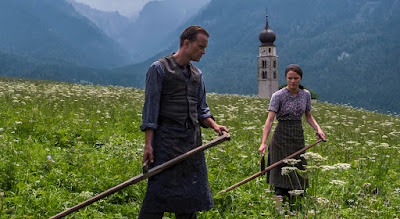
When we went to see A Hidden Life after it came out in the theaters, my wife said afterwards, "I feel like a wuss." She was referring to being 'soft' as a wife, seeing how hard Bl. Franz's wife Franziska's worked as part of their daily life as farm laborers. It seemed like every scene she was doing some kind of manual labor, working, being resourceful, often alongside her husband. Life was work. Leisure was an anomaly. 

Of course this was one hundred years ago in rural Austria. Franziska seemed to exemplify the Proverbs 31 wife, the "wife of noble character."

"She gets up while it is still dark; she provides food for her family. She considers a field and buys it; out of her earnings she plants a vineyard. She sets about her work vigorously; her arms are strong for the task. She sees that her trading is profitable, and her lamp does not go out at night. She watches over the affairs of her household and does not eat the bread of idleness. (Prov 31:15-18, 27)

In the scripture, none of this is for show only. The wife of noble character increases the bottom line of her family in tangible ways. She lets no moment waste--she is strong, resourceful, smart, profitable. 

Today, in 21st century America, I think our women are trying to figure out what it means to be a Proverbs 31 wife. Some weren't taught how to cook, and are learning. FemCatholics have adopted the sentiment to say it's okay to work. Traditional Catholic wives wear their aprons and tend to the children as their husband heads off to work. Some wives try to start some kind of home business selling essential oils or LuLuRoe or other multi-level marketing schemes (which exploit the vulnerabilities of homemakers) so they can contribute, or start a little garden to "feed their family." 

I know some women who married young and their identity is being a mom. They tend to their households and take pride in their roles but have no tangible skills that are employable in the workforce aside from minimum-wage unskilled work (retail, etc). 

We live in the tech-era, no longer an agrarian society. Anyone can cut wheat or milk cows, but how many families live in such a way today? Should a traditional wife even want to help her family financially, she finds herself stymied of how to actually do so. It's not for lack of desire.

I had an interesting conversation with a friend from India who works in supply-chain management, who told me recently in a conversation,

"Indians are conservative in morals and values (most dress modestly, have strong faith irrespective of the religion they practice, we look after our parents til they die in our homes), but believe in the value of work and independence. To be on your own feet."

When I asked her why that was, she replied,

"I think it's because we do not have Government handouts. No one will look after you if you don't look after yourself."

It's different for sure, I replied. Women working in the U.S. here has probably led to greater divorce, since they are no longer 'dependent' on their husbands.

"Ah yes," she replied. "The difference with us is, the money earned by the wife is still managed by the husband. He is still the leader of the family--currently India is like this. The husband makes the financial decisions most of the time. 

"There is a lot of wisdom in how we Indians have navigated the women contributing financially to the family. But with the onset of U.S. influence (TV shows, primarily) we are seeing an erosion of our values. 

"The working wife usually has her inlaws living in the same house. Usually, the mother in law (who would have retired from her own job) would help the daughter in law with the chores of the house and the grandkids when the wife has to go to work."


It was an interesting perspective outside my own culture as an American. Two main differences I saw--the lack of a societal safety net, and the commonness of multiple-family living in India. This is not common in American households today. Women are obviously in a bind--they can't necessarily work in an agrarian sense, and to leave the house to work often necessitates daycare, a difficult proposition. Some may live in areas where they have little family or community support, contributing to feelings of isolation. It would seem we don't live in a culture anymore that makes it very easy to live in a way more conducive to family life. I know my Distributist friends have been cognizant of this, and also critical of the breakdown of this possibility of family life where all worked together, as a result of Industrialization. 

It's a scary prospect, for a wife who has no real skills aside from homemaking, should something happen to her husband. It would imagine for such families it would make sense to have at least a $1M life insurance policy should anything happen to the husband so she does not have to work. 

Before anybody jumps down my throat, we all know wives who tend the home work the equivalent of 2-3 full time jobs. Their husbands often have it easier (in some ways) by going off to an office or whatever all day. 

I think the tech-heavy society we live in today makes it difficult for unskilled workers to eek out a living; many wives may be reticent to admit that their home lives are afforded by their husbands being successful members of this tech-class, and many working-outside-the-home wives may be reticent to admit that it is not an idea situation for homelife without the additional support of a live-in family member, as my friend in India noted. Perhaps the Proverbs 31 wife of noble character is a pragmatic composite portrait of the "ideal wife" and that no one woman would possess all these qualities. 

What then makes a Proverbs 31 wife? Is it unrealistic? Does it place unrealistic expectations on women as an unobtainable ideal? What does "work" look like for a 21st century American Christian wife and mother look like today? How does/can she contribute to her family so that her husband "has full confidence in her?" 

Wednesday, October 6, 2021

"There's No Such Thing As 'Built To Last'"


When we moved into our present home, one of the first minor upgrades I did was to replace all the incandescent bulbs in the house with Cree LED bulbs. PECO was offering a rebate which significantly brought down the cost, and I knew with my wife and kids' propensity to basically never turn off lights, the payback would be relatively short. Cree was one of the first makers of LED bulbs, and the ones I bought had a whopping rated 25 year life span, while running at a fraction of the wattage of a traditional 60w incandescent. Seven years later, the bulbs are still going strong, and our electric bill ranges from $65/month in milder seasons to $120/month or so for a few months in Summer when the AC is going.

I'm not usually an adopter of earlier technology, but in this case, it made sense to. Cree makes a great lightbulb, but as a business strategy, they are setting themselves up to be company losers. Giles Slade, in his book “Made to Break,” traces the term “planned obsolescence” to a 1932 pamphlet, circulated in New York, titled “Ending the Depression through Planned Obsolescence.” The term gained currency in 1936, through a similarly themed essay in Printer’s Ink, “Outmoded Durability: If Merchandise Does Not Wear Out Faster, Factories Will Be Idle, People Unemployed.” The basic idea is if you make products to last, your business may not, because people will not be replacing them. There's an article on the topic at the New Yorker (which also showcases the mysterious "Centennial bulb" that has been on and burning since the early 1900's in England) here.

I've noticed in recent trips to Home Depot that the LEDs on the shelf now have a significantly shorter life span quoted on the packaging--something like three to seven years, a far cry from the 25 year lifespan of a Cree bulb. Most people don't give it a second thought to go out and buy a new lightbulb when one burns out after a couple years (for a history into this, see Phoebus cartel). When I scan the free ads on Craiglist, I also see a mountain of "Free scrap" ads of shiny looking newer washers and dryers with bells and whistles that are a few years old out to trash because something stopped working and it was too expensive to repair. I made sure when our current washer conked out recently after 20 years of service, to find an older used Maytag on Craigslist that was built to last. I found one for $50 (vs $500+ for a new washer) with a manual timer, hooked it up and it's been a workhorse. Planned Obsolesce in action.

There are also a lot of new construction houses going up in our area. It blows my mind how quickly some of these houses go up. 2x4 studs and plywood. They look nice from the outside, but as to longevity only time will tell. My suspicion is they will not age gracefully, since they seem to have flashy 'luxury' features but cheap-out on material quality. My father in law had a pipe leak somewhere in his condo and the plumber that came out said if they would have spent another $.50 on a higher quality fitting when constructing the place, it wouldn't have leaked. As another example, you can see that even new-growth timber is vastly weaker and inferior to old-growth timber used in construction 50-100 years ago. Our brick home was built in the 1950's and with newer plumbing and electrical, I feel like we have the best of both worlds. Men were genuine craftsmen during those eras, and took pride in their labor and the quality of their work.

I think there is something to this planned obsolesce. If we used some kind of composite in our roadways that eliminated potholes and cracking, these DOT roadcrews would be out of work. I remember the Phila Plumbers Teamsters fighting hard against the proposal for waterless urinals at the Comcast center downtown because, well, there would be nothing to work on in regards to maintenance. You get the idea.

One could say some of these newer evangelical "non-denominational" megachurches are like new construction. They are appealing from the outside ("Fellowship! REAL Relationship! KidzZone! Coffee bar!"). But will they stand the test of time, to weather modernity and all its empty promises of "progress?" They are the IKEA of churches, made from particleboard and dowels. I touched on this in What's Old Is New

The Catholic Church, by contrast, is that kind of solid cherry dovetailed-joint dresser your grandmother owned for a hundred years that none of the grandchildren want because its not disposable and minimalist. So it gets put out to the curb, or sold for pennies on the dollar. One of these days, people will miss these kinds of pieces, and say "they don't make them like they used to" while not giving it a second thought of buying new furniture every few years because their particleboard bedroom set has fallen apart. The Church that Jesus founded, even with all its problems, was built to last. 

Even the physical structures that were built in the 1800's, with their ornate detail and craftsmanship...we wouldn't be able to afford to build something like that today! Cheap labor and cheap materials and cutting corners doesn't give us magnificent churches and cathedrals. Same for our faith lives. That's why we shouldn't fetishize Tradition, or relativize it, but recognize it's value as something that was, in fact, built to outlast the storms of modernity.

I can't help but think the plan all along for our government is to make us more and more dependent on the federal teet, a direct contradiction to the spirit of our country's founding by way of self-governance, liberty, and virtue. It's a kind of 'planned obsolesce' in it's own right. Because you can't make money off of free men and you can't control them; and that's a scary thing for the overlords to come to terms with.