Showing posts with label film. Show all posts

Monday, July 27, 2026

Time Is Slipping Through My Fingers Like Sand


I did not expect to struggle so much as a father with my kids getting older. Lamentably, my memory is very poor and I only have little snippets of mental vignettes in my mind from when they were young. I do not, cannot remember. It is distressing. I feel like a lost man searching his mind for his kids, and I cannot find them. This is why I struggle to write as well, because the pool of details in memory to draw from is very shallow. There is no shortage of material to work with when you have memory. So I write from the present, but long to write the past as well, a past which is dispersing like vapor faster than I can preserve it.

My oldest two are teenagers now, while the youngest is 8. I know every parent goes through this at some point, but I was not prepared for it, the speed at which time accelerates. Next year the oldest will be driving. Maybe a job. Then college. Then...what? I am sad. I also am struggling to keep up with the changes. I want to hold on to them, control everything like we did when they were toddlers, but to do so would be to stunt them. 

Letting go is very hard. So, whether it is fair or not, I hold my youngest tight--I stroke his cheek and slip my hand in his. I have him fall asleep next to us in bed sometimes. I try to record his little voice to preserve it. He is the last, and when is grown there will be no more. 

I also am not sure I could have handled more than three kids. God knows. I know He gives the grace, but grace builds on nature. The Epistle at Mass on Sunday from 1 Corinthians: He will not let you be tested beyond your strength. We had seven miscarriages along the way. God knows.

I lost all my photos in a botched iPhone transfer last Fall. It was pretty traumatic, and in fact I am considering looking into EDMR therapy to deal with what has become a real problem in my life lately--being triggered by tech. I am standing still as the world is rushing by me. I am getting left behind. My wife has a good amount of photos on her phone, but I almost want to print the best ones out, keep them physical and in a album in our family room. I don't want to Zoom, I want to hug. I don't want to Facetime my grown kids, I want to hear them chew and laugh at the kitchen table. I don't want to be locked out of life, which is becoming increasingly digital. I am scared. I cannot keep up. 

It is very hard to live in the present, because the present is constantly shifting. We can take our time in the past, linger in memory; we can create futures for ourselves, make ourselves anxious or sick with longing. But the present is flitting, requiring constant attention, focus, and awareness. By the time you seek to hold on to it, it is gone. You cannot hold on to the present. And so each day I get distracted and my kids get one day older, one becomes two, to weeks and months, and then they are almost slipping out of my grasp. I am not a controlling dad, but I do have fear--fear for what my kids are being launched into--and fear is not of God, is antithetical to trust, which God requires of us to live in faith. 

I was watching Terrance Malick's Tree of Life last night, a beautifully shot meditation on memory, past, nature, and grace. The opening monologue contrasts "the way of Nature" with "the way of Grace" and that one must choose which one they will follow. Jack (Sean Penn) is a middle-aged corporate executive trying to make sense of his present by reflecting on his past growing up with his mother, father, and brothers (one of whom died at the age of 19) in Texas in the 1950's. The way of Nature is reflected in Jack's father (Brad Pitt)--loving yet authoritarian, teaching the boys discipline and that the world is a hard place where you need to be on your game to survive. Jack's mother is the way of Grace--gentle, caring, empathetic. There's no real "point" or plot to the film, but the meditative aspects reminded me that memory is composed of those subtle moments that take place in the present--the trace of a mother's finger across her sleeping son's chest, the evening sun piercing through the pine trees, the sound of the screen door closing. The day their brother died. 

Without memory, or with it being so compromised, I feel as if I am disappearing. I want to remember because I want to preserve, be a good custodian of the my past. Everything is moving by so fast, and I can't stop it, can't stop my kids from getting older, nor would I want to. I just want to hold them in the present, and keep the memory from that now-past for my future self. 

Sunday, May 12, 2024

More Thoughts On Friendship, From the Isle of Inisherin


Last night I got around to watching the critically acclaimed dark comedy The Banshees of Inisherin (2022) with Colin Farrell and Brendan Gleeson. The synopsis is rather easy to relay and develops quickly straight out of gate: Pádraic and Colm are long time friends living in a village on a remote island off the mainland coast of 1920's Ireland. One day Colm decides he doesn't want to be friends with Pádraic anymore. When the stunned Pádraic asks why, Colm informs him it's because he is dull and he wants to spend his remaining years composing and playing music rather than engaging in the inane pub chatter that has composed their friendship til this point. Pádraic has trouble accepting this sudden "divorce" and Colm feels forced to take drastic measures to make it clear he wants nothing to do with Pádraic anymore: every time Pádraic attempts to talk to him, Colm will cut off one of his fingers (which, for an accomplished string musician, should indicate that he means business). What ensues is a string of escalating and tragic Quixotic events which leaves one eventually wondering "How did we get to this point?"


We don't know much about the friendship of the two prior to Colm's declaration of independence, but I found myself straddling the fence of sympathy for both characters in the aftermath: for Colm, because I don't blame him for his desire to live in silence and preserve his peace; and also for Pádraic who sees himself as a "nice" guy whose small world has just been turned upside down by his former friend. Pádraic hasn't done anything wrong; Colm has simply changed. And so there is an ideological war raging behind the character front between the opposing forces of "being nice" and "telling the truth." And because of the interdependent ecosystem of the small remote village, the social ripples emanating forth from this parting is not as without consequence as it may be in, say, a large city or other impersonal setting.  

When I was compiling the chapters for my book, Wisdom and Folly, I led off with a chapter of essays on the topic of friendship. I thought that was curious, amidst weightier topics like Faith, Prayer, Discipleship, Marriage, and Manhood. Why friendship? Maybe it is because friendship is a curious thing. In the case of Pádraic and Colm, it takes the guise of a kind of long-standing, yet non-contractual marriage in which one person can one day say "I just don't like you anymore" and walk away from it. It can hurt just as much as a marriage partner abandoning their vows, but on the face of it, friendship is not a marriage. There is no intentionality about it, but a kind of "social slide" of unspoken assumptions into a partnership of utility. And since this is what most modern friendships are founded upon (the basest level of relationship, according to the philosophers), when it no longer suits us or starts to cramp the life we envision for ourselves, we are free to leave it.  The way Colm did this in The Banshees of Inisherin is actually more admirable because he was honest and forthright, preferring to rip off the bandaid in one swoop rather than lead Pádraic on. Today Pádraic would have most likely just been ghosted via text.

The reaction of Pádraic to Colm's "breakup" with him is equal parts sad and cringe. Pádraic is incredulous to the fact that someone might find it tiresome to keep company with him and engaged in the most mundane of superfluous small talk, as if there might be more to life (as Colm does). He's a simple and nice guy, content with the smallness of his world and whose needs were being met as long as Colm played the part assigned in their friendship. As if this wasn't bad enough, he simply cannot accept Colm's proposition and reacts in a spirit of possessive, shallow narcissism.

The shadow around the corner, however, is that we know many marriages like the friendship between Pádraic and Colm--long standing marriages that lay roots for years and years in a particular time and place, ensconced in a community of friends and neighbors, yet one that may not have been founded on anything particularly meaningful. These could be marriages of convenience or of opportunity, or of mutual interest (running clubs, workplaces, pubs, etc).  The difference is, however, one cannot (or at least is not supposed to) walk so easily away from this legal and sacramental contract that knits two pieces of flesh into one garment. One falls in love and then makes a willful choice--to have and to hold, for better or worse, richer or poorer, in sickness and in health, to love and cherish, til death do you part. The contract is ratified, with one's solemn word, as well as legally and sacramentally. And yet how many of us have known someone who woke up and suddenly thought to themselves about their partners "I just don't love you no more" and seek to dissolve the bonds of the one's solemn word.

In the case of friendship, while a rare friendship goes beyond purposes of utility and has a mutual agape at its core, there is still the matter of like. Liking another person is a tenuous thing; for liking is unlike loving in that loving is an act of the will. One cannot will themselves to like another person. Where, then, does it rest if not in the will? And if one does not like the person they are bound to in friendship, why then would they choose to stay bound thus? They are under no contract to do so. In many ways, it is almost easier to love a person than to like them, for at least one can love against their will and one is forced to work through the barriers to love by way of the vows undertaken. No such contract exists in a friendship. 

The narcissism I noticed in Pádraic is the same narcissism I notice in myself. Rather than honoring Colm's request to leave him alone (essentially "letting him go"), and not taking it personally, he filters everything about the friendship in terms of how it relates to him. What did I do? WTH is wrong with him? Not being liked was a fate worse than death for the town "nice guy." He becomes depressed, spiteful and envious of Colm's music students that come to learn from him (rather than experiencing joy for a man finding meaning and purpose for his life). He even makes friends with the local idiot savant, Dominic, because unlike Colm, Pádraic cannot stand to be alone. The film in this sense is kind of a melding of social-existential and absurdist themes: one would rather burn a man's house down or dismember their hand then put a feud to rest. Perhaps this is the stubborn Irish-ness that is not in my blood. But it does lend itself to a kind of artistic Dadaism that seems to work for the purposes of the film.

But I also notice in Colm aspects of myself as well--the weariness with which I found myself, for years, having endured the superficial pub talk of nonsense and in the process feeling like I was betraying something of myself but too weak to walk away from such friendships. I was being used, and I used. Perhaps I did not know that I longed for something my friends could not provide me, something like an aquifer that flowed for years beneath the crust of my soul, until one day you wake up to--the day your friends all become strangers. You want to love with an agape love, but you realize how self-centered you are and you don't know how. You want more from a friendship, but realize no one has the time. You want to stay the course while recognizing that friendship is always conditional.

It seems like such a far cry from the concept of friendship as Jesus Christ imagined it--a man willing to lay down his life for his friends, friends who turned on him and ran away and left him during his time of need but those same friends he himself never abandoned. He loved them with a love that was not fickle, and hand-chose them for a privileged place in his life. He not only loved them--he liked them too. He prepared a place for them in his eternal home. He poured out his last ounces of love for them from the cross. He judged no one, and made time for everyone. 

One thing we lack today that the characters in The Banshees of Inisherin just took for granted was that village community in which people were knit together at the local level. For some (like Pádraic's sister, Shioban, who flees for the  mainland), the small-mindedness of such insular, inter-dependent communities can be insufferable. 

But I think we are suffering from a worse, more disconnected fate in the modern "social" media era, where we are maintain complete control and autonomy, choosing when and how we respond to someone, hiding behind avatars and monikers, indentured to no man, offering up cheap prayers and hollow consolations because they don't cost us anything, don't mean anything, relationships we can seamlessly step back from with no consequence and no follow up. I don't know which world would be harder to live in. This side of heaven, it all leaves a God-shaped hole.

Friday, March 8, 2024

"Woman is the Glory of Man": A (Critical) Film Review of 'Cabrini'


Once while visiting downtown Detroit to do some street evangelization I prayed to St. Frances Xavier Cabrini because I heard she was the patron saint for finding parking. In an unfamiliar city with a rough reputation, I figured it was a long shot to employ her for this little favor (which seemed big at the time). Low and behold, as soon as I got downtown near our set-up corners, a car pulled out from a spot right in front of me and I was able to slide in. Grazie, Madre! Truth be told, though, I didn't know much about St. Cabrini's life beyond that little tidbit of info, and that little mini-miracle she worked for me.

So I decided on a whim this afternoon to go to a matinee screening of Cabrini, because I like to give things a fair shake, not to mention think and make determinations for myself rather than second-hand. I say that because it seems people who have seen the film (or those who have not yet feel moved to comment on it anyway) seem to be of two minds about it. I have made it known in over fifteen reviews on this blog (see here) that I am a film snob, and try to go beyond the "I loved it!" or "I didn't care for it" reactions to get to the objective reasons why I either loved a film or didn't. I was also surprised to see the theater about three quarters full, which was kind of cool.

I'll say from the outset Cabrini did nothing for me, either as a Catholic or as a movie-goer in general and I found myself checking my watch during the duration of the movie on numerous occasions. The acting is acceptable, the lighting and cinematography check all the right boxes, but I was absolutely not invested in these characters. It's not that they were two-dimensional or anything--they just did not give me a reason to care about them; and that includes Mother Cabrini herself. 

I also couldn't help feeling a bit force-fed, as well. Those who were critical of the downplaying or absence of faith and prayer in a story about a Catholic saint, and the upsell of strong-willed empowerment messaging were, I think, right to be. It kind of felt like a modern Marvel movie in that sense masquerading as a religious film. The humanist innuendo didn't hit you over the head, but it was definitely there, glorifying the human dimensions of what should have been reserved for the Divine. What seemed like a massive disappointment was the missed opportunity to underscore that the massive wagers and scope of work that Mother Cabrini undertook simply would not have been possible were it not for Divine Providence. It's as if the currency of the spiritual held no value in this particular producer's economy. 

Now, I know Catholics are our own worst enemy, but honestly why do producers keep missing the mark, again and again, when trying to appeal to mass audiences on matters of faith? This seemed to be the case with the new Padre Pio movie as well. However, there have also been some very well done films (A Hidden Life, about the life of Blessed Franz Jägerstätter, and Man of God about the life of the Orthodox Saint Nektarios of Aegina as two examples) in the past few years showing what is possible. 

Cabrini is neither a beautiful film nor a convincing one. I did not care about any of the characters, and it felt like a mild lecture one had to endure rather than something that draws you in of your own volition. All of Mother Cabrini's sisters seemed to be akin to NPCs (Non-Player Characters) in a video game, though the relationship Mother has with the former prostitute who has entered into their community seems to have some slight inter-personal development. 

The battles and obstacles in the film were all external, outside the person--this seemed like a huge lost opportunity to delve beneath the skin of a formidable character to the spiritual dimension. It almost seemed like a foreign script to the producers that they scrapped in favor of the tangible and easily explainable, as if the biblical scholars of the Jesus Seminar of the 1980's got together to try their hand at film and focused on the historical Jesus devoid of his miracles. Sorry, the feeding of the five thousand wasn't because "sharing is caring." Hard pass.

I don't quite know what the agenda of Cabrini was, if there was one. Was it to inspire? And if so, inspire to what? Curiosity? Piety? Humanitarianism? Deeper faith? Female empowerment? Was there a reason it was touted as premiering on "International Women's Day?" Or the emphasis on immigration during a border crisis and election year? I don't know, and I don't really care to speculate. Because nothing about Cabrini made me care at all, because...well, why should I care about something I wasn't invested in. And that is where it fails as a film. I don't owe Angel Studios anything. If anything, my $11.50 put to rest my suspicion of the critics of this film, because I can say they were right to hold the film itself in suspicion.

Phillip Campbell has a much more thorough (and favorable) review over at Unam Sanctam Catholicam. We both saw Cabrini on the same day and were texting back and forth about it and decided to publish our reviews simultaneously.

Saturday, February 3, 2024

FALLING DOWN and the Divorced American Male "Going Home"


"You think I want to hurt your family? I have a family of my own. That's where I'm going. I'm going home to see my family. It's my little girl's birthday today. We were going to have a barbecue like you guys. She was going to play outside and my wife would hold my hand and we would talk about grownup things. And then when it got dark, we'd all go to sleep together. We'd all sleep together in the dark. And everything would be just like it was before."


These were the words of recently divorced and recently laid off defense contractor William Foster (played by Michael Douglas) in Joel Schumacher's 1993 cult classic Falling Down about half way through the film. By this point what started as a "bad morning" with a traffic jam has led to a standoff with the LAPD and a wake of assaults and property damage at the hands of an otherwise straight-edged man who has been pushed too far and simply "had enough."  


"I'm the bad guy? How'd that happen? I did everything they told me to. Do you know I build missiles? I help to protect America. You should be rewarded for that. Instead they give it to plastic surgeon. They lied to me.
 

None of Foster's violence or seeming entitlement is justified of course. As Michael Douglass' father Kirk described his son's character in the film, Foster is both the victim and the villain. His pathology is in simplicity--he wants to see his daughter on her birthday--and his derangement in just how far he is willing to go to clear the obstacles standing in his way from doing so on this particular "hot day" in L.A. What's strange is that there is a part of the viewer--that would be straight white middle aged male me, in this case--that sympathizes with his plight that didn't really register when I first saw the film in high school back when it was released.


There's an interesting scene when Foster's (ex) wife realizes he may be trying to show up at her house for their daughter's birthday party, and calls the police who are asking her some questions at her home.


"So, you have a restraining order against your husband?

"Ex-husband, yes. He'd show up on the wrong day or in the middle of the night, pounding on the door, stuff like that. Thing is, he has this horrendous temper and I didn't know if the restraining order was a good idea, and could do more harm than good. But the judge said we should make an example of him."

"Does he [your husband] drink?"

"No."

"Do drugs?"

"Oh, no."

"But he has a propensity for violence?"

"Yeah, I think you could say that."

"Did he strike the little girl?"

"No."

"Did he strike you?"

"Not exactly."

"Not exactly?"

"There were times I thought he was going to but I didn't want to wait until he got around to it."

"Uh-huh."

"It's hard to explain. He could, I think."

"You 'think'?"


I'll admit the single-minded, obsessive quality of Foster's character is a bit unnerving, and you can see how it contributes in some of the home movies to the tension in the marriage and child-rearing. But he's not abusive. He's not a drinker, doesn't do illegal drugs. That doesn't mean he can't be a "bad man." But when pressed by the cops for the reason the wife had for the restraining order, it was all a bit--wispy.   

Again, Foster is no hero here, and none of the violence is justifiable in the film. But it does go to show that when a man is stripped of the two biggest cores of his identity--his employment and his family--in a one-two punch...well, it can do a thing or two to a man's psyche. Might just be enough to break him, make him snap, or simply give up on everything. By the time lawyers and judges are involved, it's already over. It's heartbreaking to know how many children have been stripped of imperfect but otherwise loving and devoted fathers by the suicide of the courts. And how many men who want and desire to be in their children's lives and remain married to their spouse who they pledged themselves to get neutered by the sharp brass knife of law. 

I know abuse is real, and sometimes separation and legal protection is necessary, for both men and women alike. I also know that sometimes men who are not abusive, are not cheats, who essentially did nothing 'wrong' still get cut at the knees by divorce. 

"Home"--what once was but no longer is--becomes an almost mythical and painful memory everyone is telling them to forget about. Home is the one place we all want to have. Men are willing to work and grind to afford the mortgage because when you have a family you love and are devoted to, you have a reason to work. When you lose the family, you lose the will to work. And sadly too, when you are stripped of the ability to work (either via layoffs, downsizing, ageism, or not being an "economic viability" to the company anymore as referenced in the film), that can impact your marriage and family stability. When both marriage/family and work are in place, things can be really good. When you're out of work but you have the support of your family and community, you'll pull through. But when you've lost both work and your marriage and family--it's enough to crush a man's reason to get up each morning. Even the best and strongest men get cut at the knees by this one-two TKO.

I didn't get the impression William Foster was a religious man in Falling Down. Faith in God is perhaps that "third leg" needed to keep a man's stool from collapsing on itself when the other Big Two (work and family) snap in half. If nothing else, the Divine Law precludes us from exacting vengeance on the innocent for perceived crimes against our person. We aren't owed anything in this life--all is grace. Good marriages are a grace. Bad marriages are a grace (but can also be a cross). Work is a gift, not a right. Children, too. This world doesn't "owe" us anything. There is only one spotless victim--the Christ--and he didn't exact retribution. He made his way "home" not by vengeance, but submission.

There is a part of me that admires the tenacity and creepy single-minded obsession of William Foster "just wanting to go home", even on foot across L.A. during a heat wave and to a home which doesn't seem to welcome him anymore. At least he recognizes that it is worth fighting for. That many men and women are willing to so easily walk away from perfectly good (albeit imperfect) marriages for lesser things to the detriment of their children and society in general without fighting makes those who would instead fight the courts and sacrifice everything to be able to "go home again" look like the crazy ones, the obsessed, those that "should just forget about it and move on." 


Remember, that Fatima foretold that Satan's final assault would be on marriage and the family. Keep that target off your back by fortifying yourself in prayer. If you have work, work hard and be grateful--don't live beyond your means. If you are married, invest in your marriage so that the fissures of gradual drift don't create larger problems down the road. Don't take anything for granted. Including having a place to go home to.

Monday, July 3, 2023

"Too Ugly For Polite Company": A Film Review of "The Sound of Freedom"


"What man of you that hath an hundred sheep: and if he shall lose one of them, doth he not leave the ninety-nine in the desert, and go after that which was lost, until he find it?" (Lk 15:4)


God bless Jim Caviezel. He reminds me of the leper who was healed by Jesus in Luke's gospel--one of ten but the only one to return and give glory and thanks to God (Lk 17:11-19). I think because Caviezel himself recognizes the debt that has been settled for his life, and the ransom paid in blood, is he able to return to the screen to give God the glory in his profession as an actor. He knows he is a man who was dead to sin, but saved by Christ and set free (Rom 6:11). He knows what it means to be saved.

And God bless Tim Ballard, the real life DHS agent-turned-vigilante about whom the film is based. The Sound of Freedom is tough viewing, but that doesn't mean it shouldn't be viewed. And that's not because of any graphic depictions or lewdness, but simply because of the subject matter itself. Child sex trafficking is a multi billion (with a B) dollar industry that operates on the market principals of supply and demand. And the Devil's business is booming.

One of the frustrating things about being awash in societal "issues"--from climate change to cobalt mining to you name it--is that it becomes easy to paint in generalities: that somewhere out there something bad is happening, and someone is vying for our attention to "do something about it." In that sense, the producers of The Sound of Freedom are not unique in trying to mobilize action for a cause. 

But as a father myself, it was very hard to be a neutral viewer. "These are God's children," as Ballard says in the film. I don't think any father can really be a completely academic or neutral party in this nightmare. You see your own children in the faces of these poor children stolen and sold into a life of slavery of the most degrading type imaginable. "How could you sleep," the father of the two Honduran children who Ballard sets out to rescue tells him, "when you know their bed at home is empty?" The fact is, as a parent of such victimization, I don't think you ever sleep again.

That such heinous sin (let's call it what it is) passes right under our noses, day in and day out, not just here in the U.S. but in every country in the world, it may be easy to grow numb to it and feel dis-empowered. But that's where I think the film shines, because it highlights a man who could have easily said, "What difference does it make? We save one kid, and there are ninety-nine others who are lost?" Being ten months away from being vested in his government pension, it would have been easy to Ballard to settle in and do what he can from the sidelines, taking the safe and acceptable route of doing his part to fight this scourge. 

But Ballard doesn't do that. Realizing he is neutered by government bureaucracy that gives him the leverage to catch pedophiles while the child victims remain "out there somewhere" is a crisis of conscience for him. He heeds the call "not to hesitate" when called, leaves the Department of Homeland Security and teams up with some other players just outside the law to "go big or go home" in staging a faux "paradise island" as a method of entrapment for pedophile kingpins. A former cartel runner (who himself has his own dark reckoning with his past life and personal sin) and a well-financed entrepreneur form Ballard's small vigilante operations team, and lead them to rescue over fifty child sex slaves in one sting.

There is another backstage hero in this film, however, and that is Ballard's wife who fully supports this unorthodox mission: "You quit your job," she tells him, "and you go rescue those kids." With six kids of his own, and on his own deep in rebel territory in Columbia looking for a proverbial needle in a haystack (the sister of the first boy he rescues), this is no small act of faith on his wife's part. There is no one looking for this poor Honduran girl. There is no incentive, no reason, no will. Except for Ballard, her fate would be sealed and she would be completely lost. He has everything to lose. I think his wife is as invested in his mission as Ballard is.

To see the panic of Rocio and Miquel's father's face when he returns to the "talent company staging room" to pick them up only to find it empty and his children missing is utterly heartbreaking and every parent's nightmare. It is my own nightmare--not because it has happened to me, but because what's to keep it from becoming my reality? It's bad enough to know your children's beds at home are empty, but to reckon with the reality that they are being hurt or abused in some way, and you are completely powerless to help them, is a thousand times worse. And this happens to tens of thousands of children--God's children--every day, both at home and abroad. They are like lumps of coal, these victims, these child slaves, feeding the insatiable furnace of depravity that we perpetuate by our own complicity with sin. 

The sheer scale of this insatiable appetite for the corruption of innocent flesh is almost incomprehensible. The sins cry to Heaven for justice, and as Ballard quotes Matthew 18:6 in the film to one of the pedophiles "Whoever causes one of these little ones who believe in me to sin it would be better for him to have a great millstone hung around his neck and be cast into the sea." 

And yet many of these lost children are never found, but remain chained in slavery of the most horrible kind, their innocence crucified on a tree at the hands of vile men. For every one that is rescued, hundreds remain in bondage. This has the potential to be a great challenge to one's faith in a good and loving Father and in his only begotten Son who debased himself to come to earth and search out the one that was lost (Lk 15:4) when they remain out there, somewhere, in a dark room subjected to unspeakable traumas. 

And yet, "there is no one righteous, no not one" (Rom 3:10; Ps 14:3). Many of us are complicit in the sins of the flesh which have perpetuated this abominable slave ship, though--we fuel it not just with clicks and downloads, but by our apathy and fence-sitting in the face of such evil. Christ was utterly crushed by the weight of sin (Is 53:5)--our sin. He came to ransom us, left a comfortable Heaven to debase himself here on earth (Phil 2:7) and pay the price with his sacrifice and death (Rom 5:7-8). He was innocence itself (1 Pt 3:18).

I don't know Tim Ballard's back story, if he is a Christian or not, but I will say Jim Caviezel was the right man to play him in this role. When Tim is describing his "line of work" to someone in the film, he mentions that this reality (of sex trafficking) is "too ugly for polite company." 

And that hits home. Sin is ugly and it is real, and Christ didn't die on a cross in some removed, prim and proper manner amidst polite company. He was scourged and mocked, reviled with contempt and beaten to a pulp, among "bad men." God "got his hands dirty" to ransom us from perdition, and sacrificed his son, his only begotten son, to do it. There was no other way to bridge that divide. And if we are to imitate Christ in his life as his disciples, we cannot sit balancing on a fence. We, too, are called to get our hands dirty, sacrifice, and pay ransoms to set captives free. Whatever capacity one does that is between him and God. But he cannot be passive, cannot be neutral. 

God bless Tim Ballard for leaving the ninety-nine to seek out the lost one, and God bless Jim Caviezel for taking on this role. The Sound of Freedom deserves our support, and not as a charity case either. Though I viewed the film through the eyes of a Christian, it is not an overtly or even remotely "religious" film. It is well shot, well acted, and is a compelling if not difficult watch; well worth a trip to the theaters to see. I hope this film goes mainstream and convicts the heart of those who view it--even if the subject matter is "too ugly for polite company."     

Saturday, April 15, 2023

Film Review: Nefarious (2023)


I didn't have a whole lot of expectations when I took a trip to the theater this evening to see Nefarious this evening. I'm not big into the 'horror' genre but after seeing some positive recommendations and that there was no graphic violence or other lewd turnoffs, and that it was a compelling and accurate portrayal of demonic possession I figured to give it a go.

I am a bit of a film snob, though, which can make it hard to enjoy a movie sometimes. The first thing I'll say is that I give the producers (who are apparently devout Catholics from what I heard) an A for effort. The general plot is that a man is being sentenced to death for murder, but claims he is a demon taking up residence in the man's body. A young atheist psychiatrist is called in to determine whether or not the prisoner is insane and thus not able to be executed under state law. The inmate is in fact clearly possessed, and what ensues over the next hour and a half is less psychological and more of a 'spiritual thriller.' Or at least it attempts to be. I wouldn’t classify it as a horror film.

The film largely rests on monologues and sparse scenery from inside the prison. It's clear it's not a high-budget film, but I'm okay with making do with less. The acting, apart from the inmate himself (which was well acted) clearly reflects that. I like subtlety and appreciate when themes can be teased out and make you think and question. Nefarious doesn't do that; it feels more like a pre-packaged MRE. If I was an unsuspecting non-believer going into it, I may be inclined to feel a little cheated from a bait and switch, the way you might hide aspirin in applesauce for your kids. 

The theology and demonology is for the part solidly orthodox. But I couldn't help feeling like this is the Catholic version of God's Not Dead meets Screwtape Letters with less rah-rah but the same forced feeding of the message rather than having it teased out. If Taylor Marshall and Kennedy Hall switched from TradTube to making a movie together, this would be it. 

Some people like being spoon-fed though, and have no preference for subtlety, and I won't fault them for that. If that's you, you may enjoy the movie because it gives a clear takeaway with minimal questioning; it tells you what to think rather than makes you think, but maybe that’s my perspective as a well-informed Catholic—it might have a positive opposite affect for a non believer or Protestant. I had a "ah, I see what you did there" moment when the possessed tells the psychiatrist ominously "before you leave here you will have committed three murders" and then brings up the fact that the psychiatrist euthanized his mother and encouraged his girlfriend to get an abortion. Kind of clever, but the moralizing was blatant. Which again, some people like--what you see is what you get. Maybe the idea is a kind of guerrilla-evangelizing and riding the wave of the exorcist-theme popularity we see going around online today. I did like when they brought the liberal priest in and showed how impotent post-modern theology is against the demonic.

I wouldn't dissuade people from going to see Nefarious, but like I said, I just have different standards by which I judge a film, and it takes a lot of box checking for me to be satisfied with a movie--Nefarious didn't do it for me, personally, but it might for you. Curiously, I did find myself praying to my guardian angel on the drive home, something I don't do enough of. Evil exists, the Devil is real, and we need to be wearing the amour of God by remaining in a state of grace and belief.

Monday, January 2, 2023

Lost In Translation

"A perfect mortification is to avoid speaking without having to, for that is a great fault in a Christian soul. We must fear, we must avoid useless conversations because of the sins we commit in them and the time we waste in them."

St. Teresa of Avila


I currently got hooked on a bit of synth-pop via Mr. Kitty's "After Dark" dubbed over splices of the 2003 film Lost in Translation. Though this musical genre is new to me, it's been an ethereal meditation personally, syncing with my own feelings of loneliness, disconnect, and isolation as of late. The film itself (which I saw years ago) is an artfully done "romantic melancholy" working within the confines of emotional (rather than sexual) intimacy between two American strangers in Tokyo--poignant scraps of connection in a modern day world of disconnection. 


A look, a gesture, a touch--all sans words in the music video--are akin to the economics of words within poetry, all while eliciting a cogent sense of presence and longing, the lingering taste of the hangover of loneliness. In the words of Ezra Pound, "use absolutely no word that does not contribute to the presentation." 

I started writing thirty years ago inspired by the poetry of the 17th century Japanese haiku masters--Buson, Basho, Issa. Haiku is the poetry of the real, as the saying goes. Within the confines of a 3 line, 5-7-5 sylable structure, the poet has no words to waste. But because the essence of haiku is experiential, the words themselves must become wordless--the pure translation of experience. Time, too, is transcended in a moment of presence. Take for instance this haiku of Yosa Buson (1716-84), which has stayed with me to this day from when I read it decades ago:

Pressing sushi;

After a while,

A lonely feeling

In the context of the Faith, we can experience this transcendence in the reception of the Eucharist, the direct, subjective, poetic experience of the Divine, within the established and objective 5-7-5 rubrics of the Mass. We are transported from our present state to Calvary, to the Upper Room, to the bosom of the Lord with St. John...that is, when we are paying attention and enter into the reality we consume--when we become what we eat.

This wordless communion, and the silence therein, has led me to reflect on this neglected bit of scripture, the words of our Lord, 

"But I say unto you, that every idle word that men shall speak, they shall render an account for it in the day of judgment" (Mt 12:36).

Every idle word. Were I to take a true, honest inventory of the words I expel daily so carelessly...well, it is an indictment. The more I reflect on it, the more I want to sanctify not just my thoughts and actions, but the words which I speak. They should be korban, "something which draws close," not fodder for conversation, caloric filler to take up space in the atmosphere, or random texts sent to distract me from my present state of being. More often then not, our words are spoken in order to choke the silence rather than sanctify the air.

It is very difficult to intentionally starve our environment of words so that we mindfully use only what is necessary to convey a point, a direction, a salutation, an experience. But I'm going to make it a New Years resolution of sorts to try.

Not speaking at all (a "vow of silence") is not especially practical, but I do think I could cut the amount of words I speak and texts I send in a day by 75% and still function and communicate effectively. In our daily life, we deflate our currency with the frivolity of our barrage of ill-conceived words the way the Fed prints money. It's going to take some thoughtfulness, and pausing to think first. It may involve some discomforting periods of letting verbal fields lay fallow. Like the haiku artist, each word must serve a function--to be charitable, intentional, meaningful, and fruitful. 

But I'd like to undertake this challenge--to re-frame my loneliness as a power rather than a weakness, imbibing meaning in each word spoken rather than diffusing it through frivolous manners of simply talking for its own sake. To listen first, and speak second. To say only what needs to be said, text only what needs to be texted, and nothing more. To respect the role of meditation in daily life, painting with minimal strokes on the canvas of silence. To respect the Lord who oppressed and afflicted "opened not his mouth" (Is 53:7). To be mindful of my judgment. "Keep silence," writes St. Paul of the Cross, "like a golden cross destined to preserve the treasure of the other virtues. Whoever keeps his tongue, keeps his soul." 

I don't want my words to be used against me in the heavenly court. "For by thy words thou shalt be justified, and by thy words thou shalt be condemned" (Mt 12:37). I cannot take back the torrent of trifles that have spilled from my mouth over the decades, rendering judgment, causing scandal, breaking down rather than building up, decaying the enamel of how many souls, polluting my environment with excess of language. But I can repent and turn off the faucet starting today to be judicious, thoughtful, sober, tempered with regards to my words. No one is owed any of them. 


Sunday, November 27, 2022

This Advent, Become The Saint You Were Made To Be

 One of the great mysteries of the Catholic life and spiritual economy is that God, in the great dignity he bestows on us as men with free will, predestines us to be cooperators with grace. That is why the predeterministic theology of Calivin (so called "double predestination") is such an affront to human (and Divine) dignity: God, in His infinite love and goodness, did not pre-destine man for death and damnation, but life and eternal salvation. It is by our free choice that we accept the invitation to be saved, and by our lives that we cooperate with grace to achieve it. We actually do play a part in the divine economy, and what we do in this life matters.

I was reminded of this while watching (for the first time!) with my family last night It's A Wonderful Life, which we rented from the library. I was initially a little snarky about it when it came to the quirky theology ("every angel gets his wings"), but in looking past those shortcomings, found it to be a wonderful, feel-good movie, especially for the start of the Advent season.

It spoke to me especially in that I had had similar thoughts in my twenties and thirties to that of George Bailey's, that "It would be better that I had not been born." This is the distorted thinking of depression that the Devil leverages against us. I wrote a little about my experience with this battle against the demonic here, here, and here. The holidays can also be hard for people who struggle in this way. "No one is a failure who has friends," was one line in the movie, and I realize I am very rich in that regard. But many people suffer from such an acute loneliness that is felt around the holidays because they may lack the gift of friendship, and feel like if they were taken out of existence, no one would even notice. This is the great poverty Mother Teresa spoke about--of being unwanted, unloved, and uncared for. 

But God has chosen each and every one of us for a purpose, not always apparent on the surface. Lately around campus and while driving, I will see these lawn signs pop up: "You are loved," "You matter," "Don't Give Up." As if there is a spirit in the air in our present age in which many people feel the opposite, and need to be reminded. It's a noble effort, but for the person questioning their continued existence, they can come across as platitudes. "I am loved by whom? I matter to whom? Why should I not give up?" The secular world does its best to answer these questions, but often unconvincingly. That there is a divine appointment in It's A Wonderful Life--an second-class angel named Clarence sent from Heaven to intercede when George Bailey is tempted to end his life--that would be anathema to the present age of filmmaking. 


But for Christians, these questions are easily answered, though we can sometimes take them for granted: God loves me, I matter to Him, and I should not give up because I have a job to do for the Kingdom. It doesn't just happen, either: George admits he is not a "praying man" but is "at the end of his rope" and admits he needs help in his dire predicament. Essentially, his prayer is simple and sincere, and God hears him and sends Clarence to teach him a lesson. God intercedes, and George co-operates, to change the course of his family, his community, and the lives of countless people.

Christians can sometimes fall into the trap of thinking they need to be the next Mother Teresa, or St. Francis, or what have you, when really, we are being called to be the saint for our age. You were born for a purpose, set apart to fulfill a destiny, without any real idea of how many people's lives you may change. George Bailey was given a second lease on life when he was shown what life would have been like had he gotten his ill-fated wish of "never having been born." His world, his community, was not better off--in fact, it was the opposite! 

The great mystery in the predestination we believe in as Catholics is that God is ominpotent and knows when we will reject him, but respects our free will so much that He does not interfere with those choices to willfully say "no thank you" to grace. He does not impose Himself, but stands ready at the door for our hearts to turn to Him with even the slightest posture of openness. When we knock, He opens. When we ask, He gives.  

Mary the Mother of God, is our model of this humble deferance to the invitation to change the course of human history. In the Annunciation, the angel Gabriel announces the Incarnation to Mary, and Mary in turn offers her fiat--her declaration of willing assent to co-operate in this magnaimous work of grace. We are given a new lease on life because of her "Yes." 

Have you ever considered, then, how much hinges on your own "yes" to grace? How many people God has set in your path and who are depending on you to be holy? When we say "no" to God's invitation to carry out the divine will, to cooperate with grace, we are men rich in worldly treasures going away sad (Mk 10:22). When we arrive home, our "good things" fail to fill the hole of purpose. But when we say "yes," leaving all we have to follow Christ wherever he goes, we too find a new lease on life, a purpose, which surpasses all worldly wealth. "My bread," says our Lord, "is to do the will of Him who sent me and to complete His work" (Jn 4:34). 

Our Lord is calling you, and your brothers and sisters in this world are depending on you. He has given you everything you need to become a saint. The bread of grace is filling; the well of eternal life slakes even the deepest thirst. We need a revolution of saints. Do not listen to the lies of the enemy who hates you and seeks to deceive you into turning down the invitation to grace. He has no power over you...but you will have power in Christ to change the course of history with your fiat, your "yes." 

This Advent, become the saint you were made to be. 

Tuesday, October 4, 2022

The Feast of Booths


One of my favorite films of all time is titled Ushpizin which is Hebrew for "Sukkot Guests." Here is the synopsis from Wiki:

"Moshe and Mali Bellanga are an impoverished, childless, Hasidic baalei teshuva ("returnees to Judaism") couple in the Breslov community in Jerusalem. After Moshe is passed over for a stipend he expected, they cannot pay their bills, much less prepare for the upcoming Jewish holiday of Sukkot.

Moshe admires a particularly beautiful etrog, or citron, one of the four species required for the holiday observance. They console themselves by recalling a saying of Rabbi Nachman of Breslov that difficult times are a test of faith. After some anguished prayer, they receive an unexpected monetary gift on the eve of the holiday[2] and Moshe buys the etrog for 1000 shekels (approx. $300), a large sum of money that is much more than he can afford.

The couple is visited by a pair of escaped convicts, one of whom knew Moshe in his earlier, non-religious life. The convicts become their guests (ushpizin) in the sukkah, creating many conflicts and straining Moshe and Mali's relationship."


I really liked this film for a few reasons. One, because of the themes: trust in God, prayer, hospitality, conversion, and tradition. Two, because Moshe and Mali are three-dimensional, human characters, not caricatures (Rand wrote the screenplay, and his wife, who plays Mali, never acted before). I can relate to Moshe--he smokes cigarettes, has a past, and is doing his best to be a faithful Jew and husband in difficult personal circumstances. And three, because it portrays the healthy robustness of faith, religion, and community, rather than denigrating it. Here's a trailer, and a great clip scene as well.

What's neat in Ushpizin is that "the sukkot guests" who arrive are not what the couple expects. They are ex-cons from the world and from Moshe's past, and challenge the couple in hospitality. Do the poor not do the same for us? The monastic admonition in the words of St. Benedict, the first in his Rule, "Let all guests be welcomed as Christ" is a challenge, because he does not say "like" Christ, but "AS" Christ. Christ often comes in distressing guise.

One thing that just occurred to me is the Jewish holiday of Sukkot (The Feast of Booths) takes place next week. What is the significance of this Feast?

"The Hebrew word sukkōt is the plural of sukkah, "booth" or "tabernacle", which is a walled structure covered with s'chach (plant material, such as overgrowth or palm leaves). A sukkah is the name of the temporary dwelling in which farmers would live during harvesting, a fact connecting to the agricultural significance of the holiday stressed by the Book of Exodus. As stated in Leviticus, it is also intended as a reminiscence of the type of fragile dwellings in which the Israelites dwelt during their 40 years of travel in the desert after the Exodus from slavery in Egypt. Throughout the holiday, meals are eaten inside the sukkah and many people sleep there as well."


What's funny is beginning last year, I have been making my own type of pilgrimage retreat in a 'temporary dwelling' around the same time as this Jewish Feast of Booths, at a Franciscan (FFI) hermitage in New York state. There is significance there that I previously overlooked--I first encountered the Lord in the wilderness when I was sixteen, solo backpacking upstate; this was the beginning of my conversion and realization of my need for a Savior. 

And so I have made efforts to "go back" in remembrance to the wilderness, just as the Jews were commanded to remember their own exodus and ransoming. While Sukkot is a Jewish communal feast, I am taking the opportunity to fast and be alone--leaving my phone in the car, and bringing three loaves of bread and three gallons of water for the three days I am there. I will have electricity, a bed, and a desk, but no plumbing (outhouse), and will be gifted the time alone (apart from 3x/day communal prayer and Holy Mass with the Friars), to pray and read.

I would ask you prayers for me for this coming Friday to Sunday, as this is a concentrated time for me once a year in which spiritual battle takes place that feels more acute, because all the external distractions are set aside and there is nothing but me, the Lord, and the Devil in my "booth." Solitude is not necessarily sweet for me, but more a stinging balm good for the wounds that need dressing. 

There is a saying from Abba Moses in the stories of the Desert Fathers: "Sit in your cell and your cell will teach you everything." Our cells have a way of teaching us under cruel tutelage, in which we are "naked and alone" without excuse, without recourse to distraction, and without the degree of comfort we are used to. All we have is our selves, and the Lord. It should be good training and good penance, with that recognition that this earth is not our permanent home. We are simply dwelling here, in temporary glitz and glam, for a time in preparation for eternity.


Pray for me, and I will pray for you as well!


Wednesday, August 3, 2022

Review: "Man Of God" (2021)

When I was in high school, before I became a Christian, I read a story from the Orient that stayed with me for years. It went like this:


The master Hakuin was praised by his neighbors as one living a pure life. 

A beautiful Japanese girl whose parents owned a food store lived near him. Suddenly, without any warning, he parents discovered she was with child.

This made her parents angry. She would not confess who the man was, but after much harassment at last named Hakuin. 

In great anger the parents went to the master. "Is that so?" was all he would say.

After the child was born it was brought to Hakuin. By this time he has lost his reputation, which did not trouble him, but he took very good care of the child. He obtained milk from his neighbors and everything else the little one needed.

A year later the girl-mother could stand it no longer. She told her parents the truth--that the real father of the child was a young man who worked in the fishmarket.

The mother and father of the girl at once went to Hakuin to ask his forgiveness, to apologize at length, and to get the child back again. 

Hakuin was willing. In yielding the child, all he said was: "Is that so?"


Man of God follows a similar trajectory in recounting the tale of St. Nektarios, revered in the Orthodox church as a saint known for his piety, kindness, love for the poor, asceticism, and holy detachment in the face of detraction and slander. 


The false accusations leveled at him throughout the film--from the clergy who try to exile him from Egypt so he will not be a potential threat in the Episcopy, to the mother of a young nun under his care who accuses the holy man of impregnating her--are undertaken with a holy indfference. But it is also humanized in his character as one who feels the pain of being misunderstood, of losing his reputation and facing scorn from others. And yet, in the end, all that matters to St. Nektarios is the will of God, and alligning himself with that will.

The film (set in the late 19th century) was beautifully shot, and the acting was excellent. Alexander Petrov personifies the kind-hearted, gentle, and austere docility of the saint. He also has a John Vianney moment when he takes work as an itinerant preacher in a place no one else wants to go; he is reviled and ignored as he preaches to a group of disinterested local men. Eventually, he is left all alone, talking to the wind in the empty church walls..

There were some humorous parts too; as the principal of a secondary school, when he is confronted with misbehaving boys, he says, "You leave me no choice--I must punish...myself." Rather than inflict, he inspires, and in this instance undertakes a hunger strike until the conflict is resolved. The boys are impressed by his sincerity and authenticity, and many become ascetics modeling themselves after him. At one point, he secretly cleans the dormitory toilets because the janitor is ill and he knows he has a family to support. In other instances, he is seen clearing brush and hauling rocks to bring beauty to the grounds.

His companion--a boy from the school who floats his writings to publishers--carries with him the anger of the injustice in him not being elected Patriach. Nektarios is relieved to be free of the temptation to power and prestige, which he knows come with that vocation. He is content to be a priest who identifies with the poor, the outcasts, and those who hunger and thirst for the word of God. 

In the final scene, before his death, he is in a simple hospital room (which he shares with a poor man who fell from a cliff and is paralyzed, played by Mickey Rourke). He is drawing his last breaths, at in a moving vision, speaks his last words: "Are you speaking to me, my Lord?" And then with a few gasping breaths, enters into his repose. The saint's garment--which is laid on his companion during his passing--brings with it the blessings of a miraculous healing. 

I found Man of God to be a simple, inspiring, and very human film which painted a portrait of holy detachment and indifference, love of God and love of neighbor, and a willingness to bless those who revile. Very well done, and very much worth renting.   

Wednesday, July 6, 2022

Purgatory And Christian Charity


A friend recommended a film to me, Purgaotry (2021) by a Polish Catholic director, which my wife and I plan to watch this evening. I will let you know how it is in the next few days. 

For Catholics, we believe the state of Purgaotry is a savage grace our Lord extends to us for our purification after death. The souls who go to Purgatory are saved, but experience the temporary (but very real) pains of Hell, for as Scripture says, "Nothing impure will ever enter it, nor will anyone who does what is shameful or deceitful, but only those whose names are written in the Lamb's book of life" (Rev 21:27). God's justice is just that--just. He gives us every opportunity and grace to repent in this life, and through our hardness of heart and apathy, we often choose the alternative--sin. 

But even for those who die in a state of imperfection with the stains of venial sin, they will be purified in the most painful way--by the flames of Hell. The only difference is that it is not forever, and how long we remain in purgatory after death depends on how much work or burning away needs to be done on our souls to bring us to perfection. Make no mistake--Purgatory is a grace. The Lord could send us straight to Hell, which is what we deserve. 

Of course, Protestants don't believe in Purgatory, this "third state," because they don't believe in differentiation between mortal and venial sin, and erroneously deny tradition as "man-made." The saints who go straight to Heaven are those who die in a state of grace and have done the requisite penance in this life to atone for their sins (again, something Protestants take issue with based on Martin Luther's erroneous theology). But Catholics do. We recognize the Church Militant (those fighting the good fight here on earth), the Church Triumphant (the saints in Heaven), and the Church Suffering (those in Purgatory). 

Here on earth, we can do the spiritual works of mercy by praying for the souls in Purgatory. One of the best ways for this is to obtain a plenary indulgence for the dead at every opportunity.


The following is an excellent explanation of what one must do to gain indulgences. It is taken from The Gift of an Indulgence by the Apostolic Penitentiary and based on the Enchiridion Indulgentiarum, Fourth Edition, July 1999 (for more information cf. Manual of Indulgences, 2006, USCCB).

1. This is how an indulgence is defined in the Code of Canon Law (can. 992) and in the Catechism of the Catholic Church (n. 1471): "An indulgence is a remission before God of the temporal punishment due to sins whose guilt has already been forgiven, which the faithful Christian who is duly disposed gains under certain prescribed conditions through the action of the Church which, as the minister of redemption, dispenses and applies with authority the treasury of the satisfactions of Christ and the saints".

2. In general, the gaining of indulgences requires certain prescribed conditions (below, nn. 3, 4), and the performance of certain prescribed works.

3. To gain indulgences, whether plenary or partial, it is necessary that the faithful be in the state of grace at least at the time the indulgenced work is completed.

4. A plenary indulgence can be gained only once a day. In order to obtain it, the faithful must, in addition to being in the state of grace:

— have the interior disposition of complete detachment from sin, even venial sin;

— have sacramentally confessed their sins;

— receive the Holy Eucharist (it is certainly better to receive Jesus while participating in Holy Mass, but for the indulgence only Holy Communion is required);

— pray for the intentions of the Supreme Pontiff.

5. It is appropriate, but not necessary, that the sacramental Confession and especially Holy Communion and the prayer for the Pope's intentions take place on the same day that the indulgenced work is performed; but it is sufficient that these sacred rites and prayers be carried out within several days (about

20) before or after the indulgenced act. Prayer for the Pope's intentions is left to the choice of the faithful, but an "Our Father" and a "Hail Mary" are suggested. One sacramental Confession suffices for several plenary indulgences, but a separate Holy Communion and a separate prayer for the Holy Father's intentions are required for each plenary indulgence.

6. For the sake of those legitimately impeded, confessors can commute both the work prescribed and the conditions required (except, obviously, detachment from even venial sin).

7. Indulgences can always be applied either to oneself or to the souls of the deceased, but they cannot be applied to other persons living on earth. [The Gift of the Indulgence, Apostolic Penitentiary, 29 January, 2000, www.vatican.va].

The complete detachment from sin necessary to gain a plenary indulgence and mentioned in n. 4 is expressed in different words by the act of contrition below which says, “I detest all my sins…” This should be taken to mean all venial as well as mortal sin. This detachment from sin is not a feeling but simply an act of the will. 


There are various ordinary ways to obtain plenary indulgences for the dead. I try to engage in these spiritual works every opportunity I have, if not every day, because of my own debt to the Lord, but also as a work of spiritual charity. They are not hard (believe me, when compared to the pain of Purgatory), and are within reach of every Catholic:

Other works that may gain a plenary indulgence every day are a half hour of reading or listening to the Scripture, a half hour of adoration of Jesus in the Holy Eucharist whether in the tabernacle or exposed, or making the Stations of the Cross in an approved manner. Each of these works must include all the other conditions mentioned in n. 4 in the quotation above. One may fulfill the half hour of Scripture outside of a church and alone. 


Sometimes I will listen to Scritpure being read for a half hour while driving. Sometimes it will be a half hour visit to the Lord in Adoration, or a communal rosary before Mass in church. I only know a handful of people close to me who have died, so instead of "earmarking" these indulgences, I just offer them to Mary to dispense to a soul as she sees fit. 

I have committed so many sins in this life, that I am still working out my salvation with fear and trembling while I still have breath. But I also try to not let any opportunity to exercise charity go wasted, whether corporal or spiritual. You can too. Can you imagine the indebtedness of a forgotten soul, with no one to pray for them, being released from Purgatory because of your prayers here on earth on their behalf as an advocate? I have to believe there is merit there. 

Yes, yes, we do not "buy" our way into Heaven through good works. We are saved by grace and grace alone. But the authority given to Peter to loose and bind (again, another scriptural mandate spurned by Protestants) allows the Church and Her Holy Pontiff the authority to do just that--loose and bind. As the Master says, "Don't I have the right to do as I wish with my own money? Or are you jealous because I am generous?'" (Mt 20:15). Demons recognize rightful authority when they see it, and they know when one does not possess such authority given by Christ to his priests (especially in exorcisms). And they will do anything they can to keep us from praying, including praying for the dead to loose them from the torment they are experiencing by Satan's hand. 

You can't fool God. He knows everything you ever did, every slander and idle word, every foul thing done in the dark. Yes, you deserve Hell. It is only God's grace--and your co-operation with that grace by the will--that keeps you from going there. Charity and good works (remember--faith without works is dead! Ja 2:26) goes beyond feeding the hungry and giving drink to the thirsty, which we must do. It includes the spiritual works of mercy, including praying for the living and the dead.  We will be judged on our charity in this life. Don't let the opportunity to live it out pass you by.

“Settle matters quickly with your adversary who is taking you to court. Do it while you are still together on the way, or your adversary may hand you over to the judge, and the judge may hand you over to the officer, and you may be thrown into prison. Truly I tell you, you will not get out until you have paid the last penny." (Mt 25:25-26)

Thursday, June 30, 2022

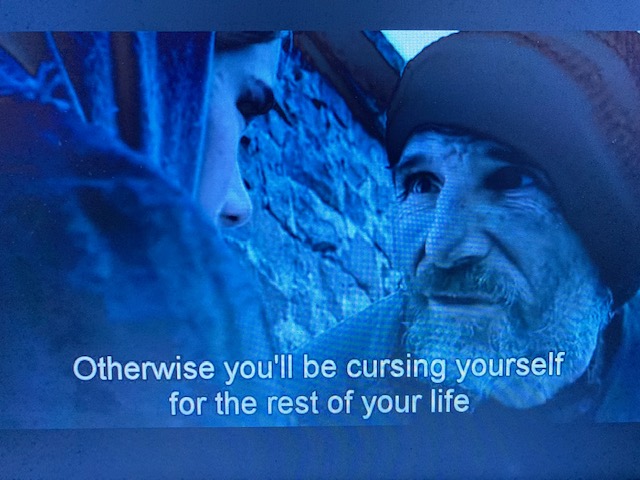
Get Off My Island

 "The Island" is a 2006 Russian biographical film about a 20th century Eastern Orthodox monk. Pyotr Mamonov, who plays the lead character, formerly a rock musician in the USSR, converted to Eastern Orthodoxy in the 1990s and lives now in an isolated village. Film director Pavel Lungin said about him that "to a large extent, he played himself." Mamonov was first very hesitant to play in the film, but then was urged by his confessor to play the character. After the filming, one of the movie crew staff decided to stay on the island and live there as a hermit.

Here's a great scene (in stills) of the starets (the holy fool) giving some straight talk to a pregnant teen who seeks him out:


Thursday, April 21, 2022

Review: "Father Stu"


In a 2017 interview with Aleteia, filmaker Barbara Nicolosi gives an astute insider perspective on the state of the Christian movie industry:

"What happened was that the Evangelical world started guerrilla filmmaking for itself and found a way to turn a profit doing it. By comparison with mainstream movies, the numbers are generally small, but the studios noticed and have been very happy to distribute the films to the Christians and make a few bucks in that space. Every studio now pretty much has a faith division where they’re looking for content for that niche market. This is good and bad. The good part is the mainstream industry is talking to people of faith instead of thinking of us as what’s wrong with the world. The bad part is that it’s ghetto-ized us.

They’re trying to find the political spot that makes a movie something the Christian audience will rally around, as opposed to trying to make something beautiful. The truth is we don’t need a rally, we need to experience compunction ourselves, and we need to attract people who don’t believe that we believe."

I respect Ms. Nicolosi because she is striving within a bottom-line, often godless industry to "make something beautiful." That is art, or at least should be one of the ends of (good) art. 

Films like The Passion of the Christ straddled that line between film as film and film as art. It was a moving, powerful cinematic project that grossed well and made cinematic history in the modern age. While not without some controversy, it's objective was to stir the spirit of man on the screen by depicting the graphic reality of Christ's torture and death on the cross. To that end, I believe it accomplished it's purpose.

Father Stu, starring Mark Wahlburg, is not art. But it is also not a ghettoized, low-brow Christian film turning fifty-cent tricks, or a Formed-worthy porcelain portrayal of the sanctity of the priestly calling you watch with your kids for movie night. It is something else entirely, and may have come onto the mainstream movie scene at an opportune time. When a worldly audience not yet redeemed hungers for purpose, redemption, and God Himself but finds overtly faith-based films unpalatable, it may have just found a curious niche.

Father Stu tells the true story of the life, redemption, and eventual grace-inspired ordination of Fr. Stuart Long, who as his mother says of her son, doesn't do anything half-heartedly. 

When his past-prime boxing career fails to pan out and his foray into acting falls flat, Stuart struggles to find his purpose. He is passionate and unrefined, rough and hard scrabble, which comes out in his fighting (both in bars and in the ring). At his core, he carries a deep father wound as a result of the lack of affirmation from his own father (played by Mel Gibson), which brings with it the experience of anger towards God, especially in the shadow of his younger brother's unexpected (and seemingly unfair) death at the age of five.

While working in the meat department of a local grocery store, Stuart is smitten with the beautiful Carmen (played by Teresa Ruiz), who he discovers is a devout and evangelistic Catholic and Sunday school volunteer. In his willingness to do anything to capture her affections, he agrees to be baptized and enters into R.C.I.A (the Rite of Christian Initiation for Adults). He's trying--hard--to be "good," though shortly after his baptism he goes to the bar, gets drunk, and brushes up against death's door when he T-bones a car on his motorcycle. Through an (unconvincing, in my opinion) encounter with the Virgin Mary while lying bloodied on the pavement, he appears to receive the much-needed grace to eventually turn away from the sins of his past life and give himself to God in service.

While his seemingly impulsive "discernment" to become a priest as a means of carrying out this purpose appears at first to be just another one of his half-cocked fancies, his tenacity in exercising the will and not letting anything stand in his way actually works to his advantage to overcome obstacles. But as saints like Augustine know, the Pelagian "will alone" does not in itself suffice one to become good and holy; it must be aided by grace. And that grace comes in the form of his unexpected diagnosis with a muscular-disease (similar to Lou Gehrig's). Suffering is the teacher of all teachers, and when it comes to learning humility and dependence, is effective at exacting the lessons for its subject. Although initially reticent to carry out his ordination as Stuart's illness progresses and he is confined to a wheelchair, the bishop is persuaded and Stuart does become "Father Stu." He visits men in prison, hears confessions, and eventually dies at age fifty "a priest forever, in the order of Melchizedek" (Heb 7:17; Ps 110:4).

As the Angelic Doctor, St. Thomas Aquinas notes, "grace does not destroy nature, but perfects it." A film is lost on its audience if it's characters are not believable, especially when they are asked to step outside their comfort zone in viewing it. Thankfully authenticity (aided by competent acting) is not lacking in the film. I think the film does over-compensate a bit in the excessive use of coarse language (and use of the Lord's name in vain), which can be jarring and unnecessary at times to those with more sensitive consciences. Again, this isn't the type of movie you would watch on Formed, and it's R rating is appropriate. If you can look past these callouses, the underlying story of God making smooth stones with coarse rock has a redemptive and inspiring element that those of us with sinful pasts can well relate to.

Every sinner has a past, something we as Catholics sometimes forget--what it's like to sit in the back pew like a publican, not knowing when to sit and when to stand, offending others with our ignorance; what it's like to stumble while trying to find our footing after being washed clean in the waters of baptism...in essence, when we "become good" (by grace), we can sometimes get--well, religiously uppity. 

Father Stu as a film has the potential to bring "good" Catholics back down to the gritty earth, while also inspiring those ignorant of the faith to look beyond the porcelain veneer of two dimensional church-goers and unrelateable clergy. At the heart of the universal salvation story present in Father Stu is the meaty center of what it means to be a fallen man ransomed and redeemed, transformed by the gift of suffering, and called by God into the vocation prepared for him.