Friday, June 24, 2022

If You've Never Seen Demons In The Flesh Before....

 ...You will soon. They're about to come out in full force.

Dig in. It's about to get real.


"Now the Spirit speaketh expressly that in the latter times some shall depart from the faith, giving heed to seducing spirits and doctrines of devils" (1 Tim 4:1)


Sunshine In A Bottle


 When I first came into the Church, I had a tough time with Mary, the Mother of God. Not for any theological reasons, but simply in a relational sense. One often hears of struggles people have with God as Father because of their wounds with their own father. For me it was the opposite--my father exemplified the unconditional love shown by the father to the prodigal son in Luke 15. But with Mary, it was an issue of her being peripheral. 

I have a good relationship with my mother and love her dearly, but I realize in sitting down tonight I don't mention or write about her much. And that's how I viewed Mary, the Mother of God, for a long time--not sure how she fits into the picture of my newfound faith. I learned to pray the rosary during those first years as a Catholic, but it was hardly my favorite prayer. My recitation of it seemed to stay on the surface of things above the depths, which now in hindsight, would be a good description of my relationship with my mother. 

My mom may quite possibly be one of the nicest and most pleasant people you will ever meet. I have described her to people who haven't met her as "literally, sunshine in a bottle." My brothers and I joke about her "permagrin"--that is, the fact that she is always smiling. I don't think it's superficial, either. She is a genuinely happy person.

But part of that happiness and effervescence is perhaps why I had trouble relating to her growing up as a broody teenager who thought about things deeply and was discontent with the supericial and fleeting nature of existence, and even today as an adult. My mom is a smart, educated woman, but she doesn't necessarily "go there" when a conversation gets too deep. She prefers to stay on the surface rather than stare into the sun with the naked eye, and will sometimes change the subject to something more essentially palatable if the discussion vears too existential. Maybe this is how she is able to maintain her positive outlook on life, by not staring straight into the abyss on the daily the way I tend to sometimes. 

I've put her through the ringer growing up, and between dealing with me and my dad and our mental health issues, she is stronger than I give her credit for. She also has a natural deference to my father's authority in most matters, though my father also recognizes how much he relies on her to complement his own deficiencies. Their marriage has withstood a lot in large part to this model, and I give her credit for it.

But there is also a degree of frustration on my part in expecting my mom to be someone she is not from time to time. For one thing, as much as I would love for her to come into the Church as a Catholic, she remains outside of it. It is not a negative in our relationship, and there is no antagonism, but I have trouble understanding people who do not consider the four Last Things: Death, Judgement, Heaven, and Hell. The impetus is not there. I want her to know herself the joy that is our hope, not the happiness tied to the externals or pleasures of this temporary life. But ultimately, these decisions to pick up our cross and follow the Truth wherever it leads must come from the individuals themselves.

It's hard to reconcile sometimes. How will the good Lord judge my mom when she comes before Him? Am I effectively living with the cognitive dissonance of trying to reconcile a modernist concept of your religion not mattering, of being a "nice person" (which my mom most certainly is!) with the exclusive claims of the Church, the necessity of the sacraments? Maybe it's why I trend towards throwing myself on God's mercy and fearing His just judgement in the same breath. I fear the hellfire myself, but I also fear it for my family.

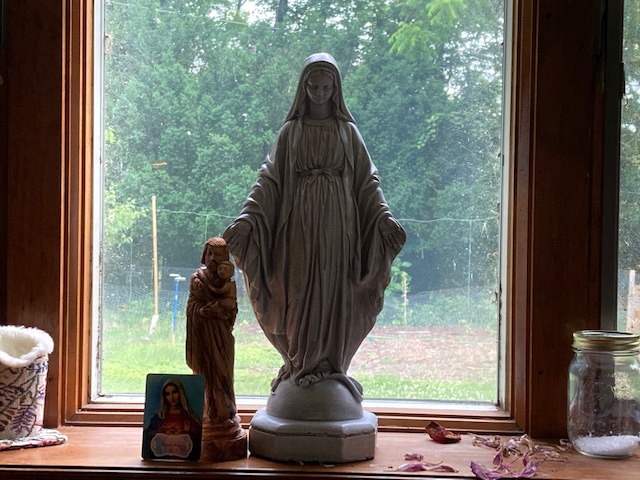
Ultimately, the Mother of God broke into my and my wife's life and flooded us with grace and afforded us her protection (by way of the Miraculous Medal). She is no longer peripheral. We pray the rosary regularly and are indebted to her for that grace.

I still hold out that that same grace might break through in my relationship with my mom. I want her so badly to be Catholic, and she's not, and I don't know what to do with that. I respect her enough not to force the topic, but maybe I'm not doing enough either to make the prospect hard to resist. And it becomes hard when you know that the popular sentiment of "good people go to Heaven" and "being kind is the most important thing" is false when you know the people you love fall into that category. "Lord, who can be saved?" As He tells us, "with men, it is impossible. But with God, all things are possible" (Mt 19:26). 


Thursday, June 23, 2022

Sit Not With Scoffers


Every now and then I will check on updates from former acquaintances in the faith who have since left it. Some are trying to figure out and reinvent themselves as former Christians. Some have simply transferred their former religious affiliations to a new flavor. Others have apologized for their former "hateful" way of life and like a college freshman coming home on Fall break, have done a 180 and love-is-lovingly embraced everything that was formerly counter to their religion. It's a cocktail of nuevo-kitch, tired predictability, and honest sadness. I'll sip the drink poolside in curiosity, but at the bottom of the glass it's just bitters.  I really need to stop following apostates.

Of the 150 psalms, the very first psalm, very first verse, begins: 

"Blessed is the man who hath not walked in the counsel of the ungodly, nor stood in the way of sinners, nor sat in the chair of pestilence." (Ps 1:1, DRA)

Why would David begin his Psalter like this? And why does St Paul in 1 Cor 5:11 exhort: the brothers:

"But now I have written to you, not to keep company, if any man that is named a brother, be a fornicator, or covetous, or a server of idols, or a railer, or a drunkard, or an extortioner: with such a one, not so much as to eat." 

As St. Paul also notes, "a little leaven leavens the whole lump" (Gal 5:9). Or, as a popular adage goes, "you are the company you keep." Believers are not immune to immoral influence, and the sowing of the seeds of doubt and scorn can be absorbed through the skin over time. 

Maybe this is why David promises the believers who find their delight in the law of the Lord that they will be "like a tree planted by streams of water, which yields its fruit in season and whose leaf does not wither— whatever they do prospers" (Ps 1:3). The goal is not to become a religious person, a "devout Catholic," or an exemplar within the community, but a lover of God's law and one who does His will. 

I think at the root of many of these disillusioned apostates and former Catholics is a deep seated woundedness. There can be a sense that their new juvenile atheism or their fervent conversion to non-deonimationalism, Orthodoxy, or what have you is the cure for their wound, which was caused by the Church herself. In some cases, this is not without warrant. One friend was abused within the Church, and is right to hurt and distrustful. But his anger and disgust for the institutional Church consumes him. It is clear from the outside (though maybe not from where he sits) that his wounds have not healed. I pray he finds his peace. But I'd bet whatever the new religion du jour is, it will simply mask over things unresolved. Healing must take place at the root. 

For another, his antagonism is directed at the community of believers and the institution itself. But in all these years, I have never heard him speak of his relationship with Christ. That's not to say he didn't have one, just that he never spoke of it or made it known. From where I stand--of COURSE the community is going to let you down; of COURSE the Church is dysfunctional and the power players within it hardly worthy of trust. The peripheries are easy targets, but the core, the center which holds everything together which is Christ, is nary mentioned. 

Why do I follow these wounded trainwrecks and listen to anything they have to say? I would not emulate them, and I do not respect their character, so why would I allow myself to be influenced by them or feed their narcissism and need for an audience? I can pray for them, sure, and I do; I know their wounds run deep and can only be healed by Christ the Divine Physician. I do not feel they are open to (loving) reproach, either, but only see it as further salt on their scars. They seek to bleed the pain by venting and continually throwing light on all the dysfunctions and abuses within the Church for others to see. 

I don't know if it is cognitive dissonance on my part, but none of this shakes my faith in Christ, my healer and deliverer. It may shed light on things I already know, or was only maybe loosely aware of. They may even have valid things to say, which I can try to sift through and respect for what it's worth. Then again, maybe it's like reading a Richard Rohr book just because he mentions Christ once or twice in it.

Part of it is probably a sinful curiosity as well. I don't wish them ill, but I do see they have not only separated themselves from the Church, but have nothing but contempt for it now. I would not count them as enemies, but it's hard to remain friends with such people, as much for them as for me. 

What more can we do? Treat them as tax collectors, as our Lord tells us--that is, sinners worthy of love and forgiveness, ones that are extended the invitation to come follow Christ by Christ himself--even if they have given up their seat at the table for their own personal greener pastures. 

Wednesday, June 22, 2022

The Most Ordinary Things


There was this thing floating around social media a while back, this little inspirational insight geared towards women and their spirituality. It went something like this:

GOD COMES TO THE WOMEN


Have you ever noticed how in the scriptures men are always going up into the mountains to commune with the Lord?

Yet in the scriptures we hardly ever
hear of women going to the mountains,
and we know why — right?

Because the women were too busy
keeping life going;
they couldn’t abandon babies,
meals,
homes,
fires,
gardens,
and a thousand responsibilities to make the climb into the mountains!

I was talking to a friend the other day,
saying that as modern woman
I feel like I’m never “free” enough
from my responsibilities,
never in a quiet enough,
or holy enough spot
to have the type of communion
I want with God.

Her response floored me,
“That is why God comes to women.
Men have to climb the mountain to meet God, but God comes to women where ever they are.”

I have been pondering on her words for weeks and have searched my scriptures
to see that what she said is true.
God does in deed come to women
where they are,
when they are doing their ordinary,
everyday work.

He meets them at the wells
where they draw water for their families,
in their homes,
in their kitchens,
in their gardens.

He comes to them
as they sit beside sickbeds,
as they give birth,
care for the elderly,
and perform necessary mourning and burial rites.

Even at the empty tomb,
Mary was the first to witness Christ’s resurrection,
She was there because she was doing the womanly chore of properly preparing Christ’s body for burial.

In these seemingly mundane
and ordinary tasks,
these women of the scriptures found themselves face to face with divinity.

So if — like me — you ever start to bemoan the fact that you don’t have as much time to spend in the mountains with God as you would like. Remember, God comes to women. He knows where we are and the burdens we carry. He sees us, and if we open our eyes and our hearts we will see Him, even in the most ordinary places and in the most ordinary things.


It irked me then, and it irks me now. And I've been trying to figure out why. 

I mean, I get the point. It speaks to the busy Marthas who "find God in the dishes & diapers." Most moms can't go to the bathroom for thirty seconds in peace without a toddler jiggling the lock on the door, let alone find time to themselves the way men do. It's sometimes thrown in our faces as a kind of "double standard" (usually when our wives are tired and frustrated and running on empty).  

Our Lord makes this clear in the ordering of the Commandments--Love God (first), then you will be able to love neighbor as yourself. He makes it clear that Mary has "chosen the better part" in her otherwise useless adoring at Jesus' feet while her sister runs herself ragged with the deets. 

When I was in discernment with the Benedictines, ora et labora was everything. This included an attentiveness to the work at hand so that it was not done slovenly or carelessly. And yet, it was clear that the actual, primary work (in the monastery) was prayer (ie, "the work of God"). 

Cue the eye rolling. "Well, this is a home, not a monastery. And you are not a monk. And while you are at it, do some dishes!"

All true. But back to the mom-post at hand.

What exactly is being conveyed here? I think what it comes down to is that I am not a woman. I think what irks me about it is this subtle inversion that the domestic work is, in fact, the "real work," and that men "going up the mountain to commune with God" is somehow the secondary. It lists out and numerates all the domestic duties--babies, meals, homes, fires. SAHM: 16. Husband: 1. Not to mention the messaging obviously meant to convey a sense of solidarity: Women stay put; men run off. Men have to climb the mountain to meet God, but God comes to women where ever they are.” 

On one level, I can't relate to their domestic work anymore than I expect my wife to be out mowing the lawn and sweating in ninety degree heat every ten days, or taking the car in for inspection and oil changes, or taking out the trash. This is stuff I do, and I'm fine with it. But it's not my primary preoccupation. It doesn't define my identity or where I find my "tribe," and it's in addition to putting 40+ hours in outside the home. It's just stuff that has to get done.

My primary vocation, however, is to head my family--spiritually, financially, and corporally. And yes, that sometimes does necessitate "going up the mountain to commune with God." This isn't something to be scoffed at or dismissed as pie-in-the-sky spiritual idealism, pitting women's work against men's work. If I'm not doing that (and believe me, it's not as often as I would like), I'm not following the Lord's model as a man, Jesus "who often withdrew to lonely places and prayed" (Lk 5:16); who was tested (Mk 1:12); who "very early in the morning, while it was still dark, left the house and went to a solitary place where he prayed" (Mk 1:35).

I have no issues with women finding solidarity with one another in their domesticity, which often can be their own kind of "lonely place" where they feel isolated and disconnected. There can be a tendency to enshrine the home as their kind of domestic palace where they rule as Queen. And God bless them for it. Let's face it--most men don't know how to do this stuff with the same touch that women do. A monastery, maybe. But without our wives, we'd have a house, but not a home. We benefit from it, and we shouldn't forget it.

But women, for their part, shouldn't forget that it's that very "communing with God" which is what spiritually fortifies the home and makes it a sanctuary from the outside world. If we traded those early morning hours, or those times away "up the mountain," we trade away our spiritual fortitude and protection which comes from hearing the word of God in prayer and carrying it out in our vocation as husbands and fathers. Otherwise we don't grow, but stagnate in the here and now.  

My wife has plenty of opportunities to get up early and pray the Psalms, or meditate on the scriptures, or drive to the Adoration chapel. So do I, for that matter. We just trade these golden opportunities for inferior things--scrolling on our phones, lounging around, shuttling from here to there. We both de-prioritize what should be our top priority--God--we just do it in different ways. 

I think where the difference lies is that men need to carve out this time intentionally and seperated from others, whereas women, in my experience, enter into those culiminated little moments of divine encounter throughout their day, organically, and often in communion with other women. It is natural for me to get up early and "go to a lonely place" to pray with a degree of asceticism, whereas for my wife this may not be necessary. For my part, if all I did was wash dishes and change diapers and make lunches or whatever all day, and didn't work (see Fred The Fireman and the SAHD Dillema), I think I would want to kill myself. For my wife, she jokes that as hard as it is some days on the SAHM front, she's "living the dream." And she means it.

Men's spirituality and women's spirituality doesn't have to be pitted or scored against one another. We are different for a reason--"male and female He created them"--and find and serve God in different ways. Though I have many women saints I admire, my calling is to be a man, and be the best man God has made me to be. That means prayer and work--ora et labora--appropriate to my state in life. Not "my work is my prayer." Prayer AND work. And if I have to go up a mountain for a few days to live that out, then so be it.
We find God when we embrace what He has called us each to live out and who he has made us to be, as men and as women respectively. Mountain or no mountain. 

Monday, June 20, 2022

Not By Constraint

Boniface at Unam Sanctam Catholicam had a good post the other day on the current papal clamp-down on the creation of new traditional orders. I found myself nodding along when reading about the current leachfield which is the state of the Church, not with despair, but tipping my hat to his creative insight as to how traditionalists should approach the faith and living it out under this current pontificate. Remember, we are to be wise as serpents and innocent as doves. A few snippets:


Point One: The Total Overthrow of Institutional Credibility

"The Church itself has continually debased its own institutional credibility since Vatican II by torrents of abuses gone too long unchecked, by the stream of garbled nonsense that is ceaselessly vomited out of the Vatican, and by unjust persecutions of Catholics whose only crime was to hold their tradition too dearly. The Church has spent a generation cultivating the mindset that the letter of the law doesn't ultimately matter; the "spirit" and the "signs of the times" are much more important. 

Thus, having worked so hard to enthrone the spirit, it is laughable that the Vatican now thinks it can rule by the letter; having spent a generation undermining the value of the letter, it now wishes to subvert the authority of every bishop by pen stroke. It is almost comedic. Liberals have long ignored the letter of the law; and Traditionalists have realized the implementation of the law is hopelessly stacked against them. The only ones still trying to square the circle are the naïve neo-Catholics, who have their heads so deep in the sand they can see Beijing. Traditionalism arose despite the letter of the law and it will not be crushed by the letter of the law—especially a law whose import has been eviscerated by decades of the Vatican's selective interpretation."


Point 2: Necessity of New Models of Organization

"But if no more traditional institutes are allowed to be erected by bishops on their own initiative, how shall we escape the letter of the law? The answer is simply that we will have recourse to organizational models not envisioned by the current canonical strictures. I refer you to an article called "Into the Woods" I wrote in 2018 in the aftermath of the Congregation for the Institutes of Consecrated Life document Cor Orans, which essentially revolutionized the way women's religious communities governed themselves. The gist of the essay is that as the institutional Church becomes more untrustworthy under the current zeitgeist, traditional movements will be more about living a certain lifestyle than obtaining any specific ecclesiastical status. The Vatican might regulate the episcopal erection of new religious institutes, but it can do nothing against a group of individuals living together and making their own private vows. It may prohibit the creation of a new priestly society dedicated to the Traditional Latin Mass, but it cannot prohibit priests who love the Traditional Latin Mass from organizing on their own outside of official channels. It may prohibit the Latin Mass being said in diocesan parishes, but it cannot prevent it being said in private venues. The Church can shove the NAB and the Liturgy of the Hours at me as much as they please, but they can't prevent me gathering with likeminded men to pray the traditional Divine Office in Latin. Whatever we want done, we are going to have to do it ourselves—not by going "against" ecclesiastical authority in any schismatic sense, but by merely operating in spheres where ecclesiastical authority has no say. This is how Christendom was built; St. Benedict had no episcopal letter when he clambered up the slopes of Mount Subiaco and wandered into a cave."


Point 3: Machiavellian Delegation and the Farce of Synodality

"In case anyone had any shred of doubt left, this should make it perfectly clear that Pope Francis's ideas about "decentralization" and "synodality" are farcical. The same pope who allegedly wants to allow local bishops' conferences to make true doctrinal judgments also wants to tell bishops what organizations they can and cannot erect in their own dioceses. This is the same pontificate that, in the explanatory letter after Traditionis Custodes, purported to tell individual parishes what they could and could not advertise on the parish website or in the parish bulletin. The same pontificate who has systematically dismantled the independence of various religious orders and trampled on their charisms. Decentralization and synodality indeed!

Francis does not, and has never wanted, decentralization. Rather, he believes in what I would call Machiavellian delegation. Actual decentralization is too risky. After all, bishops like Cordileone and Mutsaerts exist, and we can't risk allowing more space for their ideas. He lacks the testicular fortitude to throw the cards to the wind and see where they land. Actual administrative control must be centralized as much as possible. But, since Francis is the pope of the peripheries, he needs his more revolutionary bold-stroke changes to appear to come "from the people"; after all, if everything were imposed from top down, it would merely reinforce the caricature of Francis as a dictator pope. So certain things are strategically delegated to local churches where and when Francis knows they will return a result favorable to his overall agenda.  In this way the most radical changes can appear to have come "from the peripheries," their adoption being presented not as a bureaucratic fiat but as yielding to the vox populi that the God of surprises foists on us. It is a machination worthy of Pontius Pilate. To put it bluntly, power is centralized, but revolutionary change is outsourced.

It's all carefully crafted theater rigged to return pre-determined results."


I know some Catholics of tender conscience struggle when it comes to what and who we owe our obedience to with regard to Rome. Are we no better than dissenting liberal Catholics if the Pope says No Mas to the TLM? Shouldn't we just assent to whatever is coming from this cluster of a trainwreck that is Rome? It's something I struggle with and waffle on myself. I think Boniface has a good take on how to approach keeping the flame of tradition alive. 

(As an aside, the other day our family and I watched the 1973 film adaptation of Brian Moore's Catholics of a traditional hold-out order of monks in Ireland after the Second Vatican Council (second viewing for me). Martin Sheen plays one of the post-conciliar "new priests" sent from Rome to shut down the order and ban the Latin Mass. It's worth watching and relevant today, view it here. I reference some of the dialogue from the film in "I Was A Lefty Catholic and Other Tales," here)

As I was meditating on the readings this morning for the Feast of St. Silverius, St. Peter seemed to speak of this current situation we find ourselves in today:

"The ancients therefore that are among you, I beseech, who am myself also an ancient, and a witness of the sufferings of Christ: as also a partaker of that glory which is to be revealed in time to come: Feed the flock of God which is among you, taking care of it, not by constraint, but willingly, according to God: not for filthy lucre's sake, but voluntarily: Neither as lording it over the clergy, but being made a pattern of the flock from the heart. And when the prince of pastors shall appear, you shall receive a never fading crown of glory. But the God of all grace, who hath called us into his eternal glory in Christ Jesus, after you have suffered a little, will himself perfect you, and confirm you, and establish you.To him be glory and empire for ever and ever. Amen." (1 Peter 5:1-4, 10-11)


This pontificate will not last forever. Things may get worse before they get better, but what's going on in Rome for us here on the ground should not be our focus ad nauseum. We await the Prince of Pastors, after all.  


Saturday, June 18, 2022

To All The Ordinary Dads

 My father was extraordinary, but only in hindsight. As an only child, and having lost his own father the week before my dad graduated from college, having his own children was especially meaningful for him. 

I don't have a photographic memory--quite the opposite. It's probably why I write so much, because I can't remember anything. My childhood is a series of snapshots, vignettes of moments. I idolized my father, and we were close. Most of those memories with my dad growing up, however, are ordinary ones. 

There was the time when I was around eight years old; he had just sealed the driveway at the house we grew up in, and pretended to be stuck to the tar, yelling for me for help. I still remember when I jumped out of our big blue Chevy van and ran over to pull him out, and he feigned relief and made me feel like a hero. 

When I was thirteen or so, we set off together to bike from Eastham to Provincetown, Massachusetts while on vacation. I was nervous--it was about fifty miles round trip, and I only had a Kmart mountain bike and my dad a Panasonic 10-speed. But he had confidence we could make it. When we made it to the tip of the Cape, we bought donuts and sat on a bench overlooking the ocean.

After I graduated high school and set off to hike the Appalachain Trail, I remember calling him from a payphone at a lonely general store in New York state; I wanted to come home. When he pulled up a few hours later, I'll never forget the hug he gave me; I didn't need to say a word.

There were times I pushed him away, too. In my early twenties, when he came to visit me in a rough part of Harrisburg where I was living and running a house of hospitality for men in recovery, I lectured him on the the realities of poverty and inner-city living. He listened quietly, nodded his head and let me talk. I knew everything, after all. 

When I introduced him and my mom to the woman who was to become my wife, he took me aside and bought me a cup of coffee and we sat outside a bakery on Germantown Avenue in Mount Airy. When I asked him how you know you've met "the one," he said "you'll know it's her when you are more yourself around her than with anyone else."

I could always be myself with my father. I could confide in him, and he encouraged that. He wasn't distant, and took an active role in the lives of my brothers and I. I felt like he entrusted a special trust and responsibility to me as well because I was the oldest, which could feel onerous at times. Even now, as my parents are aging, I know most of the responsibility for caring for them will fall to me. 

My dad was extraordinary in how he loved us unconditionally, sacrificed everything for our sakes, and taught us how to go through life. He wasn't without his flaws and shortcomings. But when I think back on growing up with a father, it was very much in the ordinary moments and snapshots of memories I retained that formed my mental portrait of him. Now that I have my own kids, I find myself conscious of that privilege and working from the model I had growing up that my father gave me. 

As a good buddy and father of eight told me, "Ninety percent of life is just showing up." For all the new fathers, and those with a few years under their belt--you don't have to do big things, heroic things, novel or spectacular things. Sometimes it's just about showing up. And I'll let you in on a little secret: there's no "World's Best Dad" contest to have to compete in. Most of what your kids are going to remember about you are going to be these little snapshots of moments, the everyday instances they'll catalog for years and reference later where you made the decision to step in and show up. It's the one place in life in which an otherwise ordinary dad can grow to be an extraordinary man.


Thursday, June 16, 2022

You Are Not Untouchable


One of the most unnerving and wiley capital sins--if not the most--is pride. It is probably the sharpest arrow in the Devil's quiver because it was Satan's pride which was his ultimate downfall. Remember, Lucifer ("Light-bearer") was a seraphim, the highest choir of angels who see and adore God directly. In the beginning angels had free will, and Satan exercised it: "I will not serve." One-strike policy. 

Thanks be to God, by the gift of grace, we have the opportunity to repent and turn back to God in this life when we turn away by this gift given to the angels, that of free will, for "the Lord is good; His mercy is everlasting" (Ps 100:5). 

To bring a soul down by pride--even would-be saints one ladder rung away from their salvatific repose--is one of Satan's greatest and most effective strategies (see the icon above depicting The Ladder of Divine Ascent). That's why it's so important to constantly employ and cultivate the virtue of humility, and pull up at the root even the tiny strands of pride which have the potential to give birth to sin, and ultimately, death (Ja 1:15). 

But there is another sin closely related to pride that is very damaging to the fortification of the soul as well, and that is presumption. The Devil leverages this sin early on in the Garden in a way ("Did God really say you must not eat the fruit? You will not surely die."). In a similar vein to his own demise, the one-strike policy applied to man before the Fall. Eve's disobedience was enough to banish them for all eternity, and though God never stopped loving and caring for them, they had forfeited their protected sanctuary in the Garden, and enmity was introduced.  

Presumption is predicated upon the belief in God's mercy apart from the exercise of the will to repent:

"It may be defined as the condition of a soul that, because of a badly regulated reliance on God’s mercy and power, hopes for salvation without doing anything to deserve it, or for pardon of his sins without repenting of them."

I want to take this in a different direction if I may. For the arrows of presumption on which Satan has leveled his bow seek to strike to the heart of creation itself, as St. Lucia of Fatima predicted, "The decisive battle between the Lord and the kingdom of Satan will be over marriage and the family.” 

Spiritual blindness is not limited to those in the secular world. Many "good Catholics" have had their intellects darkened and wills compromised by the smoke of Satan permeating throughout the culture and within the Church Herself. These are Sunday (sometimes even daily) Mass goers, those who cantor or lector, are on the parish council, homeschool, have large families, maybe have even evangelized publically or written books or apologetics on the faith...basically are checking all the boxes and living their best Catholic life from all external goalposts. 

And yet, nothing is off-limits for the Devil, and these folks can become prime targets in this decisive battle. Attack the family through confusion and disorder (dysphoria, sodomy, etc), strike at the heart of marriage through adultery and pervert the generative function through pornography, lust, and covettetness. It is a notch in the bedpost for Satan.

It's a predictable strategy, and we can't say we weren't warned (St. Lucia, Our Lady of Fatima, above). And yet, it's working. Those who felt secure in their marriages and families, and their Catholic identity, PRESUMING their spiritual security, seem to be inexplicably falling left and right. Marriages of ten, twenty, even thirty years, founded on a firm foundation, open to life and fruitful, sacramental) are being attacked and corrupted through a kind of spiritual tear-gas wafting through the cracks in the doorjamb. The Devil smokes us out, and then cuts us at the knees. Then he lifts them up and turns them upon their wives, their families, and the Church herself to deny and denigrate everything that came before their fall. He predicates this flanking upon his own fall from grace. 

The Ladder of Divine ascent is a worthy icon for meditation. It should fill us with a holy fear, that no man, no saint, is secure in this life until he rests in the bosom of the Savior and hears the words "well done, good and faithful servant." I once asked an old monk when I was a teenager, "Father, do we ever reach a point when we are not tempted by lust?" And he answered dryly, "Yes. When you die."

I have quoted it again and again, but the scripture is true: "Take heed, lest you fall" (1 Cor 10:12). You are not untouchable, you are not immune. The more beautiful and wholesome your family, the more the Devil wants to take you out and thwart your spiritual generation. 

This should fill us with a despairing fear ("Who then can be saved?" (Mt 19:25)), were it not for the fact that death has been conquered, and grace is greater than sin. This does not mean we cannot sin, but we cannot be compelled to sin apart from our will. When we step into the Devil (the chained dog)'s pervue, we become vulnerable to his bite. St. Paul says "FLEE from sexual immortality" (1 Cor 6:18). Presumption moseys and yawns and assumes the best; vigilance braces, constantly scanning til daybreak the horizon for the enemy, and prepares for the worst. 

I think it's worth noting that the Devil can also use scrupulosity (for those prone to it) against us in this battle. A man should be confident--not in Himself, but in Christ--not paranoid. He should be limber enough to pivot when he needs to, not so tense that he breaks in the slightest wind. The Devil hates common-sense, because common-sense is founded in reason and right order. Common sense says "maybe it is more prudent to eat alone than go out to lunch with a female colleague." Common sense says one should keep firm but healthy boundaries in place without being a legalist. Common sense says don't scratch an itch unless you want it to get harder to resist. The Devil loves legalism, which is what scrupulosity is rooted in. 

It is clear (but still unnerving) how many marriages are seemingly inexplicably falling apart as a result of sin and blindness. Perhaps we need to consider this sin of presumption in the context of our standing with God, but also within our marriage and families as well. You are not immune. You are not untouchable. But you do not have to live in fear, as long as you build your house on rock, not sand, and fortify your sanctuary (your home, your marriage, your family). Be vigilant, because the stakes are high the more you ascend, and the fall from those rungs will break more bones than just your own.

Wednesday, June 15, 2022

I'm Sorry, But No One Has Your Back


Our vacation last week was a nice reset--we swam at the local pond, cooked, lay in the hammock, read, and spent time together. Some friends and family came to visit a couple of the days, but largely we were removed from our normal work and social routine. It was overdue. And one of the surprising side-effects I found was that I didn't want to see, text, or talk to anyone even after we got home.

Please forgive my slightly cynical mood at the moment. I have been pouring myself out at work, with little regard or recognition. In the works of charity, this is the desired approach to build humility and merit; but at work, I get chaffy and resentful. I've felt similarly in other areas of my life, and other circles--I shouldn't be surprised at this point how quickly people can turn their backs on you, social relations can sour, and how our expectations of reciprocity are often frustrated. I'm  human, and am tired of pouring into things when I often feel empty myself. 

In Genesis 18, Abraham negotiates with Yahweh, who is looking for 50 righteous men to stem his wrath against Sodom and Gommorah. Abraham talks him down to 45, then 40, then 30, then 20, and they finally settle upon 10. He only needs to find ten righteous men to spare the city. In the end it doesn't matter, for by the time the perverts hit Lot's door and want debauchery, not hospitality and charity, Yahweh has prepared His arm to destroy it all. You can only take so much.

Ten men...not even ten righteous men in the city. I often think about the bishops, the men of God: "Give me ten righteous bishops," the Lord asks, and you realize you have trouble numbering them all on one hand. Sure, you might get a "bold" tweet or some kind of stand that should have been made fifty years ago; the bar is so low we are impressed by even a modicum of so-called bravery. And I guarantee that any of the faithful to put their neck out to pay the price on any issue would not get backed up by one of the bishops with anything other than a standard dicoesan statement on the matter. As has been proven time and time again, they'll often be the first to throw you under the bus.

Words are cheap. We see it in scripture as well: on Palm Sunday, when the crowds chanted Hosana to the King of Kings only to quickly change their tune before Pilate. We see Peter offering to die for Christ, and then disowning him. The disciples couldn't even stay awake for one hour in Jesus' greatest time of need, his most desolate hour. We see it at the Cross, when only his mother and a handful of others stay at his feet.

Christ's abandonment can be spoken of in two ways: his complete abandonment to the Father's will, and his being almost completely abandoned by men in his hour of need. He is stripped and scorned, with no human solace. His cry from the cross is a worthy meditation: Eli, Eli, lama sabachthani? ("My God, my God, why hast thou forsaken me?"). For the pain of abandonment had gone so deep as to echo David's cry that his own Father had left him. The cavalry isn't coming, because the Father willed that Christ go through, not around, the suffering and abandonment. Which, of course, is straight to the Cross, the loneliest of lonely sufferings and humiliations.

We don't often do the same. We seek human comfort and understanding, a shoulder to cry on or an ear to listen to your lament. But the longer you are in the grind, the more you realize the establishment (from the Holy Father on down) is a in-name-only set of reinforcements. Maybe it's unrealistic to expect otherwise. The Church has been made weak and a laughingstock not to be taken seriously. Because the saints and those willing to pay the price of discipleship among them do not number in the 50, or 45, 40, 30, 20, or even 10. As the sheep are led to slaughter, those willing to lay their lives down for them can be counted on one hand; the rest are simply weak men and pious administrators. 

 You will have a few friends (hopefully) in your lifetime who will sit with you in the Garden when you are sweating blood, come to your Cross, and not leave when it's dinnertime. I haven't found those friends yet, and I haven't been one either, so I don't even blame them. One can't expect too much. 

Even family, as thick as it can be, is not absolute. Otherwise Christ would not have subjected the Fourth Commandment to the call to hate father, mother, wife, children, and breathren for the Gospel (Lk 14:26). Children turn on their parents, parents disown their children. Many converts know this pain, and it cuts absolutely deep. 

There is one who does have your back, though, and that is Christ, our God, our deliverer in whom we have our hope. Zion said, The Lord has forsaken me! And yet,

"Can a mother forget the baby at her breast and have no compassion on the child she has borne? Though she may forget, I will not forget you! See, I have engraved you on the palms of my hands; your walls are ever before me" (Is 49:15-16).  

I think entering into this sadness, this desolation, can be a fertile burial plot for our spirit. No one would choose it, but when we find ourselves feeling alone and abandoned, sucked dry and empty with nothing left, the love of the Lord has room to fill us, bathe us, and comfort us. Our spirits are often crowded with the coming and going of men, of engagements, of sweet encouragement and contingent affection. 

But at the end of the day, everyone goes home to their own house promising to come back in the morning, and the sweaty dark of night seeps into your cell from beneath the door jamb. We can meet Christ now, because he has now found room at the inn. When no one else has your back, when the reinforcements aren't coming, when you are hung out to dry and have no consolation and your tears become your bread...I think then you will taste a little bit of the loneliness of Christ, who had nowhere to lay his head in this world.

Tuesday, June 14, 2022

How To Discern A Move


 State Farm had a great commercial a few years ago that almost every dad could relate to. It starts with a young man poolside with his friends at a party who says, "I'm never getting married." The next scene is of him picking out a ring at a jeweler. Subsequent scenes include "We're never having kids" while on an airplane, followed by...the wife in labor; "We're never moving to the suburbs" while in their city apartment with their child, followed by his family outside their new suburban home; "We're never getting one of those," followed by him washing his new minivan. And so on.

I've followed this sequence pretty predictably and to the letter; at first I felt like a sell-out, a betrayal of some kind of pact I made with my past-self. But then you come to just accept it, that things change, and that it's more or less a natural progression. 

One thing I've noticed is some of my Catholic friends talking about moving to a "good diocese" or a "red state." Part of this is understandable, given that we tend to want to be surrounded by people who share our values. One friend I have with ten kids took advantage of the hot Phoenix real estate market and sold their home to buy 15 acres in the Midwest with the hopes of starting a Catholic community of families affiliated with a monastery. Another friend (also with a large family) did the same thing with their home in California to relocate to Ohio and start a hobby farm. One local friend wants to move downtown so they can walk to the local parish. One acquaintance wanted to flee our home state here to escape the imagined tyranny of our liberal Govenor and move to a "red state" like North Dakota. Another moved somewhat hastily from Australia to Mexico to flee the vaccine mandates. Some have spoken about being drawn to intentional Catholic enclaves like Ave Maria in Florida, or St. Mary's in Kansas. 

All this sounds great in theory. One night I even found myself browsing Zillow for houses in Steubenville (Ohio), where Franciscan University is located. "Wouldn't it be cool to live in a Catholic town, and be able to buy a house for $50,000? Hmm." I wasn't seriously considering it, but the thought went through my head, even though we have a great local Catholic community and parish here, our family is in the area, and we feel blessed to have found a home that we can see ourselves growing old in. All things not to be taken lightly or on a whim.

On the flipside, I had been conversing with a friend who had real doubts about the decisions he had made for his family to go to Haiti as missionaries (which ultimately didn't end up working out due to lack of funds), and joining the Air Force (which necessitated another move). He felt that he hadn't really discerned these decisions carefully, but was trying to find solutions to problems that needed addressing (dealing with student loans, as one example).  

Apologist Devin Rose wrote a book a few years ago titled, Farm Flop: A City Dweller's Guide To Failing On A Farm In Two Years Or Less. In it he honestly details the dreams and realities of moving from the city to live out the ideals of Distributism and the Catholic Land Movement. I didn't read the book, but he offers some illustrations of how things didn't go as planned and how they had romaticized such a move (and vastly underestimated the amount of work required to run a farm) here. They eventually landed on their feet, and learned from the experience, but it was still an ordeal. 

Moving is sometimes necessary, and sometimes self-initiated. I initially didn't want to move from our row house in the city because of the hassle and stress, but it ended up being the best thing for us. And it's true that Americans used to move with much greater frequency in the early part of the 20th century, and that uprooting has become less prevalent in subsequent decades. But like all big decisions that can have an effect on our families, it should be discerned carefully and prudently. When a friend texted me an idea of buying an abandoned monastery and was trying to get other Catholic families to buy in and split it up into family units, I felt like I rained on his parade by bringing up the counter-points (that he hadn't considered): Where will the men work? Will they be able to find jobs to support their families? What is the local economy like? Will they need to retrain in a new industry? What about the neighboring community? The local parish? What if the families got along in our local area but didn't in this new community? How would ownership and zoning laws factor in? 

But these are valid points and even if they dampen the dreams with the realities that will have to be dealt with, they deserve to be considered, especially if a family is considering uprooting to go in on the idea. 

There is also this idea for fervent Catholics that a move from a "bad diocese" to a "good diocese" may outweigh other considerations, since faith comes first. But as one can see with what's happening in Phoenix currently, I'd hate to have moved there under Bishop Olmstead's charge only to be greeted by the new appointment of "LGBT-positive" Bishop Dolan. Church hopping because you "like the pastor" is another example on a smaller scale; and yet, pastors are reassigned quite frequently (maybe for good reason, but not without effects on the local parish community), making decisions based on this short-sighted. 

I think social media can have its drawbacks in this regard--when housewives see others in their circle on Instagram or Facebook lamenting or extolling this or that, there is a kind of infectious desire to be part of it, or find dissatisfaction with their current situation; in some cases, they may apply gentle pressure on their husbands to consider a move, which puts him in the difficult and pragmatic situation of having to find a new job, or even a new industry if jobs are not available where one has dreams of moving to. 

With any major decision, whether moving or anything else, one should as always take it to prayer. This cannot be overstated. A novena to St. Joseph (who was no stranger to moving his family) is a good start. The nine-day gestation period gives time for grace to percolate, and also to reflect on the real reasons and motivations one has for the decision. 

In addition to prayer, it can help to sit down and rationally make a pro/con list detailing the costs and benefits of a move (or a new job, or a new parish, etc). It's not contrary to faith to employ one's reason. This should be in consultation with one's spouse, and should ideally involve to a degree the children as well. All considerations should be taken into account, and weighed and discerned with regards to the family's particular circumstances and values (not because everyone on Facebook is doing it!). 

It may help to scout things out if possible, do research, and talk with people who actually live in the area you are considering moving to. Maybe rent a hotel and spend a week there to get a feel for it (again, if possible) and visit the local parish for Mass. You may find your idealized version may not square with how things actually are. 

I think it should be noted, too, that sometimes our dissatisfaction with our current situations come from something inside of us, rather than in the externals. We often blame our spouse when there is something inside of us that needs changing; we point to all the flaws in a parish when we aren't investing in it ourselves; we are unhappy in our jobs when maybe all we need is a shift in perspective or attitude. In those cases, it might make sense to stay put and not make any decisions in moments of dischord and unrest. There is something to be said in the "bloom where you are planted" mentality, and you may discern that your restlessness for "somewhere else" may have legitimacy, or it may just be an effect of not being at peace with yourself. 

Monday, June 13, 2022

A Christian Response To Abortion Advocates


Because I work in a secular and largely left-leaning environment, I don't have the benefit of people often having a Christian worldview. They may have a respectful curiosity about religious practice (assuming they are people of good will), so it is good practice if conentious issues come up to have a response that is concise, accurate, and hopefully allays ignorance of pre-conceived notions about religion. If someone is antagonistic from that point it is on them, but at least you can stand on your convictions and be able to articulate them with charity. As St. Peter says, "But sanctify the Lord Christ in your hearts, being ready always to satisfy every one that asketh you a reason of that hope which is in you" (1 Peter 3:15)

Remember, though, you can make arguments against abortion apart from religion through the light of reason and the Natural Law. But were one to take a religious (Christian) approach, that argument can be made as well. Here is one such (imagined) response I formulated at the kitchen table in prayer this morning.


Interlocuter: "Why are you against abortion rights? Why do you consider yourself anti-abortion?"


Christian: "The God I worship, Jesus Christ, became man through the womb of a simple woman, Mary, a virgin. She was chosen by God to bear God in her womb. Her circumstances were not ideal; she was poor, away from her home, and ended up giving birth in a stable. But everything hinged on her assent, her "yes."

You know the story of Eve, the mother of humanity, who lost the grace and friendship of God through disobedience in eating the fruit in the garden. Humanity was lost, but Christians believe God wanted to redeem them, but could only do so by becoming one of us. He did that through Mary, who conceived by the Holy Spirit. 

Mary did not say no to God; she said "yes." Just as the Ark of the Covenant was the dwelling place of God in the Old Testament, Mary's womb became the new ark, God's dwelling place. The womb is a sacred place where life comes from.

The opposite of life is death, and spiritual death is what all humanity merited after the Fall in the garden. God entrusted Mary to bear the Christ in her womb, and gave women a share in this divine creativity by bringing forth life from their wombs. 

Abortion takes the ark of life in every woman and turns it into a place of destruction, violence, and sacrilege. It is the anti-thesis of Christian belief in the sanctity of life, the sacredness of the womb, and the goodness of creation. It results in physical death, spiritual death, and says "no" to the gift of life that the God who created everything invites us to participate in. It can never be justified or condoned by any believing Christian."