Tuesday, November 9, 2021

The Shortcut Through Samaria

 My first class in grad school was a summer seminar on Romans, taught by a scholar who had spent his entire academic career studying this one book of the Bible. Yikes! I had been accepted to the program on a provisional basis, since I didn't have a background in theology. To boot, I had only been Catholic for a few years and was still "learning the lingo" as they say. It didn't help that beginning grad school commenced with one of the worst depressions I had experienced. It was so bad that my mother had to pick me up from my apartment once a week and drive me to class while waiting in the commons for me to finish. Every night I had to go home and look words up in the dictionary just to keep my head above water. I finished out the class with an A-. It was to be the beginning of an arduous five year period of grinding through the program while feeling like a complete outsider that didn't speak the language. 

I had moved to Philly from Harrisburg, where I worked and ministered in one of the roughest parts of the city, Allison Hill. My neighbors were the drug addicted, the dealers, the working girls. I remember one morning after Mass a young seminarian assigned at the parish across the street was in our rowhouse kitchen; his lexicon was composed almost exclusively of what we would call "church speak." I knew what a "trick," an "eight-ball," and a "john" were, but I didn't know what we he was talking about when he referenced an "alb" or a "ciborium." He was a nice guy, but from a different world.

As Catholics, we tend to seek out and fall in with our own. Like many cultures, we have our own lexicon we sometimes use as proving ground to show how Catholic we are. Msgr Pope has a great post on this here, where he notes,

"One time I proudly announced, “RCIA classes will begin next week, so if you know anyone who is interested in attending please fill out an information card on the table just outside the sacristy door.” I thought I’d been perfectly clear, but then a new member approached me after Mass to inquire about the availability of classes to become Catholic and when they would begin. Wondering if she’d forgotten the announcement I reminded her what I had said about RCIA classes. She looked at me blankly. “Oh,” I said, “Let me explain what I mean by RCIA.” After I did so, I mentioned that she could pick up a flyer over by the sacristy door. Again I got a blank stare, followed by the question “What’s a sacristy?” Did I dare tell her that the classes would be held in the rectory?"


The problem with this kind of "insider baseball" is that it can insulate us from the challenging work of sharing the Good News and making disciples of all nations. Those nations may be pagan, and they may be the places "where men fear to tread" because they are so foreign. In John 4 we see Jesus "had to go through Samaria" (Jn 4:4). He took the direct route north from Jerusalem to Galilee through Samaria, in contrast to most Jews who took the longer, indirect route east of the River Jordan through Peraea because of their hatred for the Samaritans. When I would visit clients for work when I lived in the city, I would cut across the most dangerous parts of the city on my bike because I didn't think to take a roundabout route. As a result, I had a lot of "encounters" that helped open my eyes to an societal underbelly where the Son of God is desperately needed but seen as a foreigner who would never deign to enter into this world if he knew what was good for him.

These places had their own language, their own lexicon, their own code of conduct. I read a lot of spiritual and churchy books, but I try not to limit myself either. One of these underbelly books I would like to read is Pimp written by a man who went by the moniker Iceberg Slim. Without glorifying or apologizing, he details his foray into and decades as a pimp in Chicago. It's a savage world that most of us cannot imagine. Because this was "his world" he writes in a way that many people would have to decipher, the way I would look up church words in the dictionary each night that first summer of grad school. As a result, he includes a "Glossary of Terms" he uses throughout the book. I thought it was interesting to contrast a sample of his gangster lexicon with the 'church speak' we commonly use as reputable Catholics. I'll include a truncated version of each at the bottom of this post.


The thing is, those who most desperately need the grace of God and the ransoming blood of Christ are those often most alienated by the spaces in which they can receive it. The Inquirer ran a story a few years ago about the infamous Kensington section of Philadelphia, and the abandoned churches there. If you've ever been there, it's like a scene from the Walking Dead--a former working class neighborhood that is now Philadelphia's largest open air heroin market. Even for those in the depths of addiction, there is a recognition of the divine and the sacred--even if it feels like a place far, far away:


"Day and night addicted people come and go by the dozens through once-boarded windows. Some get high and collapse onto mattresses. Some come looking for prostitutes. Others have made it a home. Even in the depths of addiction, they are drawn to the familiar, the normal. First, a library lawn, now a church.

"I know it's probably not the right thing to do," said Josh Green, who is 28 and originally from Kensington. For three months he has been sleeping on blankets in the filth of a lower church office. "But I honestly feel a little more comfortable because I know I am in God's house."

They talked of the church as a safe place – a place they show respect. As proof, Steven said, they rarely shoot up in the main church.

"We wouldn't disrespect it," he said, squeezing his fist tight and injecting his forearm, before falling back onto a mattress."

Across the hall, in what looked to be a former devotional chapel, someone had spray-painted a plea: "Forgive me, father, for my sins."


A former seminarian I used to be friends with and I used to park our cars at the Cathedral in Center City and set off on foot to the "tent cities" with bottles of water and rosaries/Miraculous Medals. We would sit with those on the streets and they would invite us into the "vestibule" of their homes. We would listen to their stories--of struggle and hurt, but also hope--and pray for and with them. That's it. Maybe this is the "field hospital" church that Pope Francis encourages us to be a part of. 

One of the greatest thing about charity (love) is that it is a universal language.  When we use street talk or church speak, we confine ourselves to our respective worlds and populations. But the Son of God came into the world not to condemn it, but that the world through him might be saved (Jn 3:17), as a ransom for many (Mk 10:45). As our Lord said, it is not the healthy who need a doctor, but the sick (Mk 2:17).


GLOSSARY


APPLE, New York City


BANG, injection of narcotics


BEEF, criminal complaint


BELL, notoriety connected to one’s name


BILL, a hundred dollars


BIT, prison term


BITE, price


BLACK GUNION, powerful, thick, dark, gummy marijuana


BOO KOOS, plenty


BOOSTER, shoplifter


BOSS, very good, excellent


BOTTOM WOMAN, pimp’s main woman, his foundation


BOY, heroin


BREAKING LUCK, a whore’s first trick of working day


BRIGHT, morning


BULL SCARE, blustering bluff


BUSTED, arrested and/or convicted


C, cocaine


CANNON, pickpocket


CAN, derriere


CAP, a small glycerin container for drugs


CHILI PIMP, small-time one-whore pimp


CHIPPIED, light periodic use of heavy drugs


CIRCUS LOVE, to run the gamut of the sexual perversions


COAST, somnolent nodding state of heroin addict


COCKTAILED, to put a marijuana butt into the end of a conventional cigarette for smoking


COME DOWN, return to normal state after drug use


COP AND BLOW, pimp theory, to get as many whores as leave him


COPPED, get or capture


CRACK WISE, usually applied to an underworld neophyte who spouts hip terminology to gain status


CROAK, kill


CROSSES, to trick or trap


CUT LOOSE, to refuse to help, to disdain


DAMPER, a place holding savings, a bank, safe deposit box, etc.; to stop or quell


DIRTY, in possession of incriminating evidence


DOG, older, hardened whore, or young sexual libertine


DOSSING, sleeping


DOWN, a pimp’s pressure on a whore, or his adherence to the rules of the pimp game; when a whore starts to work


FIX, to bribe so an illegal operation can go with impunity; also an injection of narcotics


FREAK, sexual libertine


Absolution:

Part of the sacrament of penance. It is the formal declaration by the priest that a penitent's sins are forgiven.


Abstinence:

Refraining from certain kinds of food or drink as an act of self-denial. Usually refraining from eating meat. Official days of abstinence from meat for Catholics are Ash Wednesday and Good Friday.


Acedia:

A less common synonym for sloth, one of the seven "capital" sins.


Acolyte:

A liturgical minister appointed to assist at liturgical celebrations. Priests and deacons receive this ministry before they are ordained. Lay men may be installed permanently in the ministry of acolyte through a rite of institution and blessing.


Almsgiving:

Money or goods given to the poor as an act of penance or fraternal charity. Almsgiving, together with prayer and fasting, are traditionally recommended to foster the state of interior penance.


Angelus:

A form of prayer said 3 times per day; morning, noon and evening.


Anointing:

A symbol of the Holy Spirit, whose anointing of Jesus as Messiah fulfilled the prophecies of the Old Testament. Christ in Hebrew - Messiah means the one anointed by the Holy Spirit. Anointing is the sacramental sign of Confirmation, called Chrismation in the Churches of the East. Anointings form part of the liturgical rites of the catechumenate, and of the Sacraments of Baptism and Holy Orders.


Apostasy:

The total repudiation of the Christian faith.


Apostolate:

The activity of the Christian which fulfills the apostolic nature of the whole Church by working to extend the reign of Christ to the entire world.


Ascension:

The taking up of Jesus into Heaven forty days after the resurrection and witnessed by the Apostles. Ascension Thursday is celebrated forty days after Easter.


Assumption:

The taking up of Mary, the Mother of Jesus, into Heaven. Celebrated on August 15.


Beatification:

The first step in the process by which a dead person is officially declared to be a Saint.


Beatific Vision:

The contemplation of God in heavenly glory, a gift of God which is a constitutive element of the happiness of heaven.


Beatitude:

Happiness or blessedness, especially the eternal happiness of heaven, which is described as the vision of God, or entering into God's rest by those whom he makes partakers of the divine nature.


Benediction:

A short service in which the consecrated Host is placed in a monstrance where it can be seen and venerated by the people.


Bishop:

From the Greek word "episcopos" meaning "overseer". A bishop is in charge of the Church in a local area. One who has received the fullness of the Sacrament of Holy Orders, which makes him a member of the episcopal college and a successor of the Apostles. He is the shepherd of a particular Church entrusted to him.


Blasphemy:

Speech, thought, or action involving contempt for God or the Church, or persons or things dedicated to God. Blasphemy is directly opposed to the second commandment.


Blessed Sacrament:

A term Catholics use when referring to the consecrated Host-especially when it is reserved in the Tabernacle. A name given to the Holy Eucharist, especially the consecrated elements reserved in the tabernacle for adoration, or for the sick.


Breviary:

A book containing the prayers, hymns, psalms and readings which make up the Divine Office (a form of prayer said by the Clergy.)


Calumny:

A false statement which harms the reputation of others and gives occasion for false judgments concerning them.


Canon of the Mass:

The central part of the Mass, also known as the Eucharistic Prayer or "Anaphora," which contains the prayer of thanksgiving and consecration.


Canonization:

The solemn declaration by the Pope that a deceased member of the faithful may be proposed as a model and intercessor to the Christian faithful and venerated as a Saint on the basis of the fact that the person lived a life of heroic virtue or remained faithful to God through martyrdom.


Catacombs:

System of tunnels used by early Catholics as hiding places when they were being persecuted.


Catechism:

A popular summary or compendium of Catholic doctrine about faith and morals and designed for use in catechists.


Catechist:

Someone who teaches Christian doctrine, especially in Parish or School.


Cathedral:

The official Church of the bishop of a diocese. The Greek word cathedra means chair or throne; the bishop's "Chair" symbolizes his teaching and governing authority, and is located in the principal Church or "cathedral" of the local diocese of which he is the chief pastor.


Celebrant:

The one who presides at a religious service. The priest at Mass is referred to as the Celebrant.


Chalice:

The cup used at Mass to hold the wine.


Charism:

A specific gift or grace of the Holy Spirit which directly or indirectly benefits the Church, given in order to help a person live out the Christian life, or to serve the common good in building up the Church.


Chastity:

The moral virtue which, under the cardinal virtue of temperance, provides for the successful integration of sexuality within the person leading to the inner unity of the bodily and spiritual being. Chastity is called one of the fruits of the Holy Spirit.


Chrismation:

The name used in the Eastern Churches for the sacrament of Confirmation, from the "chrism" or "myron" used in the anointing.


Ciborium:

A bowl or chalice-shaped vessel to hold the consecrated Hosts for the distribution of Holy Communion.


Clergy:

A term applied to men who have been Ordained for ministry within the Church. Bishops, Priests and Deacons are members of the Clergy.


Cloister:

A place of religious seclusion.


Commandment:

A norm of moral and/or religious action; above all, the Ten Commandments given by God to Moses. Jesus summarized all the commandments in the twofold command of love of God and love of neighbor.


Communion:

Holy Communion, the reception of the body and blood of Christ in the Eucharist. More generally, our fellowship and union with Jesus and other baptized Christians in the Church, which has its source and summit in the celebration of the Eucharist.


Conclave:

The meeting of the Cardinals in complete seclusion, when they assemble to elect a Pope.


Concupiscence:

Human appetites or desires which remain disordered due to the temporal consequences of original sin, which remain even after Baptism, and which produce an inclination to sin.


Confessor:

A Priest who hears confessions.


Conscience:

The interior voice of a human being, within whose heart the inner law of God is inscribed. Moral conscience is a judgment of practical reason about the moral quality of a human action. It moves a person at the appropriate moment to do good and to avoid evil. An examination of conscience is recommended as a preparation for the reception of the Sacrament of Penance.


Consecration:

The dedication of a thing or person to divine service by a prayer or blessing. The consecration at Mass is that part of the Eucharistic Prayer during which the Lord's words of institution of the Eucharist at the Last Supper are recited by the priestly minister, making Christ's Body and Blood his sacrifice offered on the cross once for all sacramentally present under the species of bread and wine.


Contemplation:

A form of wordless prayer in which mind and heart focus on God's greatness and goodness in affective, loving adoration; to look on Jesus and the mysteries of his life with faith and love.


Contrition:

Sorrow of the soul and hatred for the sin committed, together with a resolution not to sin again. Contrition is the most important act of the penitent, and is necessary for the reception of the Sacrament of Penance.


Convent:

The place where a community of Nuns live.


Conversion:

A radical reorientation of the whole life away from sin and evil, and toward God. This change of heart or conversion is a central element of Christ's preaching, of the Church's ministry of evangelization, and of the Sacrament of Penance and Reconciliation.


Council:

An assembly of representatives from the whole Church called together by the Pope to make decisions.


Creed:

A brief, normative summary statement or profession of Christian faith, e.g., the Apostles' Creed, the Nicene Creed. The word "Creed" comes from the latin credo, meaning "I Believe," with which the Creed begins. Creeds are also called symbols of faith.


Crucifix:

A cross with the figure of the crucified Jesus upon it. Used by Catholics to bring to mind the sufferings of Christ.


Deanery:

Several parishes form a Deanery. This unit is administered by one of the Priests' of the Deanery who has the title; 'Dean'.


Devil/Demon:

A fallen angel, who sinned against God by refusing to accept His reign. Satan or the devil, the Evil One, and the other demons were at first good angels, created naturally good, who became evil by their own doing.


Diocese:

A "particular Church", a community of the faithful in communion of faith and sacraments whose bishop has been ordained in apostolic succession. A diocese is usually a determined geographic area; sometimes it may be constituted as a group of people of the same rite or language. In Eastern churches, an eparchy.


Disciple:

Those who accepted Jesus' message to follow him are called his disciples. Jesus associated his disciples with his own life, revealed the mystery of the kingdom to the disciples and gave them a share in his mission, His joy, and his sufferings.


Dispensation:

Exemption from a Church law in a particular case for a special reason.


Divine Office:

The Liturgy of the Hours, the public prayer of the Church which sanctifies the whole course of the day and night. Christ thus continues his priestly work through the prayer of his priestly people.


Doctrine/Dogma:

The revealed teachings of Christ which are proclaimed by the fullest extent of the exercise of the authority of the Church's Magisterium. The faithful are obliged to believe the truths or dogmas contained in divine revelation and defined by the Magisterium.


Doxology:

Christian prayer which gives praise and glory to God, often in a special way to the Three Divine Persons of the Trinity. Liturgical Prayers traditionally conclude with the doxology "to the Father, through the Son, in the Holy Spirit"; the final doxology of the Lord's Prayer renews the prayer's first three petitions in the form of adoration and praise.


Ecclesiastic/Ecclesiastical:

Pertaining to or of the Church (Greek/Latin: ecclesia). Hence ecclesiastical government is Church government; an ecclesiastical province is a grouping of Church jurisdictions or dioceses; an ecclesiastic is a Church official.


Ecumenism:

Promotion of the restoration of unity among all Christians, the unity which is a gift of Christ and to which the Church is called by the Holy Spirit. For the Catholic Church, the Decree on Ecumenism of the Second Vatican Council provides a charter for ecumenical efforts.


Enclosure:

That part of a convent or monastery to which outsiders are not permitted.


Encyclical:

A pastoral letter written by the Pope and sent to the whole Church and even to the whole world, to express Church teaching on some important matter. Encyclicals are expressions of the ordinary papal magisterium.


Eparchy:

A "particular Church", a community of the faithful in communion of faith and sacraments whose bishop has been ordained in apostolic succession. A diocese is usually a determined geographic area; sometimes it may be constituted as a group of people of the same rite or language. In Eastern Churches, an eparchy.


Epiclesis:

The prayer petitioning God to send the Holy Spirit so that the offerings at the Eucharist may become the Body and Blood of Christ and thus the faithful, by receiving them, may themselves become a living offering to God. In every sacrament, the prayer asking for the sanctifying power of God's Holy Spirit is an "epiclesis".


Epiphany:

The feast which celebrates the manifestation to the world of the newborn Christ as Messiah, Son of God, and Savior of the world. The feast of epiphany celebrates the adoration of Jesus by the wise men, magi, from the East, together with his Baptism in the Jordan and the wedding feast of Cana in Galilee.


Episcopal/Episcopate:

Pertaining to the office of bishop Greek: episkopos), hence episcopal consecration, the episcopal college, episcopal conferences. Episcopate is a collective noun referring to all those who have received sacramental ordination as bishops.


Epistle:

From the Greek word meaning "letter," This word refers to the 21 books in the New Testament that were written as letters to instruct and encourage the members of the early Church.


Eremitical Life:

The life of a hermit, separate from the world in praise of God and for the salvation of the world, in the silence of solitude, assiduous prayer, and penance.


Eschatology:

From the Greek word eschaton, meaning "last." Eschatology refers to the area of Christian faith which is concerned about "the last things," and the coming of Jesus on "the last day": our human destiny, death, judgment, resurrection of the body, heaven, purgatory, and hell all of which are contained in the final articles of the Creed.


Eucharist:

The ritual, sacramental action of thanksgiving to God which constitutes the principal Christian liturgical celebration of and communion in the paschal mystery of Christ. The liturgical action called the Eucharist is also traditionally known as the holy sacrifice of the Mass. It is one of the seven sacraments of the Church; the Holy Eucharist completes Christian initiation. The Sunday celebration of the Eucharist is at the heart of the Church's life.


Euthanasia:

An action or an omission which, of itself or by intention, causes the death of handicapped, sick, or dying persons sometimes with an attempt to justify the act as a means of eliminating suffering. Euthanasia violates the fifth commandment of the law of God.


Eve:

According to the creation story in Genesis, the first woman; wife of Adam. God did not create man a solitary being; from the beginning, "male and female he created them". Because she is the mother of the eternal Son of God made man, Jesus Christ the "new adam," Mary is called the "new eve," the "mother of the living" in the order of grace.


Examination of Conscience:

Prayerful self-reflection on our words and deeds in the light of the Gospel to determine how we may have sinned against God. The reception of the Sacrament of Penance ought to be prepared for by such an examination of conscience.


Excommunication:

A severe ecclesiastical penalty, resulting from grave crimes against the Catholic religion, imposed by ecclesiastical authority or incurred as a direct result of the commission of an offense. Excommunication excludes the offender from taking part in the Eucharist or other sacraments and from the exercise of any ecclesiastical office, ministry, or function.


Exorcism:

The public and authoritative act of the Church to protect or liberate a person or object from the power of the devil (e.g., demonic possession) in the name of Christ. A simple exorcism prayer in preparation for Baptism invokes God's help in overcoming the power of Satan and the spirit of evil.


Expiation:

The act of redemption and atonement for sin which Christ won for us by the pouring out of his Blood on the cross, by His obedient love "even to the end". The expiation of sins continues in the mystical Body of Christ and the communion of saints by joining our human acts of atonement to the redemptive action of Christ, both in this life and in Purgatory.


Fasting:

Refraining from food and drink as an expression of interior penance, in imitation of the fast of Jesus for forty days in the desert. Fasting is an ascetical practice recommended in Scripture and the writings of the Church Fathers; it is sometimes prescribed by a precept of the Church, especially during the liturgical season of Lent.


Filioque:

A word meaning "and from the Son," added to the Latin version of the Niceno-Constantinopolitan Creed, by which the Latin tradition of the Creed confesses that the Holy Spirit "proceeds from the Father and the Son".


Font:

A basin or bowl in a Church used for the Baptismal water.


Fornication:

Sexual intercourse between an unmarried man and an unmarried woman. Fornication is a serious violation of the sixth commandment of God.


Free Will:

Human experience which governs our actions and gives us the freedom to make choices regarding our full expression of God's love.


Genuflection:

A reverence made by bending the knee, especially to express adoration of the Blessed Sacrament.


Godparent:

The sponsor of one who is baptized, who assumes a responsibility to assist the newly baptized child or adult on the road of Christian life.


Guardian Angels:

Angels assigned to protect and intercede for each person.


Habit:

The distinctive form of dress worn by members of religious communities.


Hail Mary:

The prayer known in Latin as the Ave Maria. The first part of the prayer praises God for the gifts he gave to Mary as Mother of the Redeemer; the second part seeks her maternal intercession for the members of the Body of Christ, the Church, of which she is the Mother.


Heresy:

The obstinate denial after Baptism of a truth which must be believed with divine and Catholic faith.


Hermit:

One who lives the eremitical life. Through silence and solitude, in prayer and penance, the hermit or anchorite vows, although not necessarily publicly, to follow the evangelical counsels out of love for God and desire for the salvation of the world.


Hierarchy:

The Apostles and their successors, the college of bishops, to whom Christ gave the authority to teach, sanctify, and rule the Church in his name.


Homily:

Preaching by an ordained minister to explain the Scriptures proclaimed in the liturgy and to exhort the people to accept them as the Word of God.


Homosexuality:

Sexual attraction or orientation toward persons of the same sex and/or sexual acts between persons of the same sex. Homosexual acts are morally wrong because they violate God's purpose for human sexual activity.


Hope:

The theological virtue by which we desire and expect from God both eternal life and the grace we need to attain it.


Host:

The wafer of consecrated bread which Catholics receive at Holy Communion. It is usually disc-shaped and thin for convenience and there are two sizes; the larger is used by the Priest at the altar.


Hypostatic Union:

The union of the divine and human natures in the one divine Person (Greek: hypostasis) of the Son of God, Jesus Christ.


Iconoclasm:

A heresy which aintained that veneration of religious images is unlawful. Iconoclasm was condemned as unfaithful to Christian tradition at the Second Ecumenical Council of Nicaea in 787 A.D.


Idolatry:

The divinization of a creature in place of God; the substitution of some one (or thing) for God; worshiping a creature (even money, pleasure, or power) instead of the Creator.


Indulgence:

The remission before God of the temporal punishment due to sin whose guilt has already been forgiven. A properly disposed member of the Christian faithful can obtain an indulgence under prescribed conditions through the help of the Church which, as the minister of redemption, dispenses and applies with authority the treasury of the satisfactions of Christ and the saints. An indulgence is partial if it removes part of the temporal punishment due to sin, or plenary if it removes all punishment.


Inerrancy:

The attribute of the books of Scripture whereby they faithfully and without error teach that truth which God, for the sake of our salvation, wished to have confided through the Sacred Scriptures.


Infallibility:

The gift of the Holy Spirit to the Church whereby the pastors of the Church, the pope and bishops in union with him, can definitively proclaim a doctrine of faith or morals for the belief of the faithful. This gift is related to the inability of the whole body of the faithful to err in matters of faith and morals.


Inquistions:

Official investigations by the Church of suspected heresies.


Intercession:

A form of prayer of petition on behalf of others. The prayer of intercession leads us to pray as Christ, our unique Intercessor, prayed.


Intercommunion:

Participation or sharing in the reception of the Eucharist or Holy Communion by Christians who are not fully united to or in full communion with the Catholic Church.


Irreligion:

A vice contrary by defect to the virtue of religion. Irreligion directs us away from rendering to God what we as creatures owe him in justice.


IHS:

three letters from the Greek name, Jesus.


INRI:

the initial letters form the Latin inscription written on the cross: Iesus Nazarenus Rex Iudaeorum, (Jesus of Nazareth, King of the Jews).


PX:

a monogram of the first two Greek letters for 'Christus'.


Justification:

The gracious action of God which frees us from sin and communicates "the righteousness of God through faith in Jesus Christ" (Rom 3:22). Justification is not only the remission of sins, but also the sanctification and renewal of the interior man.


Kyrie EleiSon:

Greek words meaning; "Lord have mercy". Sometimes said or sung in Greek during the penitential rite of the Mass.


Monday, November 8, 2021

The Flowers In The Corner

I'd like to say of the day I proposed to my now-wife, "I remember it like it was yesterday." But the truth of the matter is, I only have snippets--vignette-like petals of memory, the shards of window glass lying on the doorstep after a break-in.

I remember the name of the coffee shop downtown where we had our first date. It was an establishment trying to figure out it's identity: was it a coffee shop? A gourmet food bar, where you could fill half-quart plastic containers with pricey olives and egg salad? A sit-down establishment or a grab-and-go? I had arrived there early; I was wearing corduroy carpenter pants and nervously killed time penning a Metro crossword puzzle I kept in my back pocket. I had more hair on my face than I did on my head. 

I don't remember her walking in, or what she was wearing apart from a slightly conservative knit sweater, which she would tighten around her chest as we talked. She ordered a tomato basil salad--cherry tomatoes, because she offered me some and I popped them in my mouth like gobstoppers. We talked about our faith, our respective conversions and reversions. She was so nice, though, so easy to be around. She may have been the kindest person I had ever met. 

We got engaged five months later. I proposed on top of a hill at a park in the city over a picnic. It was nothing fancy or contrived, but I had some roses and a ring. Afterwards, we stopped at the grocery story for toilet paper and instant pudding since she was out of both.

Everything related to my memory is bits and bobs, but a complete aberration of timelines and markers. I'm not so bad as Guy Pierce in Memento, but it's a struggle. I attribute it to two and a half decades of anti-psychotic medications, but I guess you never know. It scares me some; I'm not a reliable witness of anything. I wonder if I will suffer from Alzheimer's in old age. I write to remember, because I so easily forget. 

We went through the toilet paper and the instant pudding we used to make friendship bread that afternoon in mid-summer twelve years ago. But the roses remained, now dried and retained in the corner of our family room. Most days, we forget they are even there. If you were to touch the dragon's breath interspersed among the roses, it would explode like a puff of dandelion spores, fall to the carpet like a brush of dandruff. So we don't touch them. They are a museum piece to that iconic time in between my first date with my new love and my last day as a bachelor.  

As the years pass, one after another, like the mosaic of leaves that fall year after year around this time, this material memorial remains inconspicuously in the corner of our family room. One kid, then two, now three. The baby of the family, now almost four, still has his baby voice, but I wonder for how long. I try to pay attention to the moments when he speaks, so I can mentally catalog the audio, but I know it's no use. I will forget, just like I forget what time of day or night they were all born. 

I remember with our second, our first daughter, getting some air outside the hospital while my wife rested after the birth. There was slush on the ground, and as I smoked a cigarette in a Wawa parking lot I remembered saying to God, "I can't do this," and telling Him that He would have to handle it all because otherwise I would just worry about everything.

I don't know where the days go. Everything bleeds together. That was almost nine years ago. In six years my oldest will be driving. Eventually those voices will deepen and fade out. The noise and mess will be replaced with something else (order? quiet?) and I think then the sadness will settle in because I will want to remember every detail and won't be able to. Just these little snippets of memories. 

Someone will breathe on the dragon's breath of my mind and the spores will just flutter off. We'll have the solid gold bands on our fingers, the hardened foundation of our vows, and hopefully the aquifer of our love for one another that will not have run dry. And we'll have the dried flowers in the corner, the museum piece of our beginnings that shouldn't be moved too quickly or carelessly, for fear of it blowing away like crimson powder into eternity.

Sunday, November 7, 2021

How To Build Catholic Community

 Last year I opened up an American Airlines credit card and within a year used free air miles to hit three cities: Phoenix, St. Louis, and Houston. When I was more active on Facebook, and when my base of friends began to shift to becoming almost exclusively people of faith, I began to visit friends across the country, well, just because. I found I held more in common with strangers who were Catholic than secular folks who I had been friends with for years. This is the joy of the faith.

I made the suggestion to a friend in Phoenix "We should have a Catholic party," and she said let's do it. Word got out, and people came from all over the country for a giant house party. This was during COVID when people were craving community under lockdown. It ended up being the best remedy. It was awesome. St. Louis is an incredible city to be Catholic--lots of Catholic history and heritage, beautiful old parishes, and strong traditional communities. My base there started with a couple online friends, but built up like seven degrees of Kevin Bacon. I've been there twice so far, and would love to get back for a third. My trip to Houston was two-fold in nature--to visit a buddy (whom I had met on Facebook) and scout out his strong men's group to get ideas for the one we were building up back on the East Coast. Had a great few days experiencing Texas hospitality at my friend's house, smoking meats (and cigars) and drinking whiskey with other Catholic men.

Because I am a recruiter for work, I've been trained to, well, recruit. When I pitch, I realize I have a few seconds max to make a case to someone to listen to what I have to say (the 'elevator speech'). As a recruiter, you have to be somewhat outgoing, approachable, informative, inviting without being aggressive, and make a case that you are worth listening to. Follow-up is important, as you ultimately want someone to commit to your product or service; its also just good customer service to do so. 

The Catholic Church has survived two thousand years in large part by grace and the Holy Spirit, not because of good marketing. I remember once calling multiple parish offices about something, and not even getting a call back. I also have spoken to more than one person on occasion who was curious about the Catholic faith but was turned off by the parish secretary "gatekeeper" making them jump through hoops for this or that that they just never returned. The fact is, the Church could easily do a lot to address the low hanging fruit of evangelization if they truly want to grow. The question is, do they? 

The writer Hilaire Belloc famously noted, "As a Catholic, my faith tells me that the Church has a divine origin, but my own experience tells me that it must be divine because no human institution run with an equal mixture of ineptitude and wickedness would have lasted a fortnight."

Sometimes a parish will hire a "Director of Evangelization" or something to that effect to address this need, which would seem laudable. Personally, though, I content that the most effective programs are not "programs" at all, but grass roots efforts that build from the ground up, not the top down. When it comes to building Catholic community, I have found this is the best approach.

The area we live in is not a powerhouse of Catholicism. In fact, the Northeast U.S. is largely a wasteland area of "beige Catholicism" and uninspiring 1970's era suburban parishes. But what my wife and I found after intentionally working to draw Catholic families in our area together the past few years, is that there ARE in fact lots of families "out there," but disconnected and isolated. We know this because we felt the same way--like a Catholic island in a sea of secularism and lukewarmness. 

The nondemoninational churches in the area would entice fellow Catholics with something they desired: belonging, fellowship, and community. Visit any evangelical church and you will find a sizable portion of so called "ex-Catholics" that comprise their congregations. All because a Christian from that particular church took the initiative to extend an invitation to get plugged in to their worship community.

We can do the same! Here's what I find has worked for us in one way or another:


-Take the initiative to approach someone after Mass.

 This can take you out of your comfort zone, since as Catholics we are so good about sticking to ourselves and hightailing it of the parking lot after Mass. But you might be surprised the traction you can get from simply saying to someone afterwards, "Hi, my name is ____. What's your name?" Be friendly without being overly-aggressive, while respecting personal boundaries and sensibilities. But be a "closer" too--don't be afraid to offer your email address or phone number, or take theirs if they feel comfortable giving it to you. And if you do, be sure to follow up with a friendly "It was nice to meet you," to establish a non-threatening point of contract. 


-Host a gathering

We have done this a few times over the past couple years. We are blessed with a decent backyard and personally, I like to host events and parties, so it's not "work" for me (my wife is more introverted, but she's a good sport and indulges me). So, what we do is gather up all our emails and phone numbers of the Catholic contacts we have made, set a date a few weeks out, and say "Just come, and bring your friends." We offer the forum and space for God to work (simply giving back to Him what He has given to us), but it happens organically and naturally. Don't overcomplicate it, or stress out about details. Offer some simple food and drink, invite people to bring something, and make it about the people and fellowship. When I would help run orientation for our incoming graduate students for work, I would tell people "they will not notice all the things that go wrong, or that you ran out of this-or-that giveaway, but they will remember how you made them feel when they set foot on campus, and if you were smiling and happy to be there or not." Food is the icing, company is the cake, as they say. We were shooting for a crowd of one hundred this weekend after Mass, but I think we came in around sixty or so. Next time! My attitude is always "the more the merrier." 


-Establish some small-groups

One of the neat by-products of these larger gatherings is that sub-groups begin to form naturally. Our men's group developed organically in this way three years ago, and more recently the wives of the men have formed their own social group, including book clubs, tea get togethers, and nights out. This is also a nice, less intimidating way to invite men and women into fellowship in a single-sex environment. I'm proud of my wife for sometimes getting out of her comfort zone as an introvert to minister to and interact with other women when she may be just inclined to stay home or be less social. One nice thing about this too is that the "I know a guy" network builds: need a Catholic lawyer? I know a guy. Struggling with something? So-and-so is a great listener and kind soul. Trying to plug in to a homeschool co-op? Here are four phone numbers of moms with kids in our area heading one up.


These are just three examples of things you can do to build Catholic community wherever you are in the country or world. Like all things, it can take a little effort and sometimes takes us out of our comfort zone. The seemingly-trite adage "Be the change you want to see in the world" seems to apply. Are you lonely, feeling disconnected, looking for fellowship? Maybe God wants to make things happen, but needs YOU to take the first step. As Catholics, we have the Truth, and truth is always attractive. Sometimes this is enough to draw people into the Church. But we also want them to stay. Sometimes fellowship can be that missing link to prevent the all-too-common attrition of Catholics being pilfered off.

I used to pray during those times like St. Francis, "Lord, send me some brothers." And He did! It has also helped my faith tremendously to know I am not alone, not an island, and have other people of faith to lean on.How many people, then, may now be feeling this way, and are just waiting for someone to extend an invitation to them? Take a chance, step out in faith. After all, maybe that someone that people are waiting for an invitation from....is you!

Friday, November 5, 2021

Giving It All Away

 We are very judicious in our household of what we allow our kids to watch, and never unrestricted or unsupervised. But every now and then we find some fun stuff out there. Since we don't have cable or Netflix, we rely on channels like Curiosity Stream or Youtube when we want to watch something as a family.

The kids recently discovered this 22 year old Youtuber named Mr Beast.  He is a phenomenon, with 72 million subs (subscribers to his channel) and 18 BILLION views of his channel. That's a lot! He does these crazy challenges like "Last To Take Hand Off Lamborghini Keeps It." and "$500,000 Game Of Tag". The way he throws money around at people, you'd think he was crazy. And he kind of is! But he's also very likeable and down-to-earth as well.

We ended up watching a documentary about him as a family last night, and the evolution of his YouTube channel. He started making videos when he was around 14, and was sort of obsessively focused and driven about producing content. As he noted, he didn't really make much money if any from Youtube for years. He dropped out of college to devote himself full-time to becoming a famous Youtuber. He and his best friend would just do these fun, crazy things but they weren't getting traction. At some point, he started making a little money, while at the same time giving it away on his channel, which drove up traffic. Eventually, the traffic growth became exponential and with it the revenue. The more he made, the more he gave away, the more he made, the more he gave away. 

In the documentary, I noticed two things. 

For one, the kid has a good heart. At one point he bought a fancy car for himself with the money he was making from videos, but realized "it didn't make me happy" and gave it away. 

What did make him happy, he discovered, was helping people, whatever that looked like. He would hand homeless guys $10,000 in cash, tip pizza delivery drivers $500, bought out an entire grocery store and donated all the food to a food bank, and even raised $20 million to plant 20 million trees. His mom was a struggling active duty single mom, and he paid off her house for her. The more money he made, the more he found creative ways to give it away. I don't think he's a religious guy, but he seemed to have that Zacchaeus joy of detachment in giving away his wealth. 

The other thing I noticed and appreciated was that he was focused on making positive change in the world. I think as Catholics we get in this complaining-about-how-bad-the-world-is mode--the latest scandal in the Church, the lousy state of our political system, the dire warnings of imminent destruction. I have nothing against Taylor Marshall, but he's the first person I think of who is a "famous Youtuber" on the other end of the spectrum, who has largely built his following by focusing on all the things that are wrong with the world. 

Maybe it is Mr. Beast's naïve youth and energy that makes him determined to make a difference, but he arguably is making a difference in many people's lives, and on a big scale. And he's having a good time doing it. He is pursuing his happiness, but in an inarguably unselfish way, which seems to be the key that unlocks the chest. He also seems to have adopted, in a secular way, the teaching of Christ that "those who lose their life will find it" (Mt 16:25). The more he gives, the more he makes. The more he makes, the more he is able to creatively give. 

Maybe it's the artist in me, but I appreciate creativity and creative people. And maybe it's the Augustinian in me, but I also appreciate truth, beauty, and goodness, even when it is found outside the Christian faith. Wealth has a strong propensity to corrupt; maybe Mr. Beast's formula-for-life is to give it away so that he doesn't give it that opportunity. "Helping people makes me happy," he noted. As Christians, maybe we can learn from this young man, that the joy is in the giving, and that we don't have to always be stuck in complain-outrage mode, but can creatively work to make positive change and be "the light of the world, a city on a hill" (Mt 5:14).

Wednesday, November 3, 2021

Use The Right Knife


My friend got me a Serbian Almazan chef's knife as a gift a few months back. I am very picky and annoying about gifts, but this one was totally appreciated. 

It is a serious knife--very heavy, steel, sharp but rugged, and can pretty much do anything. I used it in the kitchen for heavy hacking and chopping. I have another knife, a Japanese Santoku, which is thin, nimble, and precise. I sharpen it on a special sharpener since the edge angle is unique to this particular knife. In addition to a couple of small paring knives, these are the only two knives I own. 

As a man, I appreciate good tools. As a kid, I remember having to help my dad chop wood with these old dull iron wedges which made miserable work of splitting rounds. Good tools are important, but also having the right tool for the job. You don't use a circular saw to trim branches, you use a chainsaw. Etc.

I commuted to work by bike the other day, it was around 40 degrees in the morning--chilly but not frigid. I'm trying to get all my rides in before snow hits and makes things harder. There is an expression: "There is no bad weather, just inadequate clothing." Again, I think this reasoning makes sense. I donned insulated socks and gloves, a balaclava, hat, windbreaker, and wool sweater. I was sweating near the end of my ride. People think I'm nuts for riding when its really cold. But it's really no big deal if you dress for it.

In many ways, grace is the heated knife for the stone cold butter of our lives. We struggle and fight to "be good" and achieve the things we want to see happen. But when God infuses grace into our lives (by way of the Sacraments and Sacramentals), its as if he's lubing the skids of our sled so that we can glide across the tundra, or allowing us to ride in the slipstream behind the semi. God's grace helps us more than we can do on our own. It is "taking the elevator" rather than the stairs, as the Little Flower was fond of saying. It is the "be who you are and be that well" of St. Francis de Sales. 

Our job is to be properly disposed to receive this grace so that we are not fighting against Him and what He wants to do in our lives. "Gratia non tollit naturam, sed perficit" (Grace does not destroy nature, but perfects it). He wants us to use the right knife for the job. This may be contemplation, or serving the poor, or praying the rosary as a spiritual weapon; it may be fighting against temptation to sin, soaking in the scriptures, or taking a stand for what is right. If we insist on being active when God wants us at his feet in adoration, then we are using the wrong knife. If we insist on taking a retreat when he is calling us to head up a battalion, we are using the wrong knife. 

Ask yourself: do I make my life harder than it needs to be? Do I do so by worrying about food, drink, or clothing, or running around anxious about many things like Martha? Do I take care of what God has given me, the tools I am called to sharpen and oil, to effectively do the job we are tasked with? Do I know how to use them safely and properly? Do I respect the authority of the Church to teach me?  

We have all that we need to be saints. God has bestowed such dignity on us as human beings that we are deemed to be co-creators with Him, to literally co-operate in ushering in life and being His hands and feet on earth. He gives us sacramentals, bread, weapons, companionship--literally, everything we need. We just need to learn to accept it and use it for His glory. When we cooperate with grace, nothing is deemed too hard or onerous or unsurmountable, because He is with us. He trains our hands for war, and our fingers for battle (Ps 144:1).


Sunday, October 31, 2021

The Challenges of an Interfaith Marriage

I grew up in a mixed-faith household. My mom came from an Anglican background, and my dad was an Eastern-rite Catholic. Though neither of them were especially religious, it was a point of contention in their marriage; my dad did not respect the Episcopal church, and my mom didn't feel especially comfortable with the exclusivity of Catholicism. I guess that is why my brothers and I were not raised in either faith tradition and kind of left to our own devices.

Love has no walls as they say. You can't always help who you fall in love with. Love is blind, and its embers often jump the circle of the fire pit. 

But marriage is almost the opposite--it is a conscious choice, informed by reason and a healthy dose of pragmatism. After eleven years of marriage--not quite veterans, but not quite newlyweds either--I'm still amazed how much of building a life with someone is largely nuts-and-bolts stuff. 

Because of the way I grew up, when I became Catholic at age 18, I had it in the back of my mind that I would never marry a Protestant if I could help it. My now-wife had more temptations to marry outside the Catholic faith, though it was not her preference. Her faithful Christian friends encouraged her to consider 'widening her net' to include faithful non--Catholic Christians in her dating pool. She prayed to meet and marry a Catholic whom she could share her faith with though, and God honored that prayer. It has been a major point of unity in our marriage that we are grateful for.

Marriage is hard. Faith is hard. Faith within marriage is no exception. The living out of love within marriage is expressed in the daily routine and sacrifices marriage calls for. The living out of one's faith, likewise, is expressed in works, which looks different for a Catholic and a Protestant, especially when they are both faithful to their respective traditions.

What seems to happen more often than not is that one partner concedes things to keep the peace. It could be in obvious ways (not attending Mass) or subtle ways (not expressing devotion to Mary, 'holding back' in prayer, etc). Some couples make it work--they agree to raise the children Catholic, as one example, or attend Mass every Sunday as a family. But there is still something missing that creates a longing in one or both parties--to share something they love with the person they love, fully and without reserve. There will always be a part of their soul which lives in loneliness in these instances.

Can a Catholic marry a Protestant and make it work? Sure. Should they? That's another question entirely. Even as a child, I never doubted my parent's love for and commitment to one another and their vows; they have been married for almost fifty years. But there was an element of unity which was lacking in our family with regards to faith. 

For this reason, for any young fervent Catholic who falls in love with a Protestant Christian, I would say be very discerning. Just because you love someone, doesn't mean it always makes sense to marry them (though sometimes the wind of the Holy Spirit blows where He will, and will use it for God's glory). You will undoubtedly have challenges in an interfaith marriage that two Catholics marrying will not have to deal with, and you will need to go in with eyes wide open. 

Personally, I would always caution a young Catholic against marrying a Protestant. Marriage is different from any other relationship. It is not just rooted in love and commitment to the vows, but in creating and sharing a life together...for life! And we are called to love and serve the Lord through our spouse, but to put Him before them. "You shall worship the Lord your God and him only shall you serve" (cf 1 Sam 7:3). One also cannot serve two masters, for "either you will hate the one and love the other, or you will be devoted to the one and despise the other." (Mt 6:24).

Marrying another Catholic does not magically solve all your problems and no marriage is immune from difficulties, but it does create a unique environment of fertile ground for the seed of faith to be nourished in unity by the Sacrament. To quote Cardinal Burke, "There is no greater force against evil in the world than the love of a man and woman in marriage." How much more so when they are one flesh, united in the true faith. 

Friday, October 29, 2021

The Publican and the Zealot


I went to Mass on campus yesterday and it was the feast of SS. Simon and Jude. St. Jude is on my rolodex and I have "hopeless cause" miracles in our life that I credit to his intercession. St. Simon, however, I can't remember ever praying to! I'm not even sure in all honesty why the two are grouped together for this particular feast day. 


In the homily, the priest spoke about St. Jude on his own, and then about Simon (the Zealot) as the first part of this pair. But then he brought in St. Matthew to show just how opposite ends of the political spectrum these two holy apostles were. "It would be like one guy wearing a MAGA hat, and the other who is completely opposed (to Trump)." Or maybe like the way the Jews and Samaritans despised one another. 


It's a good point worthy of reflection, though. Simon was a Zealot, a political faction of Jews who despised being under Roman occupation and sometimes resorted to violence to achieve their political ends. And then you have Matthew, who is literally regarded as a traitorous Jew WORKING for the Romans...collecting taxes, no less! It would be an understatement to say that it was probably hard to trust him, or figure out why Jesus would call him. 


In the apostolic family, Simon and Matthew are both brothers and saints. They grew the Church and achieved sancticty working side by side whereas on the surface they should have been at each other's throats! This is the wisdom of Christ and the power of the Holy Spirit who brings the seemingly disparagent parties together in order to upend our presuppositions. 

Hate your enemy? No, love your enemy. Curse those who stone you? No, pray for those who stone you. Save your life? No, lose it in order to gain it. The Lord is a storehouse of paradox, and he also lives it out in who he calls to witness to him. 


You may be a trad warrior, or a traitorous defector for unhholy causes--but the Lord can remake you both. He may even call you to work together for the Kingdom, side by side, not just tolerating each other, but learning to love the way he loves--even when it is revolting to our political sensibilities and may stir a righteous indignation within us. 


But the Lord knows what He is about. He does not make mistakes. It is a great grace that He has called you to Himself. We are not meant to do the work on our own!


Ss. Simon, Jude, and Matthew...pray for us!

Tuesday, October 26, 2021

On Avoiding True Friends


One thing I receive periodically in the mail that I have grown to appreciate is a print edition of Sword & Spade, a publication of Fraternus, a Catholic apostolate dedicated to mentoring boys into virtuous Catholic men. Fraternus was founded by Jason Craig, who runs father/son retreats at his St. Joseph's Farm in South Carolina. My son is a couple years too young for the retreats, but I've connected with Jason a few times on the phone and he's a genuine guy who much prefers real life encounters and getting dirt under his finger nails to the mirage of social media presence.  

One of the articles in the magazine this month was "Talking At Each Other" by Tommy Killackey, who  touches on something important on the topic of friendship:

"Friendships of virtue, by contrast, require a much deeper commitment and investment than those of utility of pleasure. The facade of the screen might not just limit things like physical encounter, but it also helps us avoid the vulnerability required of true friendship. [Roger] Scruton [in Confessions of a Heretic] again helps us here:

"By placing a screen between yourself and the friend, while retaining ultimate control over what appears on that screen, you also hide from the real encounter--forbidding to the other the power and freedom to challenge you in your deeper nature and to call on you here and now to take responsibility for yourself and for him" (Scruton, 96).

Put simply, intimacy and control cannot coexist. Social media always renders us in complete control, and whether we choose to click, scroll, watch, reply, like, or close our tab, we individually always have the power within our fingertips. Scruton goes on to say, 

"Risk avoidance in human relations means the avoidance of accountability, the refusal to stand judged in another's eyes, to come face to face with another person, to live yourself in whatever measure to him or her, and so to run the risk of rejection" (Ibid, 108). 

We might call this Scruton's warning against the risk of avoiding risk. The "risky" friendships that "call us out of ourselves [to] take up our crosses" were not built online, nor could they exist there exclusively. We may still interact online, but the soul of virtuous friendship where we risk encountering another can only occur offline. 

Friendships of utility may exist on LinkedIn, friendships of pleasure may exist in double-tapping our friend's latest post on Instagram, but as long as we maintain perfect control over the encounter, we cannot truly share life, encounter, risk, accompany, and be with anyone behind a screen, full stop."


I think this is what I find social media so offensive: I value friendship so much, and online "friendships" are a kind of counterfeit for the reasons outlined above (that we may not even be cognizant of). Even in high school (before social media existed), before my conversion, I had such high regard for true friendships that never seemed to hit the mark, and always left me disappointed and disillusioned. As the author notes, "intimacy and control cannot coexist [and] social media always renders us in complete control." What we are left with, then, is utility but a lack of intimacy. And we wonder why we are such a lonely society. 


Sunday, October 24, 2021

Say It With A Smile


At our bible study last week, one of the guys' wives made a delicious zucchini bread. Zucchini is one of those vegetables that's relatively easy to "hide and sneak" into a recipe without your kids being the wiser. Nobody's a big fan of vegetables, though we all know they are good for us and that we should eat them.

Hard truth can an unpalatable thing, difficult for many people to swallow. Perhaps on account of their blindness, trauma, or even social conditioning, people often reject obvious truths reflexively and before even considering its merits. 

As I have observed, it is often the unfortunate tendency of orthodox Catholics who love and live for Truth to adopt the same outrage reflex as the Left when it comes to things like heresy, hypocrisy, and societal dishonesty. Fr. James Martin tweets "pastoral" heretical garbage? Get up in arms. Twitter war started by the SJWs? Get the clubs, bro.

I once took issue with a friend over the place of "tone" in truth-telling and, by extension, evangelization. My friend was a big fan of the Timothy Gordons and the Fr. Altmans because they didn't mince words. I can't listen to these guys, even though they sometimes have the right message. My friend thought tone didn't matter; that is, how you say what you're saying shouldn't matter if what you are saying is true. I thought that was simplistic.  

Truth is, I think we were both kind of oversimplifying things. St. Augustine initially preferred Cicero to the dull sheen of the Christian scriptures because in his eyes the gospels lacked sophistication and rhetorical beauty. And yet, it is the Word that is the way, the truth, and the life (Jn 14:6). Its essence is not in its beautiful language or power of persuasion, but because it is the Truth itself. To my friend's credit, there is a place for the unpolished John the Baptists of the world, of whom there is none greater born of woman (Mt 11:11).

That being said, I still hold that there is a case for how one says something; ie, that tone matters. The old adage rings true here, I think: no one cares what you know until they know that you care. A stranger can quote all the bible verses and catechism at a person they want; if they person doesn't trust the messenger, however, it is likely that the ground is not fertile for the seed of faith to sprout. St. Paul did not write one blanket epistle to all the communities of believers irrespective of their cultural and religious context, but tailored each letter specific to that particular church. St. Damien did not endear himself to the lepers of Molokai simply because he was a priest, but because he showed genuine love and concern towards them, caring for them not in the abstract but in the wretched physicality of their illness. 

Those opposed to Truth, who are blinded to it, are conditioned to adopt a posture of resistance. The light has come into the world, but men prefer the darkness, as scripture says (Jn 3:19) It reminds me of one of Aesop's fables:

The North Wind and the Sun had a quarrel about which of them was the stronger. While they were disputing with much heat and bluster, a Traveler passed along the road wrapped in a cloak.

"Let us agree," said the Sun, "that he is the stronger who can strip that Traveler of his cloak."

"Very well," growled the North Wind, and at once sent a cold, howling blast against the Traveler.

With the first gust of wind the ends of the cloak whipped about the Traveler's body. But he immediately wrapped it closely around him, and the harder the Wind blew, the tighter he held it to him. The North Wind tore angrily at the cloak, but all his efforts were in vain.

Then the Sun began to shine. At first his beams were gentle, and in the pleasant warmth after the bitter cold of the North Wind, the Traveler unfastened his cloak and let it hang loosely from his shoulders. The Sun's rays grew warmer and warmer. The man took off his cap and mopped his brow. At last he became so heated that he pulled off his cloak, and, to escape the blazing sunshine, threw himself down in the welcome shade of a tree by the roadside.

Force-feeding zucchinis, even if it did work, tends to diminish the dignity of the person having it rammed down his or her throat. You can't make people love truth and beauty, but you can present it as something worthy of love. When an enemy of Truth is locked into a rigid, defensive stance of opposition, they are anticipating to lock arms in battle. It is an art of war, then, to flank their sensibilities where they least expect them as a way of disarming. When they are stunned and vulnerable, it is then that one moves in to lay the lethal blow. 

We are Christians, not mercenaries. We do battle first with ourselves, seeking to smother our own egos and selfishness in our cell with the pillow of virtue and mortification. Infused with the grace of faith, hope, and charity and having obtained a modicum of mastery of our own wily natures, we approach our enemies in self-defense, not active aggression. We heap coals upon their heads by opposing our lower natures and instincts--feeding them when they are hungry, giving them drink in thirst (Rom 12:20). In the face of aggression, we turn our cheek to take a blow on the other side. 

What does this look like practically, this "stun and gun" method of Truth-delivery? We must always speak the truth, but to sweeten the spoon we should do it...with a smile. 

We already know that our culture supports the "empty shell" (as Pope Benedict XVI said) of love without truth, which is filled with emotional influences which in the worst case can result in love turning into its opposite. "The individual who is animated by true charity labours skillfully to discover the causes of misery, to find the means to combat it, to overcome it resolutely" (Pope St. Paul VI, Populorum progressio, emphasis mine). 

Imagine an instance in which we are put on the spot in our place of work to affirm that, say, abortion is a kind of healthcare, or that one's sex is irrelevant to their personhood. We can refute their assertion with firmness but disarm them with the smile of charity. In doing so we imitate the Savior, whom Isaiah prophesized would 

"not shout or cry out, or raise his voice in the streets. A bruised reed he will not break, and a smoldering wick he will not snuff out" (Is 42:1-4). 


For those poised to fight, a smile is the last thing they expect to see. It is important that it is not a self-assured smirk or a insincere saccharine gesture. Our charity must bleed through the lips to stun and melt the hearts of our adversaries in that moment, to transmit that like our Savior, we have not come to condemn but to save. They may resent us for our presumption to claim to not only know the Truth but to possess it; they may spurn our outstretched hands extended from the lifeboat and choose in pride their own demise. They may hate us. 

And yet if we love them in that moment, and let our charity bleed through our eyes, lips, and hearts to communicate that love in that opportune moment of disarmament when they are most vulnerable, we may have the chance to win our brother. In this case, tone does matter because the tone is charity itself. Charity is not a force easily argued against. Because by its nature it is not composed of rhetoric or empty words, but indisputable action which flows through the current of grace. It proves itself, rests on its own two feet. "True virtue is not sad or disagreeable, but pleasantly cheerful" --St. Josemaria Escriva.

Love completely confounds its adversaries. It may not completely appease the mob. It may not keep us from getting strung up a tree. But if we can display our charity in a resolute smile during such attacks as a means of momentary disarmament, it may be enough to blind and confound so that we can slip in a letter of Truth in that moment. And once Truth takes hold in a soul, nourished by the light of grace and sprouting in the darkness, there is no telling the lies it will untie in the process. We may win our brother in the end. 

Undone with a smile.
  

Wednesday, October 20, 2021

The Proverbs 31 Conundrum


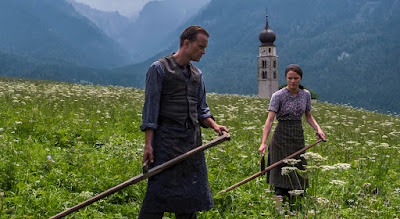
When we went to see A Hidden Life after it came out in the theaters, my wife said afterwards, "I feel like a wuss." She was referring to being 'soft' as a wife, seeing how hard Bl. Franz's wife Franziska's worked as part of their daily life as farm laborers. It seemed like every scene she was doing some kind of manual labor, working, being resourceful, often alongside her husband. Life was work. Leisure was an anomaly. 

Of course this was one hundred years ago in rural Austria. Franziska seemed to exemplify the Proverbs 31 wife, the "wife of noble character."

"She gets up while it is still dark; she provides food for her family. She considers a field and buys it; out of her earnings she plants a vineyard. She sets about her work vigorously; her arms are strong for the task. She sees that her trading is profitable, and her lamp does not go out at night. She watches over the affairs of her household and does not eat the bread of idleness. (Prov 31:15-18, 27)

In the scripture, none of this is for show only. The wife of noble character increases the bottom line of her family in tangible ways. She lets no moment waste--she is strong, resourceful, smart, profitable. 

Today, in 21st century America, I think our women are trying to figure out what it means to be a Proverbs 31 wife. Some weren't taught how to cook, and are learning. FemCatholics have adopted the sentiment to say it's okay to work. Traditional Catholic wives wear their aprons and tend to the children as their husband heads off to work. Some wives try to start some kind of home business selling essential oils or LuLuRoe or other multi-level marketing schemes (which exploit the vulnerabilities of homemakers) so they can contribute, or start a little garden to "feed their family." 

I know some women who married young and their identity is being a mom. They tend to their households and take pride in their roles but have no tangible skills that are employable in the workforce aside from minimum-wage unskilled work (retail, etc). 

We live in the tech-era, no longer an agrarian society. Anyone can cut wheat or milk cows, but how many families live in such a way today? Should a traditional wife even want to help her family financially, she finds herself stymied of how to actually do so. It's not for lack of desire.

I had an interesting conversation with a friend from India who works in supply-chain management, who told me recently in a conversation,

"Indians are conservative in morals and values (most dress modestly, have strong faith irrespective of the religion they practice, we look after our parents til they die in our homes), but believe in the value of work and independence. To be on your own feet."

When I asked her why that was, she replied,

"I think it's because we do not have Government handouts. No one will look after you if you don't look after yourself."

It's different for sure, I replied. Women working in the U.S. here has probably led to greater divorce, since they are no longer 'dependent' on their husbands.

"Ah yes," she replied. "The difference with us is, the money earned by the wife is still managed by the husband. He is still the leader of the family--currently India is like this. The husband makes the financial decisions most of the time. 

"There is a lot of wisdom in how we Indians have navigated the women contributing financially to the family. But with the onset of U.S. influence (TV shows, primarily) we are seeing an erosion of our values. 

"The working wife usually has her inlaws living in the same house. Usually, the mother in law (who would have retired from her own job) would help the daughter in law with the chores of the house and the grandkids when the wife has to go to work."


It was an interesting perspective outside my own culture as an American. Two main differences I saw--the lack of a societal safety net, and the commonness of multiple-family living in India. This is not common in American households today. Women are obviously in a bind--they can't necessarily work in an agrarian sense, and to leave the house to work often necessitates daycare, a difficult proposition. Some may live in areas where they have little family or community support, contributing to feelings of isolation. It would seem we don't live in a culture anymore that makes it very easy to live in a way more conducive to family life. I know my Distributist friends have been cognizant of this, and also critical of the breakdown of this possibility of family life where all worked together, as a result of Industrialization. 

It's a scary prospect, for a wife who has no real skills aside from homemaking, should something happen to her husband. It would imagine for such families it would make sense to have at least a $1M life insurance policy should anything happen to the husband so she does not have to work. 

Before anybody jumps down my throat, we all know wives who tend the home work the equivalent of 2-3 full time jobs. Their husbands often have it easier (in some ways) by going off to an office or whatever all day. 

I think the tech-heavy society we live in today makes it difficult for unskilled workers to eek out a living; many wives may be reticent to admit that their home lives are afforded by their husbands being successful members of this tech-class, and many working-outside-the-home wives may be reticent to admit that it is not an idea situation for homelife without the additional support of a live-in family member, as my friend in India noted. Perhaps the Proverbs 31 wife of noble character is a pragmatic composite portrait of the "ideal wife" and that no one woman would possess all these qualities. 

What then makes a Proverbs 31 wife? Is it unrealistic? Does it place unrealistic expectations on women as an unobtainable ideal? What does "work" look like for a 21st century American Christian wife and mother look like today? How does/can she contribute to her family so that her husband "has full confidence in her?"